

24
R. Ebinghaus et al.
Table 14. Measured mercury fluxes over forests and annual emission estimates. (After S.E. Lindberg
et al. in press)
Site
Canopy
Measured
Mean
Estimated
Annual mean
net emission
(ng m 1 h)
net emission
(flg/m 2 )
Median
Mean daily
(ng m- l h ')
(summer)
(ng/m')
Walker Branch
Mature
39
37
350
70
Watershed,
Tennessee, USA
Hardwood
Wartburg,
Young
17
18
150
30
Tennessee, USA
pines
Gardsjon,
Forest
9
2
Sweden
floor
to the atmosphere (Varekamp and Buseck 1983; Hanson et al. 1995). Both types of
plants have been employed for phytoremediation of contaminated sites, but at
least in the second case, this redistribution approach is very questionable. It has
been shown that Hg in lichen originates predominantly from degassing from
local soils (Bargagli et al. 1989). Vegetation surveys even reflect mercury sources
at depths greater than 200 m (Kovalevsky 1986). Trees are a special case in that
they continuously take up Hg with their foliage, which is then deposited on the
soil as litterfall, while simultaneously taking up Hg via the transpiration stream
through the roots and releasing it back to the atmosphere from the foliage. The
overall budget seems to indicate that forests could be a net source of gaseous
mercury, with the soils emitting more Hg than the foliage assimilates (Lindberg
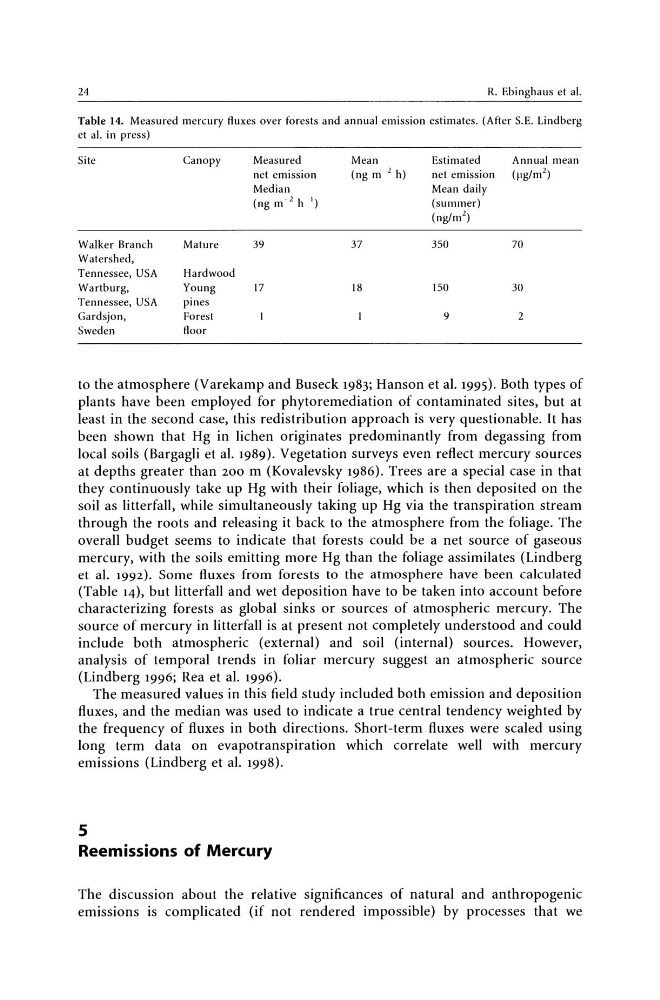
et al. 1992). Some fluxes from forests to the atmosphere have been calculated
(Table 14), but litterfall and wet deposition have to be taken into account before
characterizing forests as global sinks or sources of atmospheric mercury. The
source of mercury in litterfall is at present not completely understood and could
include both atmospheric (external) and soil (internal) sources. However,
analysis of temporal trends in foliar mercury suggest an atmospheric source
(Lindberg 1996; Rea et al. 1996).
The measured values in this field study included both emission and deposition
fluxes, and the median was used to indicate a true central tendency weighted by
the frequency of fluxes in both directions. Short-term fluxes were scaled using
long term data on evapotranspiration which correlate well with mercury
emissions (Lindberg et al. 1998).
5
Reemissions of Mercury
The discussion about the relative significances of natural and anthropogenic
emissions is complicated (if not rendered impossible) by processes that we
R. Ebinghaus et al.
Table 14. Measured mercury fluxes over forests and annual emission estimates. (After S.E. Lindberg
et al. in press)
Site
Canopy
Measured
Mean
Estimated
Annual mean
net emission
(ng m 1 h)
net emission
(flg/m 2 )
Median
Mean daily
(ng m- l h ')
(summer)
(ng/m')
Walker Branch
Mature
39
37
350
70
Watershed,
Tennessee, USA
Hardwood
Wartburg,
Young
17
18
150
30
Tennessee, USA
pines
Gardsjon,
Forest
9
2
Sweden
floor
to the atmosphere (Varekamp and Buseck 1983; Hanson et al. 1995). Both types of
plants have been employed for phytoremediation of contaminated sites, but at
least in the second case, this redistribution approach is very questionable. It has
been shown that Hg in lichen originates predominantly from degassing from
local soils (Bargagli et al. 1989). Vegetation surveys even reflect mercury sources
at depths greater than 200 m (Kovalevsky 1986). Trees are a special case in that
they continuously take up Hg with their foliage, which is then deposited on the
soil as litterfall, while simultaneously taking up Hg via the transpiration stream
through the roots and releasing it back to the atmosphere from the foliage. The
overall budget seems to indicate that forests could be a net source of gaseous
mercury, with the soils emitting more Hg than the foliage assimilates (Lindberg
et al. 1992). Some fluxes from forests to the atmosphere have been calculated
(Table 14), but litterfall and wet deposition have to be taken into account before
characterizing forests as global sinks or sources of atmospheric mercury. The
source of mercury in litterfall is at present not completely understood and could
include both atmospheric (external) and soil (internal) sources. However,
analysis of temporal trends in foliar mercury suggest an atmospheric source
(Lindberg 1996; Rea et al. 1996).
The measured values in this field study included both emission and deposition
fluxes, and the median was used to indicate a true central tendency weighted by
the frequency of fluxes in both directions. Short-term fluxes were scaled using
long term data on evapotranspiration which correlate well with mercury
emissions (Lindberg et al. 1998).
5
Reemissions of Mercury
The discussion about the relative significances of natural and anthropogenic
emissions is complicated (if not rendered impossible) by processes that we