

Estimation of Gaseous Mercury Emissions in Germany
385
MEASURED CONCENTRATIONS C· 1
•
MINIMIZING OF x.z
I
•
•
EMISSIONS
METEOROLOGY
SOURCE
VERTICAL
STRENGTHS
PROFILES
SI ....... Sn
U(z) , V(z) , T(z)
I
T
+
DISPERSION MODELLING
+
MODELLED CONCENTRATIONS f (Xi ,Yi ,~)
I
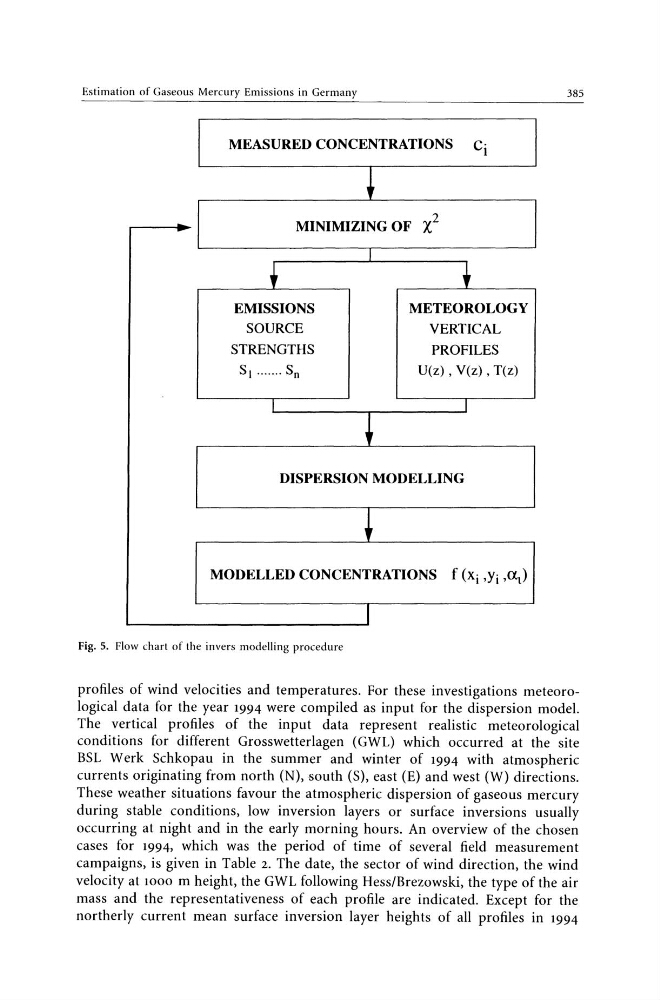
Fig. 5. Flow chart of the invers modelling procedure
profiles of wind velocities and temperatures. For these investigations meteorological data for the year 1994 were compiled as input for the dispersion model.
The vertical profiles of the input data represent realistic meteorological
conditions for different Grosswetterlagen (GWL) which occurred at the site
BSL Werk Schkopau in the summer and winter of 1994 with atmospheric
currents originating from north (N), south (S), east (E) and west (W) directions.
These weather situations favour the atmospheric dispersion of gaseous mercury
during stable conditions, low inversion layers or surface inversions usually
occurring at night and in the early morning hours. An overview of the chosen
cases for 1994, which was the period of time of several field measurement
campaigns, is given in Table 2. The date, the sector of wind direction, the wind
velocity at 1000 m height, the GWL following Hess/Brezowski, the type of the air
mass and the representativeness of each profile are indicated. Except for the
northerly current mean surface inversion layer heights of all profiles in 1994
385
MEASURED CONCENTRATIONS C· 1
•
MINIMIZING OF x.z
I
•
•
EMISSIONS
METEOROLOGY
SOURCE
VERTICAL
STRENGTHS
PROFILES
SI ....... Sn
U(z) , V(z) , T(z)
I
T
+
DISPERSION MODELLING
+
MODELLED CONCENTRATIONS f (Xi ,Yi ,~)
I
Fig. 5. Flow chart of the invers modelling procedure
profiles of wind velocities and temperatures. For these investigations meteorological data for the year 1994 were compiled as input for the dispersion model.
The vertical profiles of the input data represent realistic meteorological
conditions for different Grosswetterlagen (GWL) which occurred at the site
BSL Werk Schkopau in the summer and winter of 1994 with atmospheric
currents originating from north (N), south (S), east (E) and west (W) directions.
These weather situations favour the atmospheric dispersion of gaseous mercury
during stable conditions, low inversion layers or surface inversions usually
occurring at night and in the early morning hours. An overview of the chosen
cases for 1994, which was the period of time of several field measurement
campaigns, is given in Table 2. The date, the sector of wind direction, the wind
velocity at 1000 m height, the GWL following Hess/Brezowski, the type of the air
mass and the representativeness of each profile are indicated. Except for the
northerly current mean surface inversion layer heights of all profiles in 1994