

Modern Mercury Contamination from Historic Amalgamation Milling
o cm-..---,
(63/95%)
(106/96%)
-20 -+---11....-" (154/970/0)
-40
-60
(34/94%)
-80
200
349
400 ng/g
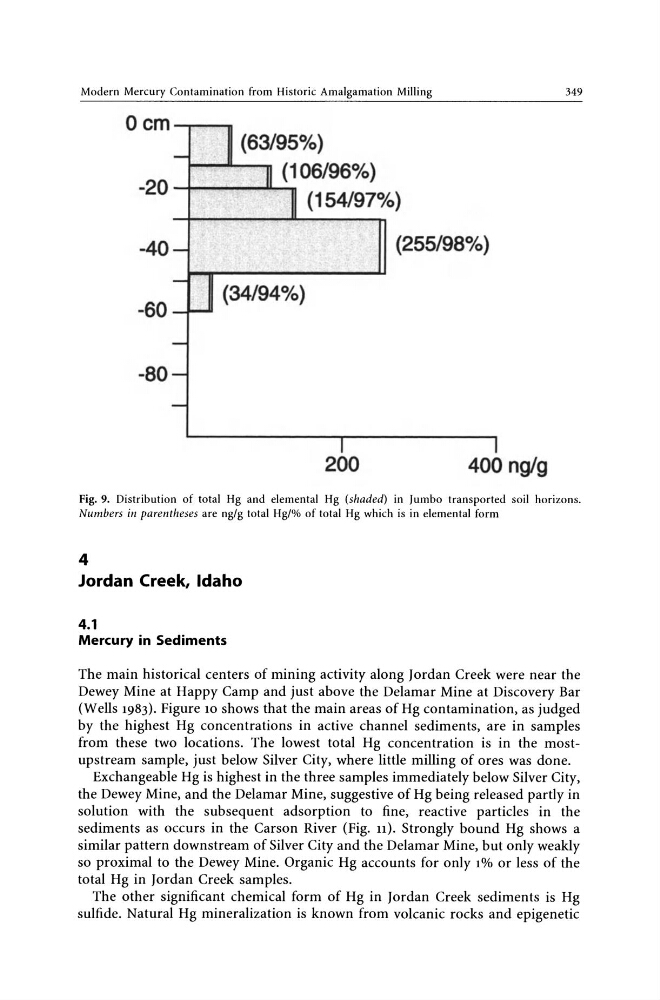
Fig. 9. Distribution of total Hg and elemental Hg (shaded) in Jumbo transported soil horizons.
Numbers in parentheses are ng/g total Hg/O/O of total Hg which is in elemental form
4
Jordan Creek, Idaho
4.1
Mercury in Sediments
The main historical centers of mining activity along Jordan Creek were near the
Dewey Mine at Happy Camp and just above the Delamar Mine at Discovery Bar
(Wells 1983). Figure 10 shows that the main areas of Hg contamination, as judged
by the highest Hg concentrations in active channel sediments, are in samples
from these two locations. The lowest total Hg concentration is in the mostupstream sample, just below Silver City, where little milling of ores was done.
Exchangeable Hg is highest in the three samples immediately below Silver City,
the Dewey Mine, and the Delamar Mine, suggestive of Hg being released partly in
solution with the subsequent adsorption to fine, reactive particles in the
sediments as occurs in the Carson River (Fig. 11). Strongly bound Hg shows a
similar pattern downstream of Silver City and the Delamar Mine, but only weakly
so proximal to the Dewey Mine. Organic Hg accounts for only 1% or less of the
total Hg in Jordan Creek samples.
The other significant chemical form of Hg in Jordan Creek sediments is Hg
sulfide. Natural Hg mineralization is known from volcanic rocks and epigenetic
o cm-..---,
(63/95%)
(106/96%)
-20 -+---11....-" (154/970/0)
-40
-60
(34/94%)
-80
200
349
400 ng/g
Fig. 9. Distribution of total Hg and elemental Hg (shaded) in Jumbo transported soil horizons.
Numbers in parentheses are ng/g total Hg/O/O of total Hg which is in elemental form
4
Jordan Creek, Idaho
4.1
Mercury in Sediments
The main historical centers of mining activity along Jordan Creek were near the
Dewey Mine at Happy Camp and just above the Delamar Mine at Discovery Bar
(Wells 1983). Figure 10 shows that the main areas of Hg contamination, as judged
by the highest Hg concentrations in active channel sediments, are in samples
from these two locations. The lowest total Hg concentration is in the mostupstream sample, just below Silver City, where little milling of ores was done.
Exchangeable Hg is highest in the three samples immediately below Silver City,
the Dewey Mine, and the Delamar Mine, suggestive of Hg being released partly in
solution with the subsequent adsorption to fine, reactive particles in the
sediments as occurs in the Carson River (Fig. 11). Strongly bound Hg shows a
similar pattern downstream of Silver City and the Delamar Mine, but only weakly
so proximal to the Dewey Mine. Organic Hg accounts for only 1% or less of the
total Hg in Jordan Creek samples.
The other significant chemical form of Hg in Jordan Creek sediments is Hg
sulfide. Natural Hg mineralization is known from volcanic rocks and epigenetic