

18
R. Ebinghaus et al.
parts of Asia add up to a total atmospheric mercury emission of just over
730 t year-I. However, vast areas of the globe have not been included here,
especially China and many developing countries, and this value of 730 t year -I is
thought to represent only 15% of the total anthropogenic emissions, which is
further discussed in Section 6.
4
Natural Emissions of Mercury
The assessment of truely "natural" mercury sources and their relative importance compared to direct anthropogenic emissions and indirect (re)emissions is
a fundamental problem in studying the global balance and cycling of mercury in
the environment. This knowledge is critical to our understanding of the fate of
mercury, since so-called natural emissions cannot be reduced or controlled in
most cases. Unfortunately, as discussed below, it is very difficult to differentiate
between natural and indirect anthropogenic mercury emissions into the
environment. Natural mercury emissions in this context are taken to include
mercury transport phenomena that would take place in the absence of human
existence and activity. However, once any pool of mercury has formed in an
environmental compartment, it is no longer important where it originated, since
all mercury is subject to the same transport and transformation processes,
although it is possible that mercury from different origins may maintain a
different speciation in the same compartment and thereby react differently. This
section will demonstrate the problems associated not only with assigning relative
importance of anthropogenic and natural contributions to the same flux
phenomena, but also with separating and comparing different controlling
processes leading to these flux phenomena.
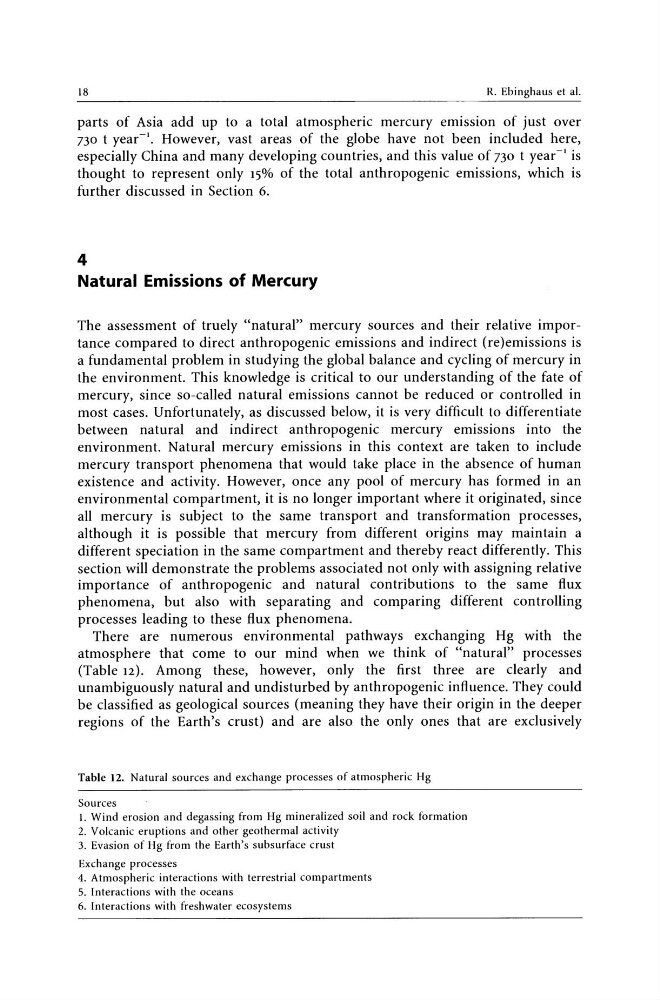
There are numerous environmental pathways exchanging Hg with the
atmosphere that come to our mind when we think of "natural" processes
(Table 12). Among these, however, only the first three are clearly and
unambiguously natural and undisturbed by anthropogenic influence. They could
be classified as geological sources (meaning they have their origin in the deeper
regions of the Earth's crust) and are also the only ones that are exclusively
Table 12. Natural sources and exchange processes of atmospheric Hg
Sources
I. Wind erosion and degassing from Hg mineralized soil and rock formation
2. Volcanic eruptions and other geothermal activity
3. Evasion of Hg from the Earth's subsurface crust
Exchange processes
4. Atmospheric interactions with terrestrial compartments
5. Interactions with the oceans
6. I nteractions with freshwater ecosystems
R. Ebinghaus et al.
parts of Asia add up to a total atmospheric mercury emission of just over
730 t year-I. However, vast areas of the globe have not been included here,
especially China and many developing countries, and this value of 730 t year -I is
thought to represent only 15% of the total anthropogenic emissions, which is
further discussed in Section 6.
4
Natural Emissions of Mercury
The assessment of truely "natural" mercury sources and their relative importance compared to direct anthropogenic emissions and indirect (re)emissions is
a fundamental problem in studying the global balance and cycling of mercury in
the environment. This knowledge is critical to our understanding of the fate of
mercury, since so-called natural emissions cannot be reduced or controlled in
most cases. Unfortunately, as discussed below, it is very difficult to differentiate
between natural and indirect anthropogenic mercury emissions into the
environment. Natural mercury emissions in this context are taken to include
mercury transport phenomena that would take place in the absence of human
existence and activity. However, once any pool of mercury has formed in an
environmental compartment, it is no longer important where it originated, since
all mercury is subject to the same transport and transformation processes,
although it is possible that mercury from different origins may maintain a
different speciation in the same compartment and thereby react differently. This
section will demonstrate the problems associated not only with assigning relative
importance of anthropogenic and natural contributions to the same flux
phenomena, but also with separating and comparing different controlling
processes leading to these flux phenomena.
There are numerous environmental pathways exchanging Hg with the
atmosphere that come to our mind when we think of "natural" processes
(Table 12). Among these, however, only the first three are clearly and
unambiguously natural and undisturbed by anthropogenic influence. They could
be classified as geological sources (meaning they have their origin in the deeper
regions of the Earth's crust) and are also the only ones that are exclusively
Table 12. Natural sources and exchange processes of atmospheric Hg
Sources
I. Wind erosion and degassing from Hg mineralized soil and rock formation
2. Volcanic eruptions and other geothermal activity
3. Evasion of Hg from the Earth's subsurface crust
Exchange processes
4. Atmospheric interactions with terrestrial compartments
5. Interactions with the oceans
6. I nteractions with freshwater ecosystems