

Natural and Anthropogenic Mercury Sources
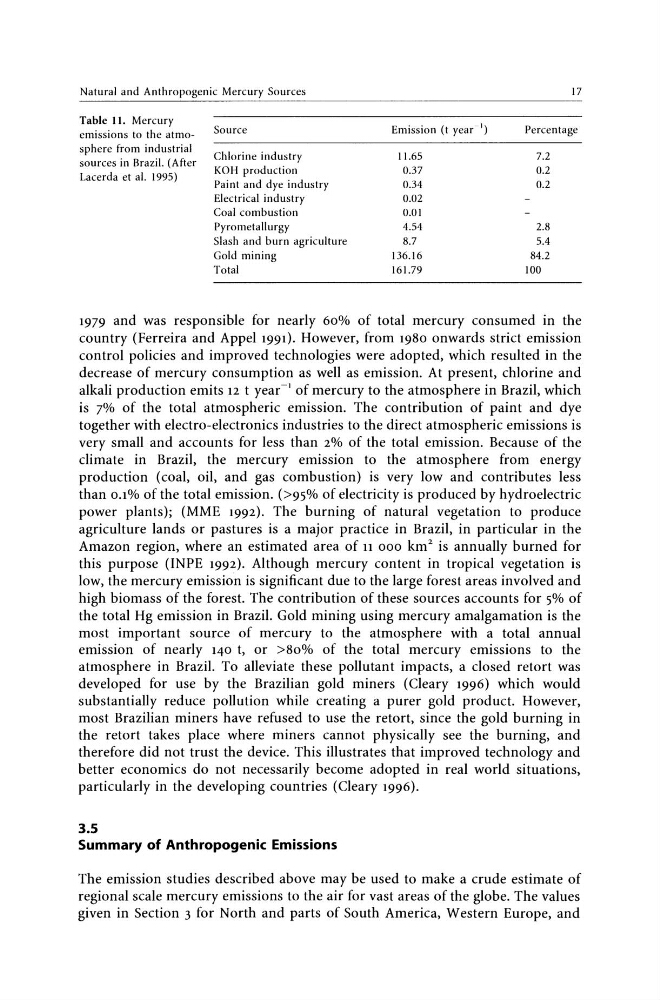
Table 11. Mercury
emissions to the atmosphere from industrial
sources in Brazil. (After
Lacerda et al. 1995)
Source
Chlorine industry
KOH production
Paint and dye industry
Electrical industry
Coal combustion
Pyrometallurgy
Slash and burn agriculture
Gold mining
Total
17
Emission (t year-I)
Percentage
11.65
7.2
0.37
0.2
0.34
0.2
0.02
0.01
4.54
2.8
8.7
5.4
136.16
84.2
161.79
100
1979 and was responsible for nearly 60% of total mercury consumed in the
country (Ferreira and Appel 1991). However, from 1980 onwards strict emission
control policies and improved technologies were adopted, which resulted in the
decrease of mercury consumption as well as emission. At present, chlorine and
alkali production emits 12 t year - I of mercury to the atmosphere in Brazil, which
is 7% of the total atmospheric emission. The contribution of paint and dye
together with electro-electronics industries to the direct atmospheric emissions is
very small and accounts for less than 2% of the total emission. Because of the
climate in Brazil, the mercury emission to the atmosphere from energy
production (coal, oil, and gas combustion) is very low and contributes less
than 0.1% of the total emission. (>95% of electricity is produced by hydroelectric
power plants); (MME 1992). The burning of natural vegetation to produce
agriculture lands or pastures is a major practice in Brazil, in particular in the
Amazon region, where an estimated area of 11 000 km
2
is annually burned for
this purpose (INPE 1992). Although mercury content in tropical vegetation is
low, the mercury emission is significant due to the large forest areas involved and
high biomass of the forest. The contribution of these sources accounts for 5% of
the total Hg emission in Brazil. Gold mining using mercury amalgamation is the
most important source of mercury to the atmosphere with a total annual
emission of nearly 140 t, or >80% of the total mercury emissions to the
atmosphere in Brazil. To alleviate these pollutant impacts, a closed retort was
developed for use by the Brazilian gold miners (Cleary 1996) which would
substantially reduce pollution while creating a purer gold product. However,
most Brazilian miners have refused to use the retort, since the gold burning in
the retort takes place where miners cannot physically see the burning, and
therefore did not trust the device. This illustrates that improved technology and
better economics do not necessarily become adopted in real world situations,
particularly in the developing countries (Cleary 1996).
3.5
Summary of Anthropogenic Emissions
The emission studies described above may be used to make a crude estimate of
regional scale mercury emissions to the air for vast areas of the globe. The values
given in Section 3 for North and parts of South America, Western Europe, and
Table 11. Mercury
emissions to the atmosphere from industrial
sources in Brazil. (After
Lacerda et al. 1995)
Source
Chlorine industry
KOH production
Paint and dye industry
Electrical industry
Coal combustion
Pyrometallurgy
Slash and burn agriculture
Gold mining
Total
17
Emission (t year-I)
Percentage
11.65
7.2
0.37
0.2
0.34
0.2
0.02
0.01
4.54
2.8
8.7
5.4
136.16
84.2
161.79
100
1979 and was responsible for nearly 60% of total mercury consumed in the
country (Ferreira and Appel 1991). However, from 1980 onwards strict emission
control policies and improved technologies were adopted, which resulted in the
decrease of mercury consumption as well as emission. At present, chlorine and
alkali production emits 12 t year - I of mercury to the atmosphere in Brazil, which
is 7% of the total atmospheric emission. The contribution of paint and dye
together with electro-electronics industries to the direct atmospheric emissions is
very small and accounts for less than 2% of the total emission. Because of the
climate in Brazil, the mercury emission to the atmosphere from energy
production (coal, oil, and gas combustion) is very low and contributes less
than 0.1% of the total emission. (>95% of electricity is produced by hydroelectric
power plants); (MME 1992). The burning of natural vegetation to produce
agriculture lands or pastures is a major practice in Brazil, in particular in the
Amazon region, where an estimated area of 11 000 km
2
is annually burned for
this purpose (INPE 1992). Although mercury content in tropical vegetation is
low, the mercury emission is significant due to the large forest areas involved and
high biomass of the forest. The contribution of these sources accounts for 5% of
the total Hg emission in Brazil. Gold mining using mercury amalgamation is the
most important source of mercury to the atmosphere with a total annual
emission of nearly 140 t, or >80% of the total mercury emissions to the
atmosphere in Brazil. To alleviate these pollutant impacts, a closed retort was
developed for use by the Brazilian gold miners (Cleary 1996) which would
substantially reduce pollution while creating a purer gold product. However,
most Brazilian miners have refused to use the retort, since the gold burning in
the retort takes place where miners cannot physically see the burning, and
therefore did not trust the device. This illustrates that improved technology and
better economics do not necessarily become adopted in real world situations,
particularly in the developing countries (Cleary 1996).
3.5
Summary of Anthropogenic Emissions
The emission studies described above may be used to make a crude estimate of
regional scale mercury emissions to the air for vast areas of the globe. The values
given in Section 3 for North and parts of South America, Western Europe, and