

324
V. Banasova
perforatum, Lotus corniculatus, Dianthus carthusianorum and Pimpinella
saxifraga, constituted only a minor part of the stand. Shrubs, Sambucus
racemosa and Salix capraea, occur in the margin of old heaps with a low cover.
Agrostis stolonifera, which also grows on the heaps after Hg mining, is also a
frequent colonizer of toxic mining spoil and can adapt to the poor soils and to
the high concentration of metals (e.f. Schubert 1954; Ernst 1974; Banasova 1976).
Some plants growing on Hg mine spoil heaps react to the extreme ecological
conditions by creating red spots on the leaves (Hypericum perforatum, Agrostis
stolonifera, Pimpinella saxifraga, Silene vulgaris) or black apical necrotic spots
on the leaves of shrubs (Sambucus racemosa, Salix capraea). The reduction of the
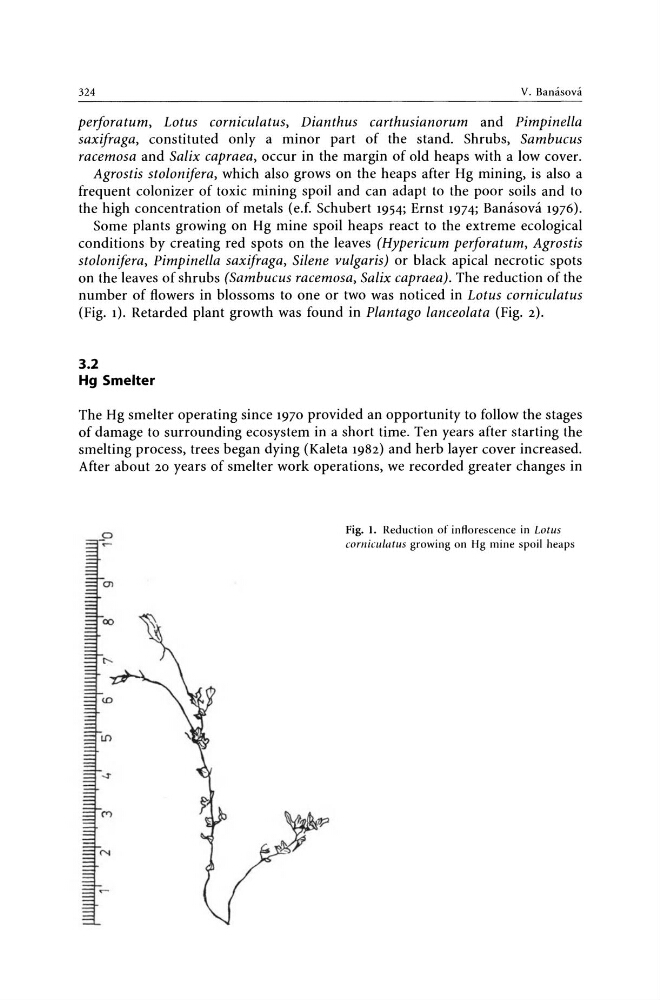
number of flowers in blossoms to one or two was noticed in Lotus corniculatus
(Fig. 1). Retarded plant growth was found in Plantago lanceolata (Fig. 2) .
3.2
Hg Smelter
The Hg smelter operating since 1970 provided an opportunity to follow the stages
of damage to surrounding ecosystem in a short time. Ten years after starting the
smelting process, trees began dying (Kaleta 1982) and herb layer cover increased.
After about 20 years of smelter work operations, we recorded greater changes in
Fig. I. Reduction of inflorescence in Lotus
comicu/utus growing on Hg mine spoil heaps
V. Banasova
perforatum, Lotus corniculatus, Dianthus carthusianorum and Pimpinella
saxifraga, constituted only a minor part of the stand. Shrubs, Sambucus
racemosa and Salix capraea, occur in the margin of old heaps with a low cover.
Agrostis stolonifera, which also grows on the heaps after Hg mining, is also a
frequent colonizer of toxic mining spoil and can adapt to the poor soils and to
the high concentration of metals (e.f. Schubert 1954; Ernst 1974; Banasova 1976).
Some plants growing on Hg mine spoil heaps react to the extreme ecological
conditions by creating red spots on the leaves (Hypericum perforatum, Agrostis
stolonifera, Pimpinella saxifraga, Silene vulgaris) or black apical necrotic spots
on the leaves of shrubs (Sambucus racemosa, Salix capraea). The reduction of the
number of flowers in blossoms to one or two was noticed in Lotus corniculatus
(Fig. 1). Retarded plant growth was found in Plantago lanceolata (Fig. 2) .
3.2
Hg Smelter
The Hg smelter operating since 1970 provided an opportunity to follow the stages
of damage to surrounding ecosystem in a short time. Ten years after starting the
smelting process, trees began dying (Kaleta 1982) and herb layer cover increased.
After about 20 years of smelter work operations, we recorded greater changes in
Fig. I. Reduction of inflorescence in Lotus
comicu/utus growing on Hg mine spoil heaps