

Mercury in Terrestrial Food Webs of the Idrija Mining Area
289
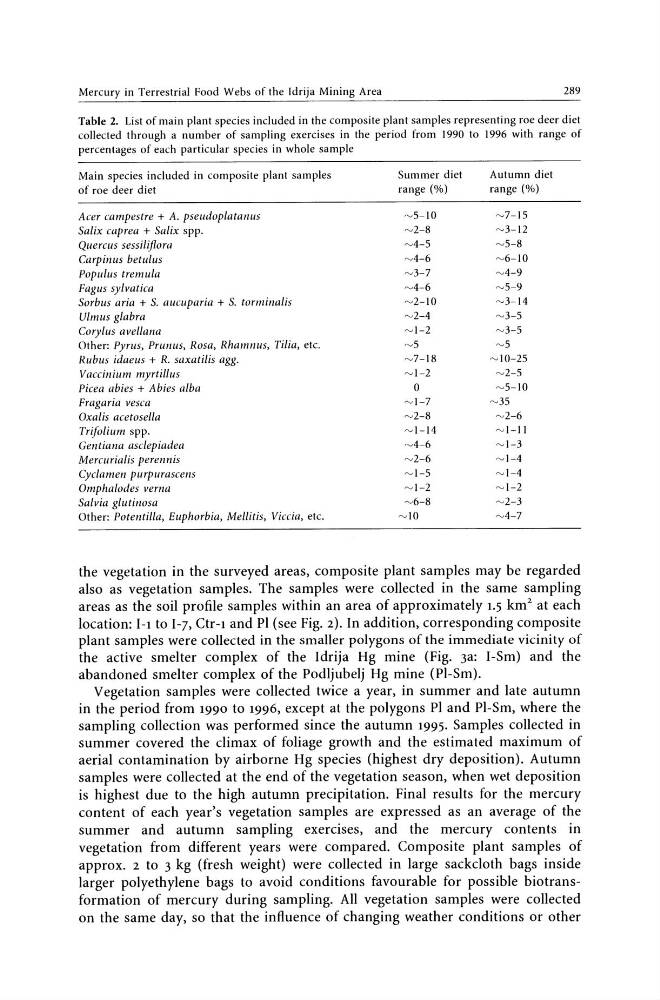
Table 2. List of main plant species included in the composite plant samples representing roe deer diet
collected through a number of sampling exercises in the period from 1990 to 1996 with range of
percentages of each particular species in whole sample
Main species included in composite plant samples
of roe deer diet
Acer campestre + A. pseudoplatallus
Salix caprea + Salix spp.
Quercus sessiliflora
Carpillus betulus
Populus tremula
Fagus sylvatica
Sorbus aria + S. uucuparia + S. tormillalis
Ulmus glabra
Corylus avel/alla
Other: Pyrus, PruIlUS, Rosa, Rhamllus, Tilia, etc.
Rubus idaeus + R. saxatilis agg.
Vaccinium myrtillus
Picea abies + A bies alba
Fragaria vesca
Oxalis acetosel/a
Trifolium spp.
Gentiana asclepiadea
Mercurialis perenllis
Cyclamell purpurascells
Omphalodes verna
Salvia glutillosa
Other: Potelltil/a, Euphorbia, Mel/itis, Viccia, etc.
Summer diet
Autumn diet
range (%)
range (%)
~5-\O
~7-15
~2-8
~3-12
~4-5
~5-8
~4-6
~6-IO
~3-7
~4-9
~4-6
~5-9
~2-\o
~3-14
~2-4
~3-5
~1-2
~3-5
~5
~5
~7-18
~IO-25
~1-2
~2-5
0
~5-10
~1-7
~35
~2-8
~2-6
~1-14
~1-11
~4-6
~1-3
~2-6
~1-4
~1-5
~1-4
~1-2
~1-2
~6-8
~2-3
~\O
~4-7
the vegetation in the surveyed areas, composite plant samples may be regarded
also as vegetation samples. The samples were collected in the same sampling
areas as the soil profile samples within an area of approximately 1.5 km
2
at each
location: I-I to 1-7, Ctr-l and PI (see Fig. 2). In addition, corresponding composite
plant samples were collected in the smaller polygons of the immediate vicinity of
the active smelter complex of the Idrija Hg mine (Fig. 3a: I-Sm) and the
abandoned smelter complex of the Podljubelj Hg mine (PI-Sm).
Vegetation samples were collected twice a year, in summer and late autumn
in the period from 1990 to 1996, except at the polygons PI and PI-Sm, where the
sampling collection was performed since the autumn 1995. Samples collected in
summer covered the climax of foliage growth and the estimated maximum of
aerial contamination by airborne Hg species (highest dry deposition). Autumn
samples were collected at the end of the vegetation season, when wet deposition
is highest due to the high autumn precipitation. Final results for the mercury
content of each year's vegetation samples are expressed as an average of the
summer and autumn sampling exercises, and the mercury contents in
vegetation from different years were compared. Composite plant samples of
approx. 2 to 3 kg (fresh weight) were collected in large sackcloth bags inside
larger polyethylene bags to avoid conditions favourable for possible biotransformation of mercury during sampling. All vegetation samples were collected
on the same day, so that the influence of changing weather conditions or other
289
Table 2. List of main plant species included in the composite plant samples representing roe deer diet
collected through a number of sampling exercises in the period from 1990 to 1996 with range of
percentages of each particular species in whole sample
Main species included in composite plant samples
of roe deer diet
Acer campestre + A. pseudoplatallus
Salix caprea + Salix spp.
Quercus sessiliflora
Carpillus betulus
Populus tremula
Fagus sylvatica
Sorbus aria + S. uucuparia + S. tormillalis
Ulmus glabra
Corylus avel/alla
Other: Pyrus, PruIlUS, Rosa, Rhamllus, Tilia, etc.
Rubus idaeus + R. saxatilis agg.
Vaccinium myrtillus
Picea abies + A bies alba
Fragaria vesca
Oxalis acetosel/a
Trifolium spp.
Gentiana asclepiadea
Mercurialis perenllis
Cyclamell purpurascells
Omphalodes verna
Salvia glutillosa
Other: Potelltil/a, Euphorbia, Mel/itis, Viccia, etc.
Summer diet
Autumn diet
range (%)
range (%)
~5-\O
~7-15
~2-8
~3-12
~4-5
~5-8
~4-6
~6-IO
~3-7
~4-9
~4-6
~5-9
~2-\o
~3-14
~2-4
~3-5
~1-2
~3-5
~5
~5
~7-18
~IO-25
~1-2
~2-5
0
~5-10
~1-7
~35
~2-8
~2-6
~1-14
~1-11
~4-6
~1-3
~2-6
~1-4
~1-5
~1-4
~1-2
~1-2
~6-8
~2-3
~\O
~4-7
the vegetation in the surveyed areas, composite plant samples may be regarded
also as vegetation samples. The samples were collected in the same sampling
areas as the soil profile samples within an area of approximately 1.5 km
2
at each
location: I-I to 1-7, Ctr-l and PI (see Fig. 2). In addition, corresponding composite
plant samples were collected in the smaller polygons of the immediate vicinity of
the active smelter complex of the Idrija Hg mine (Fig. 3a: I-Sm) and the
abandoned smelter complex of the Podljubelj Hg mine (PI-Sm).
Vegetation samples were collected twice a year, in summer and late autumn
in the period from 1990 to 1996, except at the polygons PI and PI-Sm, where the
sampling collection was performed since the autumn 1995. Samples collected in
summer covered the climax of foliage growth and the estimated maximum of
aerial contamination by airborne Hg species (highest dry deposition). Autumn
samples were collected at the end of the vegetation season, when wet deposition
is highest due to the high autumn precipitation. Final results for the mercury
content of each year's vegetation samples are expressed as an average of the
summer and autumn sampling exercises, and the mercury contents in
vegetation from different years were compared. Composite plant samples of
approx. 2 to 3 kg (fresh weight) were collected in large sackcloth bags inside
larger polyethylene bags to avoid conditions favourable for possible biotransformation of mercury during sampling. All vegetation samples were collected
on the same day, so that the influence of changing weather conditions or other