

288
A. Gnamus and M. Horvat
obtain representative samples from each location, forest soils were collected from
25 randomly chosen sampling sites within each sampling area. Each subs ample
was collected with undisturbed stratification, and was packed and sealed in a
polyethylene bag as a soil profile block of different depth depending on the soil
type. In the laboratory, soil samples were coarsely subdivided into two horizons
regarding the qualitatively estimated content of organic matter. The topsoil
horizon was classified as the humus layer including litter (A-horizon and 0horizon) with average depth from the surface (0 cm) to approx. -5 cm
(alterations in depth were approx. 2 cm in various soil types or subsamples),
and the bottom soil horizon was classified as the deeper soil layer from a depth of
approx. -5 to -15 cm (alterations in depth were approx. 5 cm in various soil types
or subsamples). Composite samples were prepared in the laboratory. Due to the
expected high concentrations of Hg in soil, samples were prepared in a separate
laboratory, away from that used for preparation of plant and animal samples.
Samples were air-dried for 4 days at approximately 20°C. Bigger particles, e.g.
stones, were removed, and then the samples were homogenized and ground in an
agate mortar. During the whole sample preparation procedure, special precautions were necessary to avoid cross-contamination of samples. Therefore,
homogenizing was started with control samples, followed by less contaminated
and continued with the more contaminated samples. The homogenizer was
thoroughly cleaned after each sample. For each sample, the first aliquot ground
was discarded, and then the bulk of the sample was ground. Homogenized
samples were stored in plastic containers, sealed in polyethylene bags, and stored
in a refrigerator until further processing. An aliquot taken for determination of
moisture content was dried at 85 °C to constant weight. All data are expressed on
a dry weight basis.
3.1.2
Plant Samples Corresponding to Roe Deer Diet
Composite plant samples corresponding to roe deer diet consisted of a minimum
of 40 species of herbaceous plants (whole plants) and small twigs with foliage of
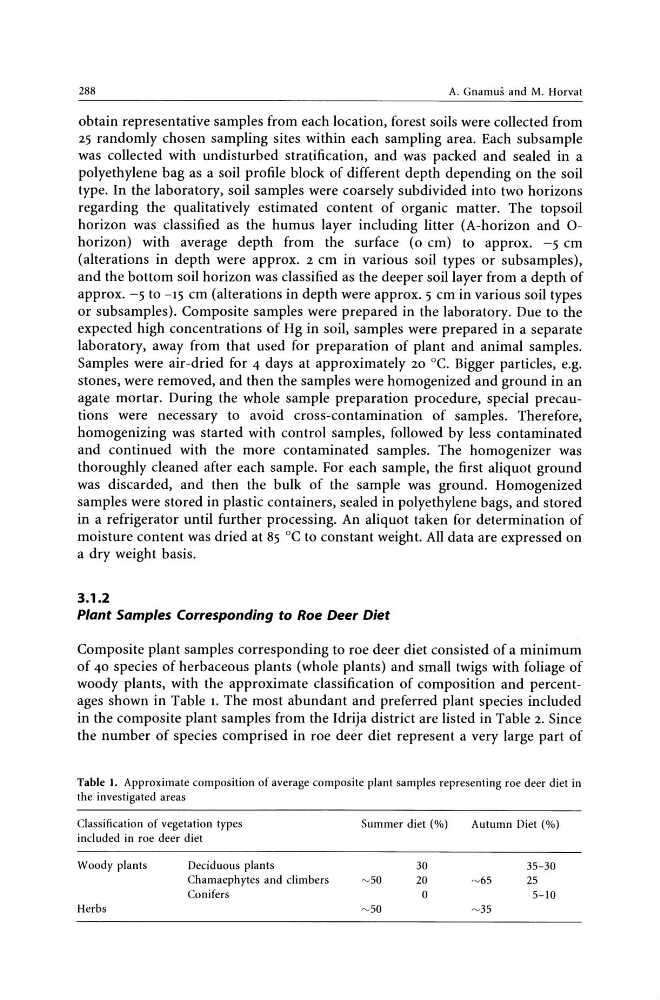
woody plants, with the approximate classification of composition and percentages shown in Table 1. The most abundant and preferred plant species included
in the composite plant samples from the Idrija district are listed in Table 2. Since
the number of species comprised in roe deer diet represent a very large part of
Table 1. Approximate composition of average composite plant samples representing roe deer diet in
the investigated areas
Classification of vegetation types
included in roe deer diet
Woody plants
Deciduous plants
Chamaephytes and climbers
Conifers
Herbs
Summer diet (%)
Autumn Diet (%)
30
35-30
~50
20
~65
25
0
5-10
~50
~35
A. Gnamus and M. Horvat
obtain representative samples from each location, forest soils were collected from
25 randomly chosen sampling sites within each sampling area. Each subs ample
was collected with undisturbed stratification, and was packed and sealed in a
polyethylene bag as a soil profile block of different depth depending on the soil
type. In the laboratory, soil samples were coarsely subdivided into two horizons
regarding the qualitatively estimated content of organic matter. The topsoil
horizon was classified as the humus layer including litter (A-horizon and 0horizon) with average depth from the surface (0 cm) to approx. -5 cm
(alterations in depth were approx. 2 cm in various soil types or subsamples),
and the bottom soil horizon was classified as the deeper soil layer from a depth of
approx. -5 to -15 cm (alterations in depth were approx. 5 cm in various soil types
or subsamples). Composite samples were prepared in the laboratory. Due to the
expected high concentrations of Hg in soil, samples were prepared in a separate
laboratory, away from that used for preparation of plant and animal samples.
Samples were air-dried for 4 days at approximately 20°C. Bigger particles, e.g.
stones, were removed, and then the samples were homogenized and ground in an
agate mortar. During the whole sample preparation procedure, special precautions were necessary to avoid cross-contamination of samples. Therefore,
homogenizing was started with control samples, followed by less contaminated
and continued with the more contaminated samples. The homogenizer was
thoroughly cleaned after each sample. For each sample, the first aliquot ground
was discarded, and then the bulk of the sample was ground. Homogenized
samples were stored in plastic containers, sealed in polyethylene bags, and stored
in a refrigerator until further processing. An aliquot taken for determination of
moisture content was dried at 85 °C to constant weight. All data are expressed on
a dry weight basis.
3.1.2
Plant Samples Corresponding to Roe Deer Diet
Composite plant samples corresponding to roe deer diet consisted of a minimum
of 40 species of herbaceous plants (whole plants) and small twigs with foliage of
woody plants, with the approximate classification of composition and percentages shown in Table 1. The most abundant and preferred plant species included
in the composite plant samples from the Idrija district are listed in Table 2. Since
the number of species comprised in roe deer diet represent a very large part of
Table 1. Approximate composition of average composite plant samples representing roe deer diet in
the investigated areas
Classification of vegetation types
included in roe deer diet
Woody plants
Deciduous plants
Chamaephytes and climbers
Conifers
Herbs
Summer diet (%)
Autumn Diet (%)
30
35-30
~50
20
~65
25
0
5-10
~50
~35