

Atmospheric Mercury in Abandoned Mine Structures
255
ago, the ground is still contaminated with mercury. The datum reported above
shows that even razing buildings is not really enough to ensure a cleanup of the
contaminated area.
The mercury concentrations shown in Fig. 3, measured with point monitors,
are much higher than the concentrations reported in Fig. 2, determined with the
LIDAR technique. This is explained by the fact that with the point monitors the
measurements were made 1 m above the ground, while with the LIDAR system
they were generally made at a height of around 10 m, and mercury concentrations decrease exponentially with height (Kvietkus and Sakalys 1994). At present,
the ground is the main source of the metal due to the widespread presence of the
pools of mercury, mostly scattered around the condensation plant, and to the
fallout of mercury-rich dust from the stacks throughout the long period of
mining.
The broken line in Fig. 3 represents the fence separating the mine structures
from the commercial activities initiated in 1990.
Outside the restored buildings, the air mercury levels range between 50 and
500 ng/m\ with values essentially depending on the distance from the main
polluting structures.
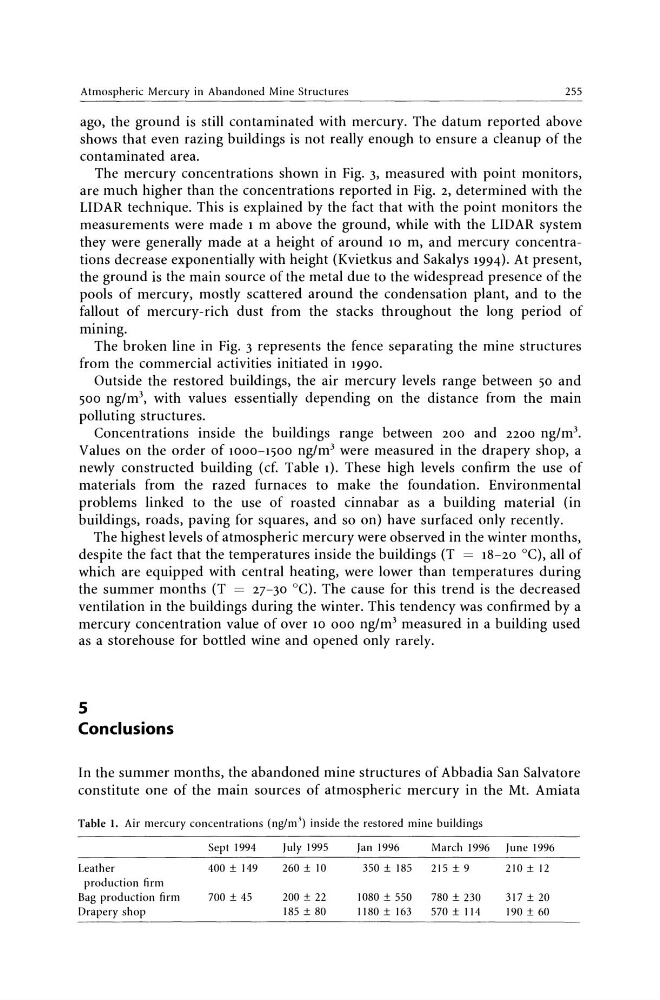
Concentrations inside the buildings range between 200 and 2200 ng/m3.
Values on the order of 1000-1500 ng/m3 were measured in the drapery shop, a
newly constructed building (cf. Table 1). These high levels confirm the use of
materials from the razed furnaces to make the foundation. Environmental
problems linked to the use of roasted cinnabar as a building material (in
buildings, roads, paving for squares, and so on) have surfaced only recently.
The highest levels of atmospheric mercury were observed in the winter months,
despite the fact that the temperatures inside the buildings (T = 18-20 0c), all of
which are equipped with central heating, were lower than temperatures during
the summer months (T = 27-30 °C). The cause for this trend is the decreased
ventilation in the buildings during the winter. This tendency was confirmed by a
mercury concentration value of over 10 000 ng/m3 measured in a building used
as a storehouse for bottled wine and opened only rarely.
5
Conclusions
In the summer months, the abandoned mine structures of Abbadia San Salvatore
constitute one of the main sources of atmospheric mercury in the Mt. Amiata
Table l. Air mercury concentrations (ng/m.!) inside the restored mine buildings
Sept 1994
July 1995
Jan 1996
March 1996 June 1996
Leather
400 ± 149
260 ± 10
350 ± 185 215 ± 9
210 ± 12
production firm
Bag production firm
700 ± 45
200 ± 22
\080 ± 550 780 ± 230
317 ± 20
Drapery shop
185 ± 80
1180 ± 163 570 ± 114
190 ± 60
255
ago, the ground is still contaminated with mercury. The datum reported above
shows that even razing buildings is not really enough to ensure a cleanup of the
contaminated area.
The mercury concentrations shown in Fig. 3, measured with point monitors,
are much higher than the concentrations reported in Fig. 2, determined with the
LIDAR technique. This is explained by the fact that with the point monitors the
measurements were made 1 m above the ground, while with the LIDAR system
they were generally made at a height of around 10 m, and mercury concentrations decrease exponentially with height (Kvietkus and Sakalys 1994). At present,
the ground is the main source of the metal due to the widespread presence of the
pools of mercury, mostly scattered around the condensation plant, and to the
fallout of mercury-rich dust from the stacks throughout the long period of
mining.
The broken line in Fig. 3 represents the fence separating the mine structures
from the commercial activities initiated in 1990.
Outside the restored buildings, the air mercury levels range between 50 and
500 ng/m\ with values essentially depending on the distance from the main
polluting structures.
Concentrations inside the buildings range between 200 and 2200 ng/m3.
Values on the order of 1000-1500 ng/m3 were measured in the drapery shop, a
newly constructed building (cf. Table 1). These high levels confirm the use of
materials from the razed furnaces to make the foundation. Environmental
problems linked to the use of roasted cinnabar as a building material (in
buildings, roads, paving for squares, and so on) have surfaced only recently.
The highest levels of atmospheric mercury were observed in the winter months,
despite the fact that the temperatures inside the buildings (T = 18-20 0c), all of
which are equipped with central heating, were lower than temperatures during
the summer months (T = 27-30 °C). The cause for this trend is the decreased
ventilation in the buildings during the winter. This tendency was confirmed by a
mercury concentration value of over 10 000 ng/m3 measured in a building used
as a storehouse for bottled wine and opened only rarely.
5
Conclusions
In the summer months, the abandoned mine structures of Abbadia San Salvatore
constitute one of the main sources of atmospheric mercury in the Mt. Amiata
Table l. Air mercury concentrations (ng/m.!) inside the restored mine buildings
Sept 1994
July 1995
Jan 1996
March 1996 June 1996
Leather
400 ± 149
260 ± 10
350 ± 185 215 ± 9
210 ± 12
production firm
Bag production firm
700 ± 45
200 ± 22
\080 ± 550 780 ± 230
317 ± 20
Drapery shop
185 ± 80
1180 ± 163 570 ± 114
190 ± 60