

Atmospheric Mercury in Abandoned Mine Structures
•
.,
/
253
o
100m
..
' ---===='
dJ·,·,
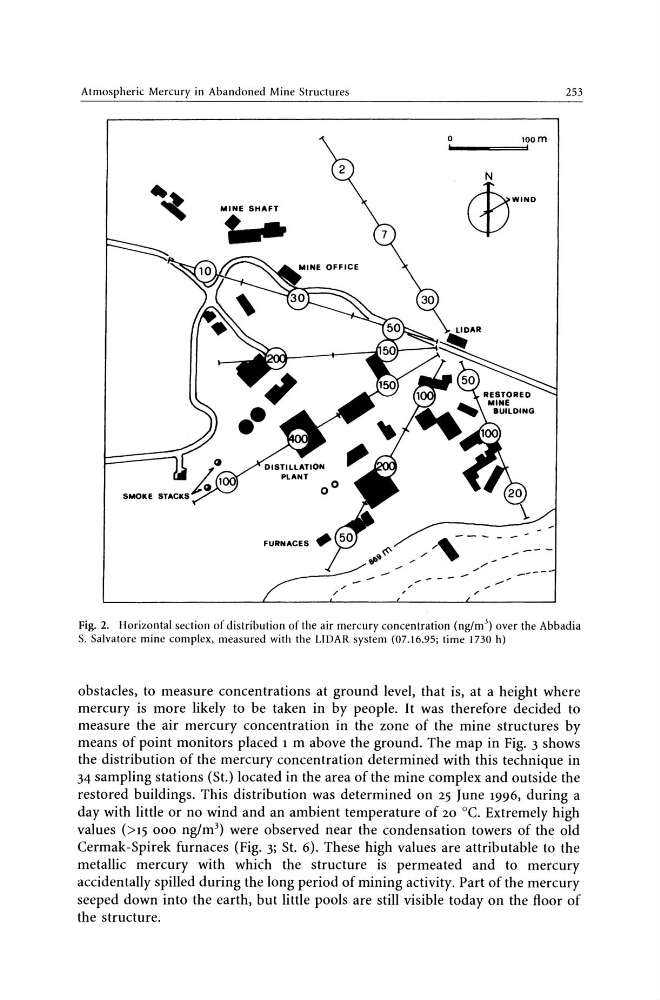
Fig. 2. Horizontal section of distribution of the air mercury concentration (ng/m.l) over the Abbadia
S. Salvatore mine complex, measured with the LIDAR system (07.16.95; time 1730 h)
obstacles, to measure concentrations at ground level, that is, at a height where
mercury is more likely to be taken in by people. It was therefore decided to
measure the air mercury concentration in the zone of the mine structures by
means of point monitors placed 1 m above the ground. The map in Fig. 3 shows
the distribution of the mercury concentration determined with this technique in
34 sampling stations (St.) located in the area of the mine complex and outside the
restored buildings. This distribution was determined on 25 June 1996, during a
day with little or no wind and an ambient temperature of 20°C. Extremely high
values (>15 000 ng/m3) were observed near the condensation towers of the old
Cermak-Spirek furnaces (Fig. 3; St. 6). These high values are attributable to the
metallic mercury with which the structure is permeated and to mercury
accidentally spilled during the long period of mining activity. Part of the mercury
seeped down into the earth, but little pools are still visible today on the floor of
the structure.
•
.,
/
253
o
100m
..
' ---===='
dJ·,·,
Fig. 2. Horizontal section of distribution of the air mercury concentration (ng/m.l) over the Abbadia
S. Salvatore mine complex, measured with the LIDAR system (07.16.95; time 1730 h)
obstacles, to measure concentrations at ground level, that is, at a height where
mercury is more likely to be taken in by people. It was therefore decided to
measure the air mercury concentration in the zone of the mine structures by
means of point monitors placed 1 m above the ground. The map in Fig. 3 shows
the distribution of the mercury concentration determined with this technique in
34 sampling stations (St.) located in the area of the mine complex and outside the
restored buildings. This distribution was determined on 25 June 1996, during a
day with little or no wind and an ambient temperature of 20°C. Extremely high
values (>15 000 ng/m3) were observed near the condensation towers of the old
Cermak-Spirek furnaces (Fig. 3; St. 6). These high values are attributable to the
metallic mercury with which the structure is permeated and to mercury
accidentally spilled during the long period of mining activity. Part of the mercury
seeped down into the earth, but little pools are still visible today on the floor of
the structure.