

Relative Importance of Non-Point Sources of Mercury
213
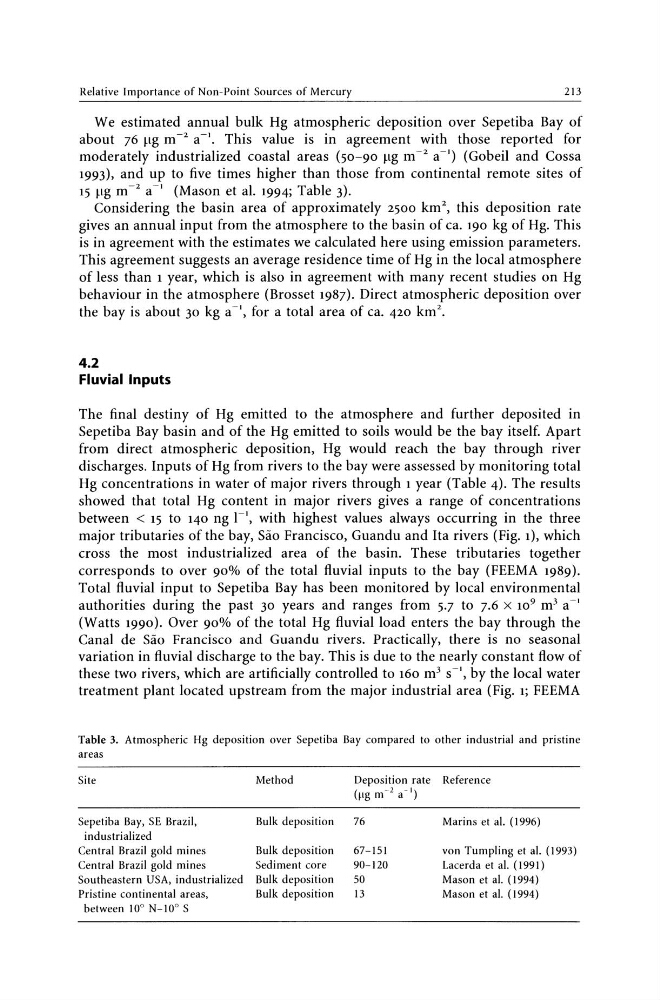
We estimated annual bulk Hg atmospheric deposition over Sepetiba Bay of
about 76 ~lg m -2 a-I. This value is in agreement with those reported for
moderately industrialized coastal areas (50-90 ~lg m -2 a-I) (Gobeil and Cossa
1993), and up to five times higher than those from continental remote sites of
15 ~lg m- 2 a-I (Mason et al. 1994; Table 3).
Considering the basin area of approximately 2500 km\ this deposition rate
gives an annual input from the atmosphere to the basin of ca. 190 kg of Hg. This
is in agreement with the estimates we calculated here using emission parameters.
This agreement suggests an average residence time of Hg in the local atmosphere
of less than 1 year, which is also in agreement with many recent studies on Hg
behaviour in the atmosphere (Brosset 1987). Direct atmospheric deposition over
the bay is about 30 kg a -t, for a total area of ca. 420 km 2 •
4.2
Fluvial Inputs
The final destiny of Hg emitted to the atmosphere and further deposited in
Sepetiba Bay basin and of the Hg emitted to soils would be the bay itself. Apart
from direct atmospheric deposition, Hg would reach the bay through river
discharges. Inputs of Hg from rivers to the bay were assessed by monitoring total
Hg concentrations in water of major rivers through 1 year (Table 4). The results
showed that total Hg content in major rivers gives a range of concentrations
between < 15 to 140 ng l-t, with highest values always occurring in the three
major tributaries of the bay, Sao Francisco, Guandu and Ita rivers (Fig. 1), which
cross the most industrialized area of the basin. These tributaries together
corresponds to over 90% of the total fluvial inputs to the bay (FEEMA 1989).
Total fluvial input to Sepetiba Bay has been monitored by local environmental
authorities during the past 30 years and ranges from 5.7 to 7.6 x 10 9 m 3 a-I
(Watts 1990). Over 90% of the total Hg fluvial load enters the bay through the
Canal de Sao Francisco and Guandu rivers. Practically, there is no seasonal
variation in fluvial discharge to the bay. This is due to the nearly constant flow of
these two rivers, which are artificially controlled to 160 m 3 s -I, by the local water
treatment plant located upstream from the major industrial area (Fig. 1; FEEMA
Table 3. Atmospheric Hg deposition over Sepetiba Bay compared to other industrial and pristine
areas
Site
Sepetiba Bay, SE Brazil,
industrialized
Central Brazil gold mines
Central Brazil gold mines
Southeastern USA, industrialized
Pristine continental areas,
between 10° N-IO° S
Method
Bulk deposition
Bulk deposition
Sediment core
Bulk deposition
Bulk deposition
Deposition rate Reference
(11g m- 2 a-I)
76
Marins et al. (1996)
67-151
von rumpling et al. (1993)
90-120
Lacerda et al. (1991)
50
Mason et al. (1994)
13
Mason et al. (1994)
213
We estimated annual bulk Hg atmospheric deposition over Sepetiba Bay of
about 76 ~lg m -2 a-I. This value is in agreement with those reported for
moderately industrialized coastal areas (50-90 ~lg m -2 a-I) (Gobeil and Cossa
1993), and up to five times higher than those from continental remote sites of
15 ~lg m- 2 a-I (Mason et al. 1994; Table 3).
Considering the basin area of approximately 2500 km\ this deposition rate
gives an annual input from the atmosphere to the basin of ca. 190 kg of Hg. This
is in agreement with the estimates we calculated here using emission parameters.
This agreement suggests an average residence time of Hg in the local atmosphere
of less than 1 year, which is also in agreement with many recent studies on Hg
behaviour in the atmosphere (Brosset 1987). Direct atmospheric deposition over
the bay is about 30 kg a -t, for a total area of ca. 420 km 2 •
4.2
Fluvial Inputs
The final destiny of Hg emitted to the atmosphere and further deposited in
Sepetiba Bay basin and of the Hg emitted to soils would be the bay itself. Apart
from direct atmospheric deposition, Hg would reach the bay through river
discharges. Inputs of Hg from rivers to the bay were assessed by monitoring total
Hg concentrations in water of major rivers through 1 year (Table 4). The results
showed that total Hg content in major rivers gives a range of concentrations
between < 15 to 140 ng l-t, with highest values always occurring in the three
major tributaries of the bay, Sao Francisco, Guandu and Ita rivers (Fig. 1), which
cross the most industrialized area of the basin. These tributaries together
corresponds to over 90% of the total fluvial inputs to the bay (FEEMA 1989).
Total fluvial input to Sepetiba Bay has been monitored by local environmental
authorities during the past 30 years and ranges from 5.7 to 7.6 x 10 9 m 3 a-I
(Watts 1990). Over 90% of the total Hg fluvial load enters the bay through the
Canal de Sao Francisco and Guandu rivers. Practically, there is no seasonal
variation in fluvial discharge to the bay. This is due to the nearly constant flow of
these two rivers, which are artificially controlled to 160 m 3 s -I, by the local water
treatment plant located upstream from the major industrial area (Fig. 1; FEEMA
Table 3. Atmospheric Hg deposition over Sepetiba Bay compared to other industrial and pristine
areas
Site
Sepetiba Bay, SE Brazil,
industrialized
Central Brazil gold mines
Central Brazil gold mines
Southeastern USA, industrialized
Pristine continental areas,
between 10° N-IO° S
Method
Bulk deposition
Bulk deposition
Sediment core
Bulk deposition
Bulk deposition
Deposition rate Reference
(11g m- 2 a-I)
76
Marins et al. (1996)
67-151
von rumpling et al. (1993)
90-120
Lacerda et al. (1991)
50
Mason et al. (1994)
13
Mason et al. (1994)