

Natural and Anthropogenic Mercury Sources
Dry
Transformations +
I Coo~~~"io",
,------._ T";~ ~
Diffusion
Total Emissions
L-_'-'~ I Scavenging I
~
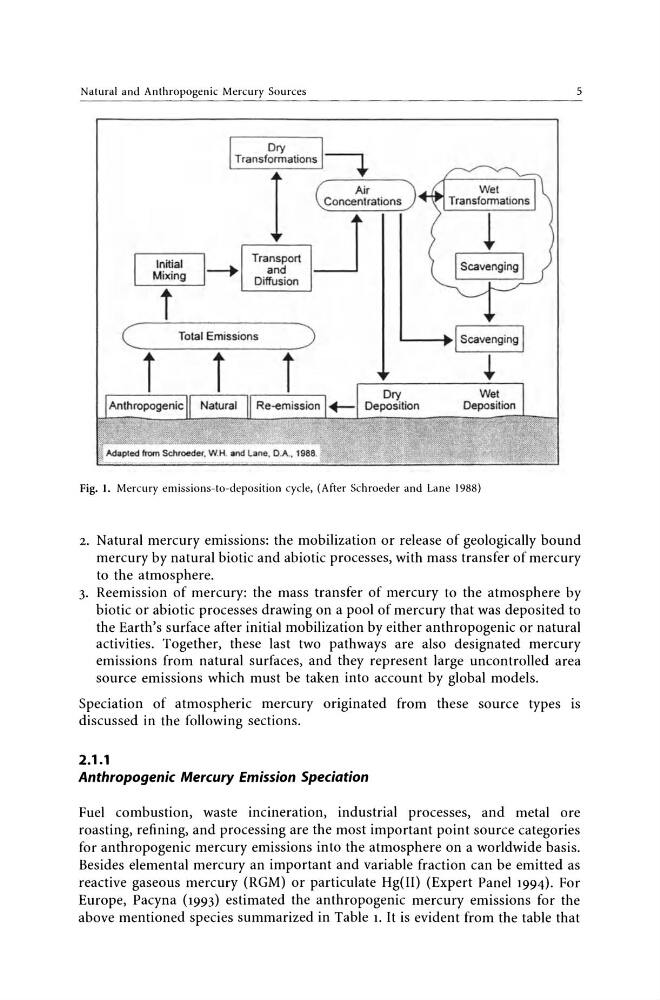
Fig. 1. Mercury emissions-to-deposition cycle, (Alier Schroeder and Lane 1988)
5
2. Natural mercury emissions: the mobilization or release of geologically bound
mercury by natural biotic and abiotic processes, with mass transfer of mercury
to the atmosphere.
3. Reemission of mercury: the mass transfer of mercury to the atmosphere by
biotic or abiotic processes drawing on a pool of mercury that was deposited to
the Earth's surface after initial mobilization by either anthropogenic or natural
activities. Together, these last two pathways are also designated mercury
emissions from natural surfaces, and they represent large uncontrolled area
source emissions which must be taken into account by global models.
Speciation of atmospheric mercury originated from these source types is
discussed in the following sections.
2.1.1
Anthropogenic Mercury Emission Speciation
Fuel combustion, waste incineration, industrial processes, and metal ore
roasting, refining, and processing are the most important point source categories
for anthropogenic mercury emissions into the atmosphere on a worldwide basis.
Besides elemental mercury an important and variable fraction can be emitted as
reactive gaseous mercury (RGM) or particulate Hg(lI) (Expert Panel 1994). For
Europe, Pacyna (1993) estimated the anthropogenic mercury emissions for the
above mentioned species summarized in Table 1. It is evident from the table that
Dry
Transformations +
I Coo~~~"io",
,------._ T";~ ~
Diffusion
Total Emissions
L-_'-'~ I Scavenging I
~
Fig. 1. Mercury emissions-to-deposition cycle, (Alier Schroeder and Lane 1988)
5
2. Natural mercury emissions: the mobilization or release of geologically bound
mercury by natural biotic and abiotic processes, with mass transfer of mercury
to the atmosphere.
3. Reemission of mercury: the mass transfer of mercury to the atmosphere by
biotic or abiotic processes drawing on a pool of mercury that was deposited to
the Earth's surface after initial mobilization by either anthropogenic or natural
activities. Together, these last two pathways are also designated mercury
emissions from natural surfaces, and they represent large uncontrolled area
source emissions which must be taken into account by global models.
Speciation of atmospheric mercury originated from these source types is
discussed in the following sections.
2.1.1
Anthropogenic Mercury Emission Speciation
Fuel combustion, waste incineration, industrial processes, and metal ore
roasting, refining, and processing are the most important point source categories
for anthropogenic mercury emissions into the atmosphere on a worldwide basis.
Besides elemental mercury an important and variable fraction can be emitted as
reactive gaseous mercury (RGM) or particulate Hg(lI) (Expert Panel 1994). For
Europe, Pacyna (1993) estimated the anthropogenic mercury emissions for the
above mentioned species summarized in Table 1. It is evident from the table that