

170
A.C.A. da Costa
N-acetylglucosamine-N-acetylmuramic acid--N-acetylglucosamine
I
L-alanine
I
D-glutamic acid
I
000000
Glycine
I
L-Iysine
I
Glycine
I
D-alanine
Glycine
Glycine
I
Glycine
I
D-alanine
I
L-Iysine
I
D-glutamic acid
I
L-alanine
I
N-acetylglucosamine--N-acetylmuramic acid--N-acetylglucosamine
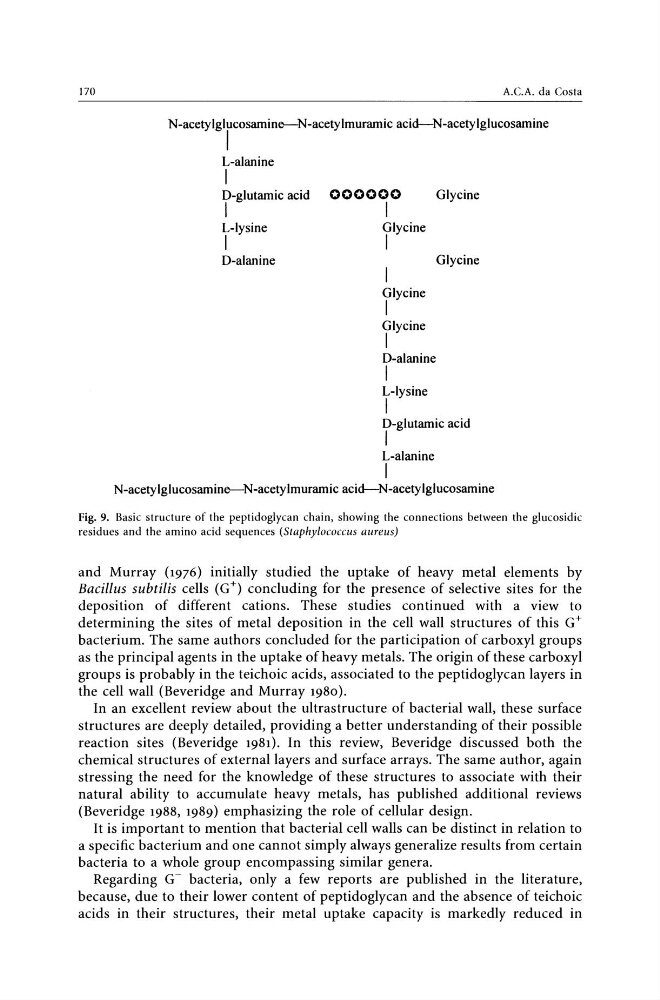
Fig. 9. Basic structure of the peptidoglycan chain, showing the connections between the glucosidic
residues and the amino acid sequences (Staphylococcus aureus)
and Murray (1976) initially studied the uptake of heavy metal elements by
Bacillus subtilis cells (G+) concluding for the presence of selective sites for the
deposition of different cations. These studies continued with a view to
determining the sites of metal deposition in the cell wall structures of this G+
bacterium. The same authors concluded for the participation of carboxyl groups
as the principal agents in the uptake of heavy metals. The origin of these carboxyl
groups is probably in the teichoic acids, associated to the peptidoglycan layers in
the cell wall (Beveridge and Murray 1980).
In an excellent review about the ultrastructure of bacterial wall, these surface
structures are deeply detailed, providing a better understanding of their possible
reaction sites (Beveridge 1981). In this review, Beveridge discussed both the
chemical structures of external layers and surface arrays. The same author, again
stressing the need for the knowledge of these structures to associate with their
natural ability to accumulate heavy metals, has published additional reviews
(Beveridge 1988, 1989) emphasizing the role of cellular design.
It is important to mention that bacterial cell walls can be distinct in relation to
a specific bacterium and one cannot simply always generalize results from certain
bacteria to a whole group encompassing similar genera.
Regarding G- bacteria, only a few reports are published in the literature,
because, due to their lower content of peptidoglycan and the absence of teichoic
acids in their structures, their metal uptake capacity is markedly reduced in
A.C.A. da Costa
N-acetylglucosamine-N-acetylmuramic acid--N-acetylglucosamine
I
L-alanine
I
D-glutamic acid
I
000000
Glycine
I
L-Iysine
I
Glycine
I
D-alanine
Glycine
Glycine
I
Glycine
I
D-alanine
I
L-Iysine
I
D-glutamic acid
I
L-alanine
I
N-acetylglucosamine--N-acetylmuramic acid--N-acetylglucosamine
Fig. 9. Basic structure of the peptidoglycan chain, showing the connections between the glucosidic
residues and the amino acid sequences (Staphylococcus aureus)
and Murray (1976) initially studied the uptake of heavy metal elements by
Bacillus subtilis cells (G+) concluding for the presence of selective sites for the
deposition of different cations. These studies continued with a view to
determining the sites of metal deposition in the cell wall structures of this G+
bacterium. The same authors concluded for the participation of carboxyl groups
as the principal agents in the uptake of heavy metals. The origin of these carboxyl
groups is probably in the teichoic acids, associated to the peptidoglycan layers in
the cell wall (Beveridge and Murray 1980).
In an excellent review about the ultrastructure of bacterial wall, these surface
structures are deeply detailed, providing a better understanding of their possible
reaction sites (Beveridge 1981). In this review, Beveridge discussed both the
chemical structures of external layers and surface arrays. The same author, again
stressing the need for the knowledge of these structures to associate with their
natural ability to accumulate heavy metals, has published additional reviews
(Beveridge 1988, 1989) emphasizing the role of cellular design.
It is important to mention that bacterial cell walls can be distinct in relation to
a specific bacterium and one cannot simply always generalize results from certain
bacteria to a whole group encompassing similar genera.
Regarding G- bacteria, only a few reports are published in the literature,
because, due to their lower content of peptidoglycan and the absence of teichoic
acids in their structures, their metal uptake capacity is markedly reduced in