

Chemical Interactions between Mercurial Species and Surface Biomolecules
169
monomeric units are arranged in such a way to form the peptidoglycan layer,
including glucosidic bonds, peptide bonds and also specific bridges between
peptide chains. Some differences between the peptide chains from G+ and Gcells must also to be considered, a fact that can be reflected in their metal binding
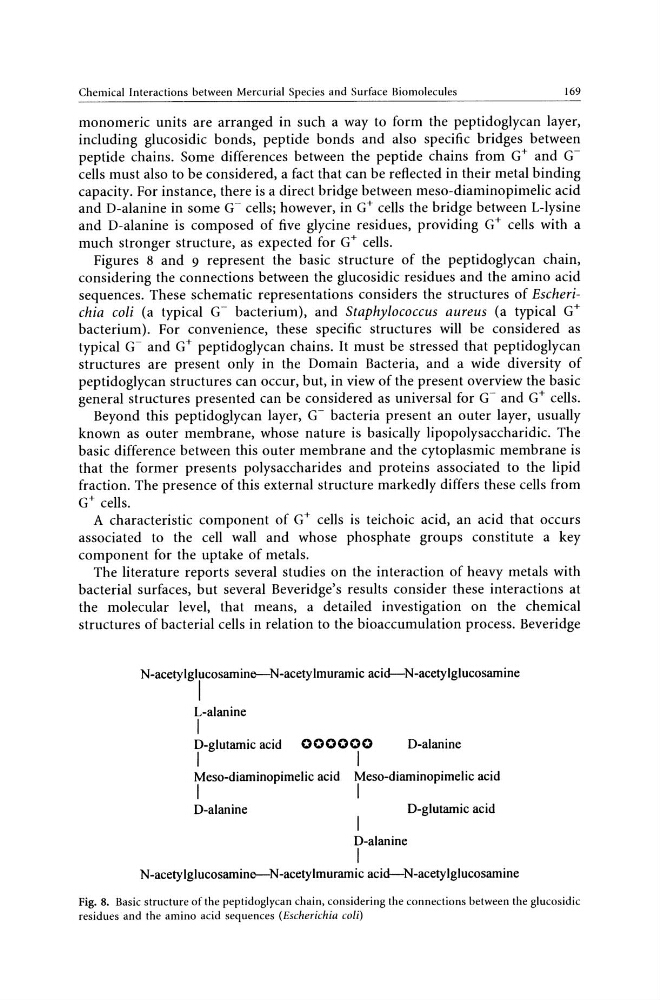
capacity. For instance, there is a direct bridge between meso-diaminopimelic acid
and D-alanine in some G- cells; however, in G+ cells the bridge between L-Iysine
and D-alanine is composed of five glycine residues, providing G+ cells with a
much stronger structure, as expected for G+ cells.
Figures 8 and 9 represent the basic structure of the peptidoglycan chain,
considering the connections between the glucosidic residues and the amino acid
sequences. These schematic representations considers the structures of Escherichia coli (a typical G- bacterium), and Staphylococcus aureus (a typical G+
bacterium). For convenience, these specific structures will be considered as
typical G- and G+ peptidoglycan chains. It must be stressed that peptidoglycan
structures are present only in the Domain Bacteria, and a wide diversity of
peptidoglycan structures can occur, but, in view of the present overview the basic
general structures presented can be considered as universal for G- and G+ cells.
Beyond this peptidoglycan layer, G- bacteria present an outer layer, usually
known as outer membrane, whose nature is basically lipopolysaccharidic. The
basic difference between this outer membrane and the cytoplasmic membrane is
that the former presents polysaccharides and proteins associated to the lipid
fraction. The presence of this external structure markedly differs these cells from
G+ cells.
A characteristic component of G+ cells is teichoic acid, an acid that occurs
associated to the cell wall and whose phosphate groups constitute a key
component for the uptake of metals.
The literature reports several studies on the interaction of heavy metals with
bacterial surfaces, but several Beveridge's results consider these interactions at
the molecular level, that means, a detailed investigation on the chemical
structures of bacterial cells in relation to the bioaccumulation process. Beveridge
N-acetylglucosamine--N-acetylmuramic acid--N-acetylglucosamine
I
L-alanine
I
D-glutamic acid 000000
I
I
D-alanine
Meso-diaminopimelic acid Meso-diaminopimelic acid
I
I
D-alanine
D-glutamic acid
D-alanine
I
N-acetylglucosamine--N-acetylmuramic acid--N-acetylglucosamine
Fig. 8. Basic structure of the peptidoglycan chain, considering the connections between the glucosidic
residues and the amino acid sequences (Escherichia coli)
169
monomeric units are arranged in such a way to form the peptidoglycan layer,
including glucosidic bonds, peptide bonds and also specific bridges between
peptide chains. Some differences between the peptide chains from G+ and Gcells must also to be considered, a fact that can be reflected in their metal binding
capacity. For instance, there is a direct bridge between meso-diaminopimelic acid
and D-alanine in some G- cells; however, in G+ cells the bridge between L-Iysine
and D-alanine is composed of five glycine residues, providing G+ cells with a
much stronger structure, as expected for G+ cells.
Figures 8 and 9 represent the basic structure of the peptidoglycan chain,
considering the connections between the glucosidic residues and the amino acid
sequences. These schematic representations considers the structures of Escherichia coli (a typical G- bacterium), and Staphylococcus aureus (a typical G+
bacterium). For convenience, these specific structures will be considered as
typical G- and G+ peptidoglycan chains. It must be stressed that peptidoglycan
structures are present only in the Domain Bacteria, and a wide diversity of
peptidoglycan structures can occur, but, in view of the present overview the basic
general structures presented can be considered as universal for G- and G+ cells.
Beyond this peptidoglycan layer, G- bacteria present an outer layer, usually
known as outer membrane, whose nature is basically lipopolysaccharidic. The
basic difference between this outer membrane and the cytoplasmic membrane is
that the former presents polysaccharides and proteins associated to the lipid
fraction. The presence of this external structure markedly differs these cells from
G+ cells.
A characteristic component of G+ cells is teichoic acid, an acid that occurs
associated to the cell wall and whose phosphate groups constitute a key
component for the uptake of metals.
The literature reports several studies on the interaction of heavy metals with
bacterial surfaces, but several Beveridge's results consider these interactions at
the molecular level, that means, a detailed investigation on the chemical
structures of bacterial cells in relation to the bioaccumulation process. Beveridge
N-acetylglucosamine--N-acetylmuramic acid--N-acetylglucosamine
I
L-alanine
I
D-glutamic acid 000000
I
I
D-alanine
Meso-diaminopimelic acid Meso-diaminopimelic acid
I
I
D-alanine
D-glutamic acid
D-alanine
I
N-acetylglucosamine--N-acetylmuramic acid--N-acetylglucosamine
Fig. 8. Basic structure of the peptidoglycan chain, considering the connections between the glucosidic
residues and the amino acid sequences (Escherichia coli)