

146
A. Kudo and R.R. Turner
Minamata Bay were dredged several times between 1964 and 1970 to construct
and maintain a navigation channel (Fujiki and Tajima 1992).
The mercury levels in bay sediments and fishery were characterized beginning
around 1959 and continued until 1974 when the Kumamoto Prefecture, the
jurisdictional government, issued an extensive restoration plan for the bay. The
plan focused on dredging all sediments from the bay above 25 ppm in mercury
content. The most contaminated area of the bay was designated to be surrounded
by a barrier (i.e., contained) and used as the disposal site for dredged sediments.
Dredging commenced in 1980 and ended in December 1987, but the entire
restoration process (including final closure of the contained area) was not
completed until March 1990.
1.3
Mercury Releases to the Environment
Total mercury losses in wastewater from the acetaldehyde production process,
which was the main source of environmental releases, can only be estimated
based on a few reported (see review by Fujiki and Tajima 1992) mercury
concentrations in wastewater (e.g., 20 ppm) and other information (Arima 1979
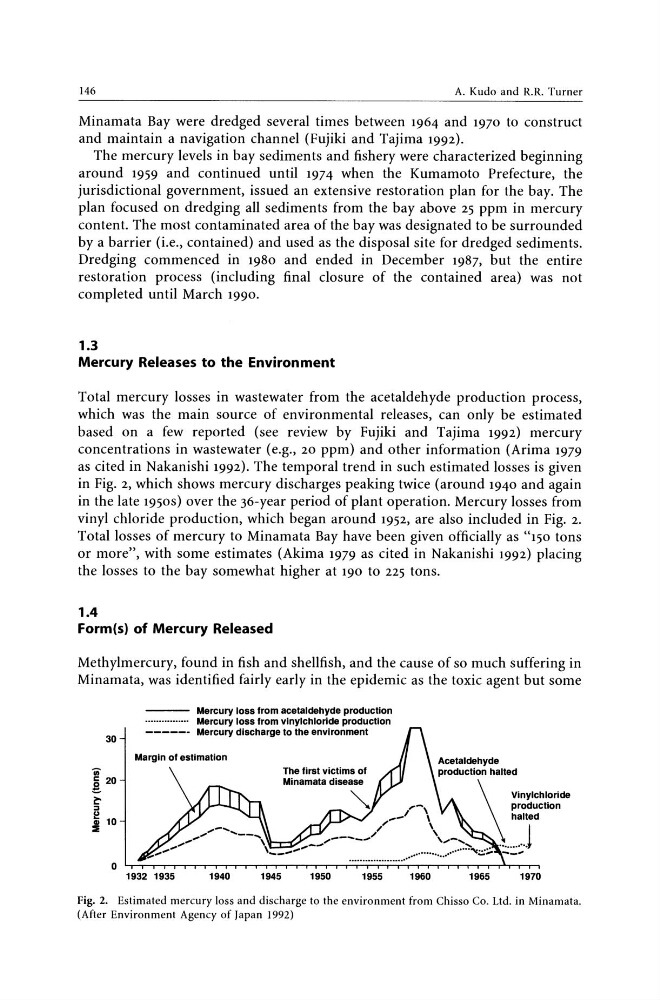
as cited in Nakanishi 1992). The temporal trend in such estimated losses is given
in Fig. 2, which shows mercury discharges peaking twice (around 1940 and again
in the late 1950S) over the 36-year period of plant operation. Mercury losses from
vinyl chloride production, which began around 1952, are also included in Fig. 2.
Total losses of mercury to Minamata Bay have been given officially as "150 tons
or more", with some estimates (Akima 1979 as cited in Nakanishi 1992) placing
the losses to the bay somewhat higher at 190 to 225 tons.
1.4
Form(s) of Mercury Released
Methylmercury, found in fish and shellfish, and the cause of so much suffering in
Minamata, was identified fairly early in the epidemic as the toxic agent but some
30
o
Mercury loss from acetaldehyde production
Mercury loss from vinylchlorlde prodUCtion
Mercury discharge to the environment
Margin of estimation
1932 1935
1940
1945
The first victims of
Minamata disease
1950
1955
1960
1965
1970
Fig. 2. Estimated mercury loss and discharge to the environment from Chisso Co. Ltd. in Minamata.
(After Environment Agency of Japan 1992)
A. Kudo and R.R. Turner
Minamata Bay were dredged several times between 1964 and 1970 to construct
and maintain a navigation channel (Fujiki and Tajima 1992).
The mercury levels in bay sediments and fishery were characterized beginning
around 1959 and continued until 1974 when the Kumamoto Prefecture, the
jurisdictional government, issued an extensive restoration plan for the bay. The
plan focused on dredging all sediments from the bay above 25 ppm in mercury
content. The most contaminated area of the bay was designated to be surrounded
by a barrier (i.e., contained) and used as the disposal site for dredged sediments.
Dredging commenced in 1980 and ended in December 1987, but the entire
restoration process (including final closure of the contained area) was not
completed until March 1990.
1.3
Mercury Releases to the Environment
Total mercury losses in wastewater from the acetaldehyde production process,
which was the main source of environmental releases, can only be estimated
based on a few reported (see review by Fujiki and Tajima 1992) mercury
concentrations in wastewater (e.g., 20 ppm) and other information (Arima 1979
as cited in Nakanishi 1992). The temporal trend in such estimated losses is given
in Fig. 2, which shows mercury discharges peaking twice (around 1940 and again
in the late 1950S) over the 36-year period of plant operation. Mercury losses from
vinyl chloride production, which began around 1952, are also included in Fig. 2.
Total losses of mercury to Minamata Bay have been given officially as "150 tons
or more", with some estimates (Akima 1979 as cited in Nakanishi 1992) placing
the losses to the bay somewhat higher at 190 to 225 tons.
1.4
Form(s) of Mercury Released
Methylmercury, found in fish and shellfish, and the cause of so much suffering in
Minamata, was identified fairly early in the epidemic as the toxic agent but some
30
o
Mercury loss from acetaldehyde production
Mercury loss from vinylchlorlde prodUCtion
Mercury discharge to the environment
Margin of estimation
1932 1935
1940
1945
The first victims of
Minamata disease
1950
1955
1960
1965
1970
Fig. 2. Estimated mercury loss and discharge to the environment from Chisso Co. Ltd. in Minamata.
(After Environment Agency of Japan 1992)