

Advanced Technology Available for the Abatement of Mercury Pollution
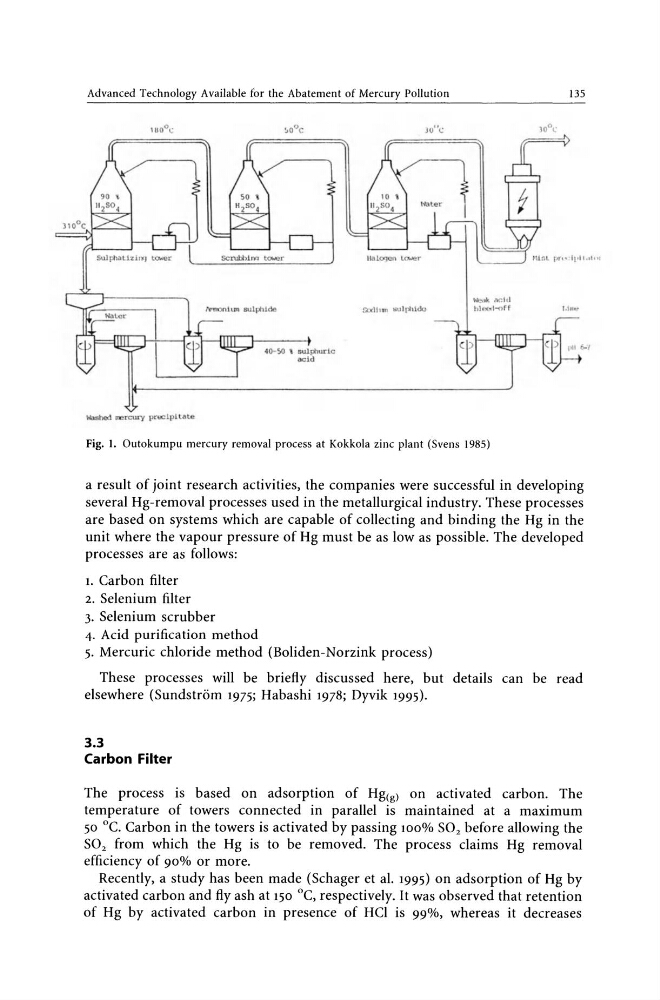
40-50 " sulphurlc
acid
Fig. I. Outokumpu mercury removal process at Kokkola zinc plant (Svens 1985)
135
a result of joint research activities, the companies were successful in developing
several Hg-removal processes used in the metallurgical industry. These processes
are based on systems which are capable of collecting and binding the Hg in the
unit where the vapour pressure of Hg must be as low as possible. The developed
processes are as follows:
I. Carbon filter
2. Selenium filter
3. Selenium scrubber
4. Acid purification method
5. Mercuric chloride method (Boliden-Norzink process)
These processes will be briefly discussed here, but details can be read
elsewhere (Sundstrom 1975; Habashi 1978; Dyvik 1995).
3.3
Carbon Filter
The process is based on adsorption of Hg(g) on activated carbon. The
temperature of towers connected in parallel is maintained at a maximum
50 DC. Carbon in the towers is activated by passing 100% S02 before allowing the
S02 from which the Hg is to be removed. The process claims Hg removal
efficiency of 90% or more.
Recently, a study has been made (Schager et al. 1995) on adsorption of Hg by
activated carbon arid fly ash at 150 DC, respectively. It was observed that retention
of Hg by activated carbon in presence of HCl is 99%, whereas it decreases
40-50 " sulphurlc
acid
Fig. I. Outokumpu mercury removal process at Kokkola zinc plant (Svens 1985)
135
a result of joint research activities, the companies were successful in developing
several Hg-removal processes used in the metallurgical industry. These processes
are based on systems which are capable of collecting and binding the Hg in the
unit where the vapour pressure of Hg must be as low as possible. The developed
processes are as follows:
I. Carbon filter
2. Selenium filter
3. Selenium scrubber
4. Acid purification method
5. Mercuric chloride method (Boliden-Norzink process)
These processes will be briefly discussed here, but details can be read
elsewhere (Sundstrom 1975; Habashi 1978; Dyvik 1995).
3.3
Carbon Filter
The process is based on adsorption of Hg(g) on activated carbon. The
temperature of towers connected in parallel is maintained at a maximum
50 DC. Carbon in the towers is activated by passing 100% S02 before allowing the
S02 from which the Hg is to be removed. The process claims Hg removal
efficiency of 90% or more.
Recently, a study has been made (Schager et al. 1995) on adsorption of Hg by
activated carbon arid fly ash at 150 DC, respectively. It was observed that retention
of Hg by activated carbon in presence of HCl is 99%, whereas it decreases