

134
A.B. Mukherjee
a temperature of 350°C are washed by 85-90% H2S0 4 in a brick-lined tower. The
temperature of the gases drops from 350 to 200 °c and they are then scrubbed with
the same acid to convert the Hgo into the sulfate as per the following equation:
(1)
The Hg-containing acid slurry in the sulphatizing tower is settled in a thickener
and is then washed and filtered for the production of metallic Hg and Se at the
Kokkola Zinc Plant.
The roaster gases contain moisture which may dilute the acid, causing it to be
ineffective as a sulphating agent. The vapour pressure of water in the acid must
correspond to the water partial pressure of the gas to be treated (Rastas et al.
1971). To maintain the vapour pressure, the H2S0 4 concentration is about 90%
and its inlet and outlet temperatures inside the Hg-sulphatizer are 40 and 180°C,
respectively. Gas leaving the Hg-sulphatizer contains about 20 ~lg Nm -3 of Hgo.
In the scrubber unit, the gas is further washed with weak H2S0 4 to bring down
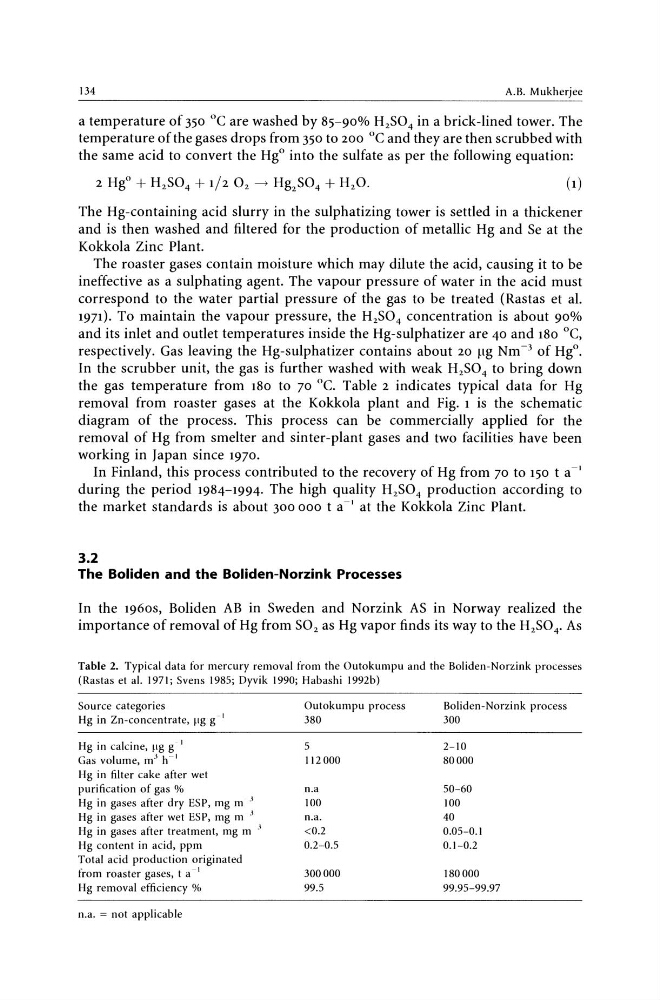
the gas temperature from 180 to 70°C. Table 2 indicates typical data for Hg
removal from roaster gases at the Kokkola plant and Fig. 1 is the schematic
diagram of the process. This process can be commercially applied for the
removal of Hg from smelter and sinter-plant gases and two facilities have been
working in Japan since 1970.
In Finland, this process contributed to the recovery of Hg from 70 to 150 t a-I
during the period 1984-1994. The high quality H2S0 4 production according to
the market standards is about 300000 t a-I at the Kokkola Zinc Plant.
3.2
The Boliden and the Boliden-Norzink Processes
In the 1960s, Boliden AB in Sweden and Norzink AS in Norway realized the
importance of removal of Hg from S02 as Hg vapor finds its way to the H2S0 4 • As
Table 2. Typical data for mercury removal from the Outokumpu and the Boliden-Norzink processes
(Rastas et al. 1971; Svens 1985; Dyvik 1990; Habashi 1992b)
Source categories
Hg in Zn-concentrate, r'g g-I
Hg in calcine, rig g I
Gas volume, m
j h- I
Hg in filter cake after wet
purification of gas %
Hg in gases after dry ESP, mg m- j
Hg in gases after wet ESP, mg mj
Hg in gases after treatment, mg m -,
Hg content in acid, ppm
Total acid production originated
from roaster gases, t a-I
Hg removal efficiency %
n.a. = not applicable
Outokumpu process
380
S
112 000
n.a
100
n.a.
<0.2
0.2-0.S
300000
99.S
Boliden-Norzink process
300
2-10
80000
SO-60
100
40
O.OS-O.1
0.1-0.2
180000
99.9S-99.97
A.B. Mukherjee
a temperature of 350°C are washed by 85-90% H2S0 4 in a brick-lined tower. The
temperature of the gases drops from 350 to 200 °c and they are then scrubbed with
the same acid to convert the Hgo into the sulfate as per the following equation:
(1)
The Hg-containing acid slurry in the sulphatizing tower is settled in a thickener
and is then washed and filtered for the production of metallic Hg and Se at the
Kokkola Zinc Plant.
The roaster gases contain moisture which may dilute the acid, causing it to be
ineffective as a sulphating agent. The vapour pressure of water in the acid must
correspond to the water partial pressure of the gas to be treated (Rastas et al.
1971). To maintain the vapour pressure, the H2S0 4 concentration is about 90%
and its inlet and outlet temperatures inside the Hg-sulphatizer are 40 and 180°C,
respectively. Gas leaving the Hg-sulphatizer contains about 20 ~lg Nm -3 of Hgo.
In the scrubber unit, the gas is further washed with weak H2S0 4 to bring down
the gas temperature from 180 to 70°C. Table 2 indicates typical data for Hg
removal from roaster gases at the Kokkola plant and Fig. 1 is the schematic
diagram of the process. This process can be commercially applied for the
removal of Hg from smelter and sinter-plant gases and two facilities have been
working in Japan since 1970.
In Finland, this process contributed to the recovery of Hg from 70 to 150 t a-I
during the period 1984-1994. The high quality H2S0 4 production according to
the market standards is about 300000 t a-I at the Kokkola Zinc Plant.
3.2
The Boliden and the Boliden-Norzink Processes
In the 1960s, Boliden AB in Sweden and Norzink AS in Norway realized the
importance of removal of Hg from S02 as Hg vapor finds its way to the H2S0 4 • As
Table 2. Typical data for mercury removal from the Outokumpu and the Boliden-Norzink processes
(Rastas et al. 1971; Svens 1985; Dyvik 1990; Habashi 1992b)
Source categories
Hg in Zn-concentrate, r'g g-I
Hg in calcine, rig g I
Gas volume, m
j h- I
Hg in filter cake after wet
purification of gas %
Hg in gases after dry ESP, mg m- j
Hg in gases after wet ESP, mg mj
Hg in gases after treatment, mg m -,
Hg content in acid, ppm
Total acid production originated
from roaster gases, t a-I
Hg removal efficiency %
n.a. = not applicable
Outokumpu process
380
S
112 000
n.a
100
n.a.
<0.2
0.2-0.S
300000
99.S
Boliden-Norzink process
300
2-10
80000
SO-60
100
40
O.OS-O.1
0.1-0.2
180000
99.9S-99.97