

96
R.R. Turner and G.R. Southworth
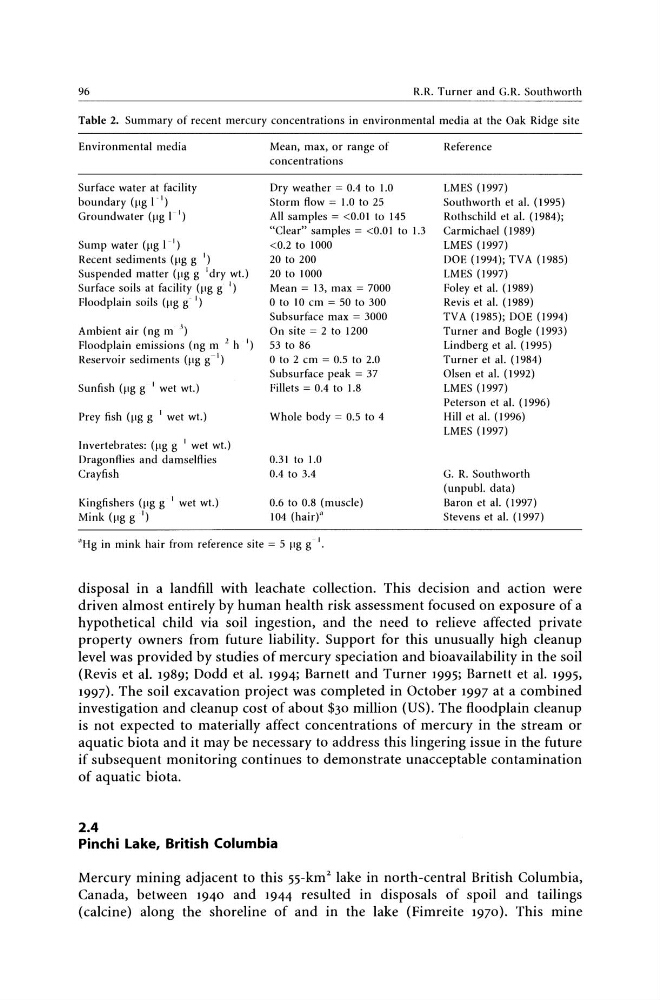
Table 2. Summary of recent mercury concentrations in environmental media at the Oak Ridge site
Environmental media
Surface water at facility
boundary (11g 1-')
Groundwater (11g 1-')
Sump water (pg 1-')
Recent sediments (11g g ')
Suspended matter (11g g 'dry wt.)
Surface soils at facility (pg g" ')
Floodplain soils (11g g- ')
Ambient air (ng m 3)
Floodplain emissions (ng m I h ')
Reservoir sediments (11g g-')
Sunfish (pg g--' wet wt.)
Prey fish (11g g , wet wt.)
Invertebrates: (ILg g , wet wt.)
Dragonflies and damselflies
Crayfish
Kingfishers (pg g , wet wt.)
Mink (11g g')
Mean, max, or range of
concentrations
Dry weather = 0.4 to 1.0
Storm flow = 1.0 to 25
All samples = <0.01 to 145
"Clear" samples = <0.01 to 1.3
<0.2 to 1000
20 to 200
20 to 1000
Mean = 13, max = 7000
o to 10 cm = 50 to 300
Subsurface max = 3000
On site = 2 to 1200
53 to 86
o to 2 cm = 0.5 to 2.0
Subsurface peak = 37
Fillets = 0.4 to 1.8
Whole body = 0.5 to 4
0.31 to 1.0
0.4 to 3.4
0.6 to 0.8 (muscle)
104 (hair)"
"Hg in mink hair from reference site = 5 pg g '.
Reference
LMES (1997)
Southworth et al. (1995)
Rothschild et al. (1984);
Carmichael (1989)
LMES (1997)
DOE (1994); TVA (1985)
LMES (1997)
Foley et al. (1989)
Revis et al. (1989)
TVA (1985); DOE (1994)
Turner and Bogle (1993)
Lindberg et al. (1995)
Turner et al. (1984)
Olsen et al. (1992)
LMES (1997)
Peterson et al. (1996)
Hill et al. (1996)
LMES (1997)
G. R. Southworth
(unpubl. data)
Baron et al. (1997)
Stevens et al. (1997)
disposal in a landfill with leachate collection. This decision and action were
driven almost entirely by human health risk assessment focused on exposure of a
hypothetical child via soil ingestion, and the need to relieve affected private
property owners from future liability. Support for this unusually high cleanup
level was provided by studies of mercury speciation and bioavailability in the soil
(Revis et al. 1989; Dodd et al. 1994; Barnett and Turner 1995; Barnett et al. 1995,
1997). The soil excavation project was completed in October 1997 at a combined
investigation and cleanup cost of about $30 million (US). The floodplain cleanup
is not expected to materially affect concentrations of mercury in the stream or
aquatic biota and it may be necessary to address this lingering issue in the future
if subsequent monitoring continues to demonstrate unacceptable contamination
of aquatic biota.
2.4
Pinchi Lake, British Columbia
Mercury mining adjacent to this 55-km2 lake in north-central British Columbia,
Canada, between 1940 and 1944 resulted in disposals of spoil and tailings
(calcine) along the shoreline of and in the lake (Fimreite 1970). This mine
R.R. Turner and G.R. Southworth
Table 2. Summary of recent mercury concentrations in environmental media at the Oak Ridge site
Environmental media
Surface water at facility
boundary (11g 1-')
Groundwater (11g 1-')
Sump water (pg 1-')
Recent sediments (11g g ')
Suspended matter (11g g 'dry wt.)
Surface soils at facility (pg g" ')
Floodplain soils (11g g- ')
Ambient air (ng m 3)
Floodplain emissions (ng m I h ')
Reservoir sediments (11g g-')
Sunfish (pg g--' wet wt.)
Prey fish (11g g , wet wt.)
Invertebrates: (ILg g , wet wt.)
Dragonflies and damselflies
Crayfish
Kingfishers (pg g , wet wt.)
Mink (11g g')
Mean, max, or range of
concentrations
Dry weather = 0.4 to 1.0
Storm flow = 1.0 to 25
All samples = <0.01 to 145
"Clear" samples = <0.01 to 1.3
<0.2 to 1000
20 to 200
20 to 1000
Mean = 13, max = 7000
o to 10 cm = 50 to 300
Subsurface max = 3000
On site = 2 to 1200
53 to 86
o to 2 cm = 0.5 to 2.0
Subsurface peak = 37
Fillets = 0.4 to 1.8
Whole body = 0.5 to 4
0.31 to 1.0
0.4 to 3.4
0.6 to 0.8 (muscle)
104 (hair)"
"Hg in mink hair from reference site = 5 pg g '.
Reference
LMES (1997)
Southworth et al. (1995)
Rothschild et al. (1984);
Carmichael (1989)
LMES (1997)
DOE (1994); TVA (1985)
LMES (1997)
Foley et al. (1989)
Revis et al. (1989)
TVA (1985); DOE (1994)
Turner and Bogle (1993)
Lindberg et al. (1995)
Turner et al. (1984)
Olsen et al. (1992)
LMES (1997)
Peterson et al. (1996)
Hill et al. (1996)
LMES (1997)
G. R. Southworth
(unpubl. data)
Baron et al. (1997)
Stevens et al. (1997)
disposal in a landfill with leachate collection. This decision and action were
driven almost entirely by human health risk assessment focused on exposure of a
hypothetical child via soil ingestion, and the need to relieve affected private
property owners from future liability. Support for this unusually high cleanup
level was provided by studies of mercury speciation and bioavailability in the soil
(Revis et al. 1989; Dodd et al. 1994; Barnett and Turner 1995; Barnett et al. 1995,
1997). The soil excavation project was completed in October 1997 at a combined
investigation and cleanup cost of about $30 million (US). The floodplain cleanup
is not expected to materially affect concentrations of mercury in the stream or
aquatic biota and it may be necessary to address this lingering issue in the future
if subsequent monitoring continues to demonstrate unacceptable contamination
of aquatic biota.
2.4
Pinchi Lake, British Columbia
Mercury mining adjacent to this 55-km2 lake in north-central British Columbia,
Canada, between 1940 and 1944 resulted in disposals of spoil and tailings
(calcine) along the shoreline of and in the lake (Fimreite 1970). This mine