

84
900
800
700
600
;:- 500
~ 400
en
.s 300
en
:I: 200
L.D. Lacerda and W. Salomons
10~ lliJLJtiJU~L[~~r~~U~g:~71
Distance from tailings
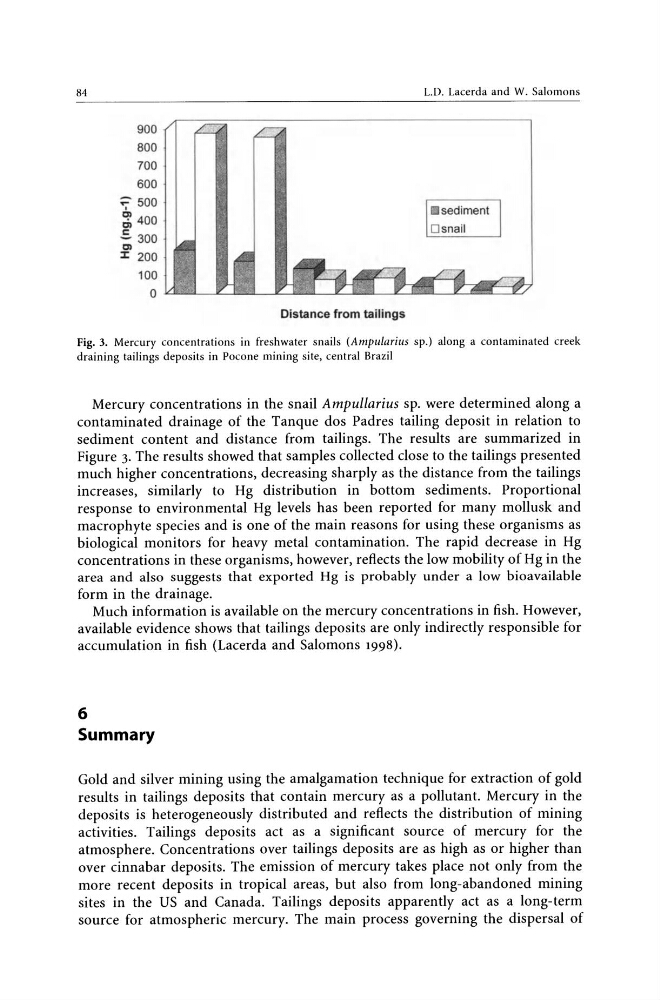
Fig. 3. Mercury concentrations in freshwater snails (Ampularius sp.) along a contaminated creek
draining tailings deposits in Pocone mining site, central Brazil
Mercury concentrations in the snail Ampullarius sp. were determined along a
contaminated drainage of the Tanque dos Padres tailing deposit in relation to
sediment content and distance from tailings. The results are summarized in
Figure 3. The results showed that samples collected close to the tailings presented
much higher concentrations, decreasing sharply as the distance from the tailings
increases, similarly to Hg distribution in bottom sediments. Proportional
response to environmental Hg levels has been reported for many mollusk and
macrophyte species and is one of the main reasons for using these organisms as
biological monitors for heavy metal contamination. The rapid decrease in Hg
concentrations in these organisms, however, reflects the low mobility of Hg in the
area and also suggests that exported Hg is probably under a low bioavailable
form in the drainage.
Much information is available on the mercury concentrations in fish. However,
available evidence shows that tailings deposits are only indirectly responsible for
accumulation in fish (Lacerda and Salomons 1998).
6
Summary
Gold and silver mining using the amalgamation technique for extraction of gold
results in tailings deposits that contain mercury as a pollutant. Mercury in the
deposits is heterogeneously distributed and reflects the distribution of mining
activities. Tailings deposits act as a significant source of mercury for the
atmosphere. Concentrations over tailings deposits are as high as or higher than
over cinnabar deposits. The emission of mercury takes place not only from the
more recent deposits in tropical areas, but also from long-abandoned mining
sites in the US and Canada. Tailings deposits apparently act as a long-term
source for atmospheric mercury. The main process governing the dispersal of
900
800
700
600
;:- 500
~ 400
en
.s 300
en
:I: 200
L.D. Lacerda and W. Salomons
10~ lliJLJtiJU~L[~~r~~U~g:~71
Distance from tailings
Fig. 3. Mercury concentrations in freshwater snails (Ampularius sp.) along a contaminated creek
draining tailings deposits in Pocone mining site, central Brazil
Mercury concentrations in the snail Ampullarius sp. were determined along a
contaminated drainage of the Tanque dos Padres tailing deposit in relation to
sediment content and distance from tailings. The results are summarized in
Figure 3. The results showed that samples collected close to the tailings presented
much higher concentrations, decreasing sharply as the distance from the tailings
increases, similarly to Hg distribution in bottom sediments. Proportional
response to environmental Hg levels has been reported for many mollusk and
macrophyte species and is one of the main reasons for using these organisms as
biological monitors for heavy metal contamination. The rapid decrease in Hg
concentrations in these organisms, however, reflects the low mobility of Hg in the
area and also suggests that exported Hg is probably under a low bioavailable
form in the drainage.
Much information is available on the mercury concentrations in fish. However,
available evidence shows that tailings deposits are only indirectly responsible for
accumulation in fish (Lacerda and Salomons 1998).
6
Summary
Gold and silver mining using the amalgamation technique for extraction of gold
results in tailings deposits that contain mercury as a pollutant. Mercury in the
deposits is heterogeneously distributed and reflects the distribution of mining
activities. Tailings deposits act as a significant source of mercury for the
atmosphere. Concentrations over tailings deposits are as high as or higher than
over cinnabar deposits. The emission of mercury takes place not only from the
more recent deposits in tropical areas, but also from long-abandoned mining
sites in the US and Canada. Tailings deposits apparently act as a long-term
source for atmospheric mercury. The main process governing the dispersal of