

Hg Contamnation from New World Gold & Silver Mine Tailings
en
en
2:
Cl
:I:
1.2
0.8
0.6
0.4
0.2
0
:>3 .0
Guts (mud Hg 2.45 I-Ig.g" )
Muscle (mud Hg 2.45 I-Ig.g" )
Guts (mud Hg 0.8 1-19·9" )
83
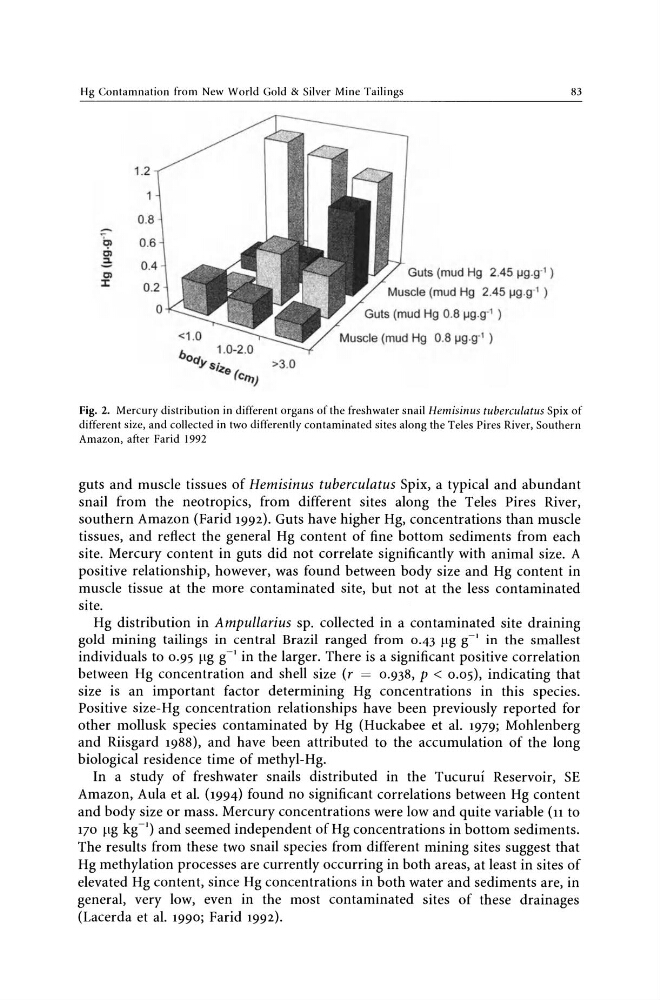
Fig. 2. Mercury distribution in different organs of the freshwater snail Hemisinus tuberculatus Spix of
different size, and collected in two differently contaminated sites along the Teles Pires River, Southern
Amazon, after Farid 1992
guts and muscle tissues of Hemisinus tuberculatus Spix, a typical and abundant
snail from the neotropics, from different sites along the Teles Pires River,
southern Amazon (Farid 1992). Guts have higher Hg, concentrations than muscle
tissues, and reflect the general Hg content of fine bottom sediments from each
site. Mercury content in guts did not correlate significantly with animal size. A
positive relationship, however, was found between body size and Hg content in
muscle tissue at the more contaminated site, but not at the less contaminated
site.
Hg distribution in Ampullarius sp. collected in a contaminated site draining
gold mining tailings in central Brazil ranged from 0.43 ~tg g- I in the smallest
individuals to 0.95 ~lg g - I in the larger. There is a significant positive correlation
between Hg concentration and shell size (r = 0.938, P < 0.05), indicating that
size is an important factor determining Hg concentrations in this species.
Positive size-Hg concentration relationships have been previously reported for
other mollusk species contaminated by Hg (Huckabee et al. 1979; Mohlenberg
and Riisgard 1988), and have been attributed to the accumulation of the long
biological residence time of methyl-Hg.
In a study of freshwater snails distributed in the Tucurul Reservoir, SE
Amazon, Aula et al. (1994) found no significant correlations between Hg content
and body size or mass. Mercury concentrations were low and quite variable (11 to
170 pg kg - I) and seemed independent of Hg concentrations in bottom sediments.
The results from these two snail species from different mining sites suggest that
Hg methylation processes are currently occurring in both areas, at least in sites of
elevated Hg content, since Hg concentrations in both water and sediments are, in
general, very low, even in the most contaminated sites of these drainages
(Lacerda et al. 1990; Farid 1992).
en
en
2:
Cl
:I:
1.2
0.8
0.6
0.4
0.2
0
:>3 .0
Guts (mud Hg 2.45 I-Ig.g" )
Muscle (mud Hg 2.45 I-Ig.g" )
Guts (mud Hg 0.8 1-19·9" )
83
Fig. 2. Mercury distribution in different organs of the freshwater snail Hemisinus tuberculatus Spix of
different size, and collected in two differently contaminated sites along the Teles Pires River, Southern
Amazon, after Farid 1992
guts and muscle tissues of Hemisinus tuberculatus Spix, a typical and abundant
snail from the neotropics, from different sites along the Teles Pires River,
southern Amazon (Farid 1992). Guts have higher Hg, concentrations than muscle
tissues, and reflect the general Hg content of fine bottom sediments from each
site. Mercury content in guts did not correlate significantly with animal size. A
positive relationship, however, was found between body size and Hg content in
muscle tissue at the more contaminated site, but not at the less contaminated
site.
Hg distribution in Ampullarius sp. collected in a contaminated site draining
gold mining tailings in central Brazil ranged from 0.43 ~tg g- I in the smallest
individuals to 0.95 ~lg g - I in the larger. There is a significant positive correlation
between Hg concentration and shell size (r = 0.938, P < 0.05), indicating that
size is an important factor determining Hg concentrations in this species.
Positive size-Hg concentration relationships have been previously reported for
other mollusk species contaminated by Hg (Huckabee et al. 1979; Mohlenberg
and Riisgard 1988), and have been attributed to the accumulation of the long
biological residence time of methyl-Hg.
In a study of freshwater snails distributed in the Tucurul Reservoir, SE
Amazon, Aula et al. (1994) found no significant correlations between Hg content
and body size or mass. Mercury concentrations were low and quite variable (11 to
170 pg kg - I) and seemed independent of Hg concentrations in bottom sediments.
The results from these two snail species from different mining sites suggest that
Hg methylation processes are currently occurring in both areas, at least in sites of
elevated Hg content, since Hg concentrations in both water and sediments are, in
general, very low, even in the most contaminated sites of these drainages
(Lacerda et al. 1990; Farid 1992).