

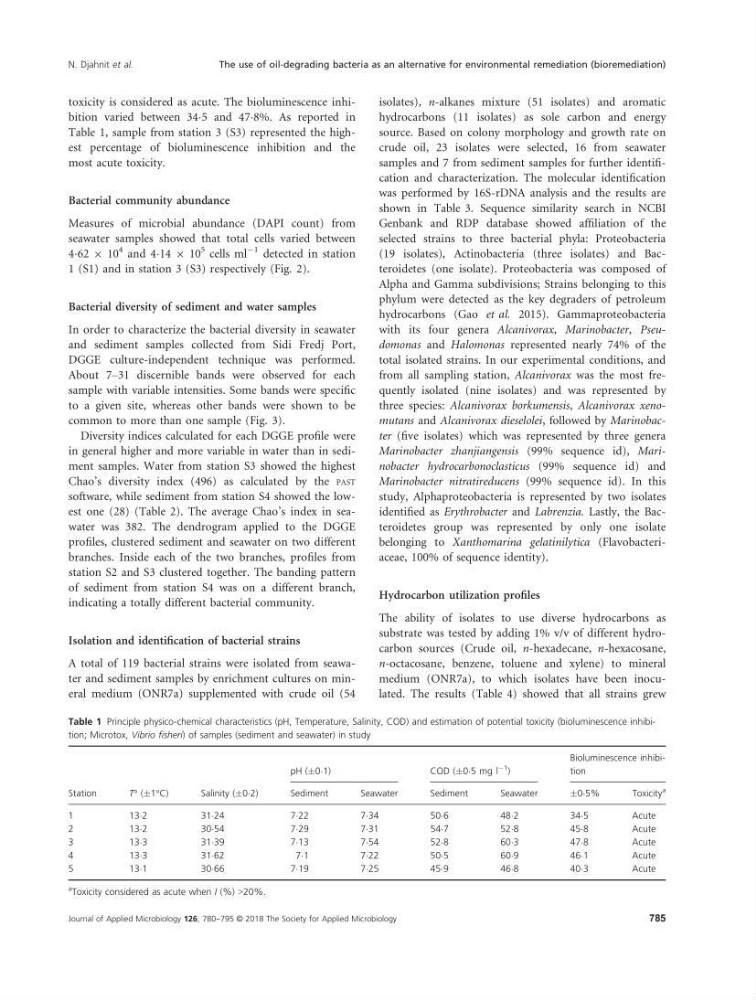
toxicity is considered as acute. The bioluminescence inhibition varied between 34Á5 and 47Á8%. As reported in
Table 1, sample from station 3 (S3) represented the highest percentage of bioluminescence inhibition and the
most acute toxicity.
Bacterial community abundance
Measures of microbial abundance (DAPI count) from
seawater samples showed that total cells varied between
4Á62 9 10
4 and 4Á14 9 10
5 cells ml
À1 detected in station
1 (S1) and in station 3 (S3) respectively (Fig. 2).
Bacterial diversity of sediment and water samples
In order to characterize the bacterial diversity in seawater
and sediment samples collected from Sidi Fredj Port,
DGGE culture-independent technique was performed.
About 7–31 discernible bands were observed for each
sample with variable intensities. Some bands were specific
to a given site, whereas other bands were shown to be
common to more than one sample (Fig. 3).
Diversity indices calculated for each DGGE profile were
in general higher and more variable in water than in sediment samples. Water from station S3 showed the highest
Chao’s diversity index (496) as calculated by the PAST
software, while sediment from station S4 showed the lowest one (28) (Table 2). The average Chao’s index in seawater was 382. The dendrogram applied to the DGGE
profiles, clustered sediment and seawater on two different
branches. Inside each of the two branches, profiles from
station S2 and S3 clustered together. The banding pattern
of sediment from station S4 was on a different branch,
indicating a totally different bacterial community.
Isolation and identification of bacterial strains
A total of 119 bacterial strains were isolated from seawater and sediment samples by enrichment cultures on mineral medium (ONR7a) supplemented with crude oil (54
isolates), n-alkanes mixture (51 isolates) and aromatic
hydrocarbons (11 isolates) as sole carbon and energy
source. Based on colony morphology and growth rate on
crude oil, 23 isolates were selected, 16 from seawater
samples and 7 from sediment samples for further identification and characterization. The molecular identification
was performed by 16S-rDNA analysis and the results are
shown in Table 3. Sequence similarity search in NCBI
Genbank and RDP database showed affiliation of the
selected strains to three bacterial phyla: Proteobacteria
(19 isolates), Actinobacteria (three isolates) and Bacteroidetes (one isolate). Proteobacteria was composed of
Alpha and Gamma subdivisions; Strains belonging to this
phylum were detected as the key degraders of petroleum
hydrocarbons (Gao et al. 2015). Gammaproteobacteria
with its four genera Alcanivorax, Marinobacter, Pseudomonas and Halomonas represented nearly 74% of the
total isolated strains. In our experimental conditions, and
from all sampling station, Alcanivorax was the most frequently isolated (nine isolates) and was represented by
three species: Alcanivorax borkumensis, Alcanivorax xenomutans and Alcanivorax dieselolei, followed by Marinobacter (five isolates) which was represented by three genera
Marinobacter zhanjiangensis (99% sequence id), Marinobacter hydrocarbonoclasticus (99% sequence id) and
Marinobacter nitratireducens (99% sequence id). In this
study, Alphaproteobacteria is represented by two isolates
identified as Erythrobacter and Labrenzia. Lastly, the Bacteroidetes group was represented by only one isolate
belonging to Xanthomarina gelatinilytica (Flavobacteriaceae, 100% of sequence identity).
Hydrocarbon utilization profiles
The ability of isolates to use diverse hydrocarbons as
substrate was tested by adding 1% v/v of different hydrocarbon sources (Crude oil, n-hexadecane, n-hexacosane,
n-octacosane, benzene, toluene and xylene) to mineral
medium (ONR7a), to which isolates have been inoculated. The results (Table 4) showed that all strains grew
Table 1 Principle physico-chemical characteristics (pH, Temperature, Salinity, COD) and estimation of potential toxicity (bioluminescence inhibition; Microtox, Vibrio fisheri) of samples (sediment and seawater) in study
Station
T° (Æ1°C)
Salinity (Æ0Á2)
pH (Æ0Á1)
COD (Æ0Á5 mg l
À1 )
Bioluminescence inhibition
Sediment
Seawater
Sediment
Seawater
Æ0Á5%
Toxicity
a
1
1 3 Á2
3 1 Á24
7Á22
7Á34
50Á6
4 8 Á2
3 4 Á5
Acute
2
1 3 Á2
3 0 Á54
7Á29
7Á31
54Á7
5 2 Á8
4 5 Á8
Acute
3
1 3 Á3
3 1 Á39
7Á13
7Á54
52Á8
6 0 Á3
4 7 Á8
Acute
4
1 3 Á3
3 1 Á62
7Á1
7 Á22
50Á5
6 0 Á9
4 6 Á1
Acute
5
1 3 Á1
3 0 Á66
7Á19
7Á25
45Á9
4 6 Á8
4 0 Á3
Acute
a
Toxicity considered as acute when I (%) >20%.
Journal of Applied Microbiology 126, 780--795 © 2018 The Society for Applied Microbiology
785
N. Djahnit et al.
The use of oil-degrading bacteria as an alternative for environmental remediation (bioremediation)
Table 1, sample from station 3 (S3) represented the highest percentage of bioluminescence inhibition and the
most acute toxicity.
Bacterial community abundance
Measures of microbial abundance (DAPI count) from
seawater samples showed that total cells varied between
4Á62 9 10
4 and 4Á14 9 10
5 cells ml
À1 detected in station
1 (S1) and in station 3 (S3) respectively (Fig. 2).
Bacterial diversity of sediment and water samples
In order to characterize the bacterial diversity in seawater
and sediment samples collected from Sidi Fredj Port,
DGGE culture-independent technique was performed.
About 7–31 discernible bands were observed for each
sample with variable intensities. Some bands were specific
to a given site, whereas other bands were shown to be
common to more than one sample (Fig. 3).
Diversity indices calculated for each DGGE profile were
in general higher and more variable in water than in sediment samples. Water from station S3 showed the highest
Chao’s diversity index (496) as calculated by the PAST
software, while sediment from station S4 showed the lowest one (28) (Table 2). The average Chao’s index in seawater was 382. The dendrogram applied to the DGGE
profiles, clustered sediment and seawater on two different
branches. Inside each of the two branches, profiles from
station S2 and S3 clustered together. The banding pattern
of sediment from station S4 was on a different branch,
indicating a totally different bacterial community.
Isolation and identification of bacterial strains
A total of 119 bacterial strains were isolated from seawater and sediment samples by enrichment cultures on mineral medium (ONR7a) supplemented with crude oil (54
isolates), n-alkanes mixture (51 isolates) and aromatic
hydrocarbons (11 isolates) as sole carbon and energy
source. Based on colony morphology and growth rate on
crude oil, 23 isolates were selected, 16 from seawater
samples and 7 from sediment samples for further identification and characterization. The molecular identification
was performed by 16S-rDNA analysis and the results are
shown in Table 3. Sequence similarity search in NCBI
Genbank and RDP database showed affiliation of the
selected strains to three bacterial phyla: Proteobacteria
(19 isolates), Actinobacteria (three isolates) and Bacteroidetes (one isolate). Proteobacteria was composed of
Alpha and Gamma subdivisions; Strains belonging to this
phylum were detected as the key degraders of petroleum
hydrocarbons (Gao et al. 2015). Gammaproteobacteria
with its four genera Alcanivorax, Marinobacter, Pseudomonas and Halomonas represented nearly 74% of the
total isolated strains. In our experimental conditions, and
from all sampling station, Alcanivorax was the most frequently isolated (nine isolates) and was represented by
three species: Alcanivorax borkumensis, Alcanivorax xenomutans and Alcanivorax dieselolei, followed by Marinobacter (five isolates) which was represented by three genera
Marinobacter zhanjiangensis (99% sequence id), Marinobacter hydrocarbonoclasticus (99% sequence id) and
Marinobacter nitratireducens (99% sequence id). In this
study, Alphaproteobacteria is represented by two isolates
identified as Erythrobacter and Labrenzia. Lastly, the Bacteroidetes group was represented by only one isolate
belonging to Xanthomarina gelatinilytica (Flavobacteriaceae, 100% of sequence identity).
Hydrocarbon utilization profiles
The ability of isolates to use diverse hydrocarbons as
substrate was tested by adding 1% v/v of different hydrocarbon sources (Crude oil, n-hexadecane, n-hexacosane,
n-octacosane, benzene, toluene and xylene) to mineral
medium (ONR7a), to which isolates have been inoculated. The results (Table 4) showed that all strains grew
Table 1 Principle physico-chemical characteristics (pH, Temperature, Salinity, COD) and estimation of potential toxicity (bioluminescence inhibition; Microtox, Vibrio fisheri) of samples (sediment and seawater) in study
Station
T° (Æ1°C)
Salinity (Æ0Á2)
pH (Æ0Á1)
COD (Æ0Á5 mg l
À1 )
Bioluminescence inhibition
Sediment
Seawater
Sediment
Seawater
Æ0Á5%
Toxicity
a
1
1 3 Á2
3 1 Á24
7Á22
7Á34
50Á6
4 8 Á2
3 4 Á5
Acute
2
1 3 Á2
3 0 Á54
7Á29
7Á31
54Á7
5 2 Á8
4 5 Á8
Acute
3
1 3 Á3
3 1 Á39
7Á13
7Á54
52Á8
6 0 Á3
4 7 Á8
Acute
4
1 3 Á3
3 1 Á62
7Á1
7 Á22
50Á5
6 0 Á9
4 6 Á1
Acute
5
1 3 Á1
3 0 Á66
7Á19
7Á25
45Á9
4 6 Á8
4 0 Á3
Acute
a
Toxicity considered as acute when I (%) >20%.
Journal of Applied Microbiology 126, 780--795 © 2018 The Society for Applied Microbiology
785
N. Djahnit et al.
The use of oil-degrading bacteria as an alternative for environmental remediation (bioremediation)