

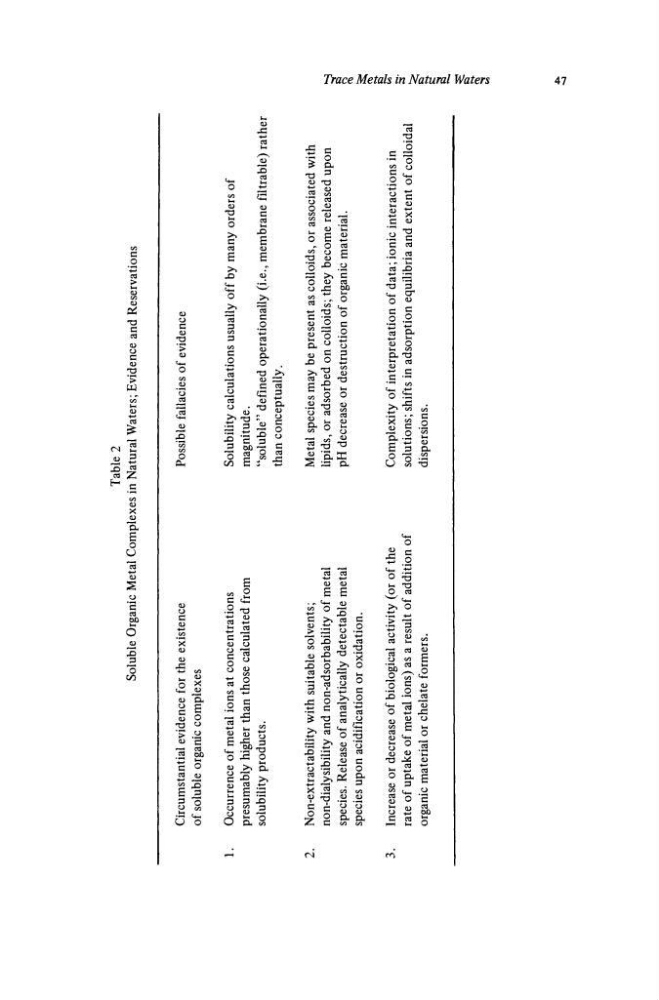
Table 2
Soluble Organic Metal Complexes in Natural Waters; Evidence and Reservations
Circumstantial evidence for the existence
of soluble organic complexes
Possible fallacies of evidence
Occurrence of metal ions at concentrations
presumably higher than those calculated from
solubility products.
Solubility calculations usually off by many orders of
magnitude.
"soluble" defined operationally (i.e., membrane filtrable) rather
than conceptually.
2.
Non-extractability with suitable solvents;
non-dialysibility and non-adsorbability of metal
species. Release of analytically detectable metal
species upon acidification or oxidation.
3.
Increase or decrease of biological activity (or of the
rate of uptake of metal ions) as a result of addition of
organic material or chelate formers.
Metal species may be present as colloids, or associated with
lipids, or adsorbed on colloids; they become released upon
pH decrease or destruction of organic material.
Complexity of interpretation of data; ionic interactions in
solutions; shifts in adsorption equilibria and extent of colloidal
dispersions.
"
Trace Metals in Natural Waters
Soluble Organic Metal Complexes in Natural Waters; Evidence and Reservations
Circumstantial evidence for the existence
of soluble organic complexes
Possible fallacies of evidence
Occurrence of metal ions at concentrations
presumably higher than those calculated from
solubility products.
Solubility calculations usually off by many orders of
magnitude.
"soluble" defined operationally (i.e., membrane filtrable) rather
than conceptually.
2.
Non-extractability with suitable solvents;
non-dialysibility and non-adsorbability of metal
species. Release of analytically detectable metal
species upon acidification or oxidation.
3.
Increase or decrease of biological activity (or of the
rate of uptake of metal ions) as a result of addition of
organic material or chelate formers.
Metal species may be present as colloids, or associated with
lipids, or adsorbed on colloids; they become released upon
pH decrease or destruction of organic material.
Complexity of interpretation of data; ionic interactions in
solutions; shifts in adsorption equilibria and extent of colloidal
dispersions.
"
Trace Metals in Natural Waters