

Discussion
593
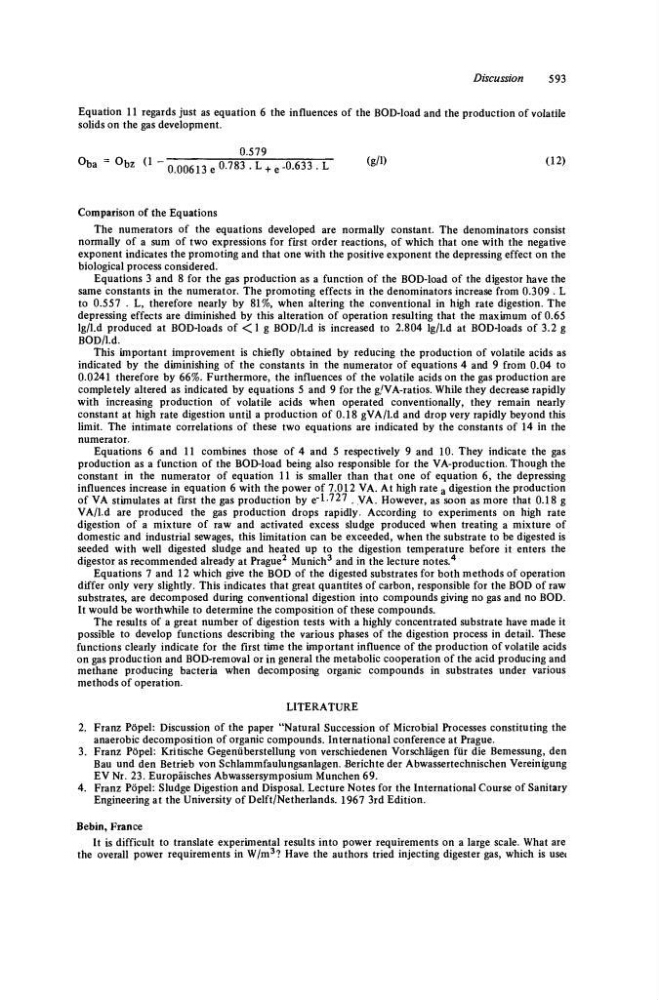
Equation 11 regards just as equation 6 the influences of the BOD-load and the production of volatile
solids on the gas development.
0.579
°ba = O b z (1 - a o o 6 1 3 e 0.783. L + e - 0 . 6 3 3 . L
<*/»
<
12
>
Comparison of the Equations
The numerators of the equations developed are normally constant. The denominators consist
normally of a sum of two expressions for first order reactions, of which that one with the negative
exponent indicates the promoting and that one with the positive exponent the depressing effect on the
biological process considered.
Equations 3 and 8 for the gas production as a function of the BOD-load of the digestor have the
same constants in the numerator. The promoting effects in the denominators increase from 0.309 . L
to 0.557 . L, therefore nearly by 81%, when altering the conventional in high rate digestion. The
depressing effects are diminished by this alteration of operation resulting that the maximum of 0.65
lg/l.d produced at BOD-loads of < 1 g BOD/l.d is increased to 2.804 lg/l.d at BOD-loads of 3.2 g
BOD/l.d.
This important improvement is chiefly obtained by reducing the production of volatile acids as
indicated by the diminishing of the constants in the numerator of equations 4 and 9 from 0.04 to
0.0241 therefore by 66%. Furthermore, the influences of the volatile acids on the gas production are
completely altered as indicated by equations 5 and 9 for the g/VA-ratios. While they decrease rapidly
with increasing production of volatile acids when operated conventionally, they remain nearly
constant at high rate digestion until a production of 0.18 gVA/l.d and drop very rapidly beyond this
limit. The intimate correlations of these two equations are indicated by the constants of 14 in the
numerator.
Equations 6 and 11 combines those of 4 and 5 respectively 9 and 10. They indicate the gas
production as a function of the BOD-load being also responsible for the VA-production. Though the
constant in the numerator of equation 11 is smaller than that one of equation 6, the depressing
influences increase in equation 6 with the power of 7.012 VA. At high rate a digestion the production
of VA stimulates at first the gas production by e'1-727 m y ^ . However, as soon as more that 0.18 g
VA/l.d are produced the gas production drops rapidly. According to experiments on high rate
digestion of a mixture of raw and activated excess sludge produced when treating a mixture of
domestic and industrial sewages, this limitation can be exceeded, when the substrate to be digested is
seeded with well digested sludge and heated up to the digestion temperature before it enters the
digestor as recommended already at Prague
2 Munich
3 and in the lecture notes.
4
Equations 7 and 12 which give the BOD of the digested substrates for both methods of operation
differ only very slightly. This indicates that great quantites of carbon, responsible for the BOD of raw
substrates, are decomposed during conventional digestion into compounds giving no gas and no BOD.
It would be worthwhile to determine the composition of these compounds.
The results of a great number of digestion tests with a highly concentrated substrate have made it
possible to develop functions describing the various phases of the digestion process in detail. These
functions clearly indicate for the first time the important influence of the production of volatile acids
on gas production and BOD-removal or in general the metabolic cooperation of the acid producing and
methane producing bacteria when decomposing organic compounds in substrates under various
methods of operation.
LITERATURE
2. Franz Popel: Discussion of the paper "Natural Succession of Microbial Processes constituting the
anaerobic decomposition of organic compounds. International conference at Prague.
3. Franz Pφpel: Kritische Gegenόberstellung von verschiedenen Vorschlδgen fόr die Bemessung, den
Bau und den Betrieb von Schlammfaulungsanlagen. Berichte der Abwassertechnischen Vereinigung
EV Nr. 23. Europδisches Abwassersymposium Mόnchen 69.
4. Franz PΦpel: Sludge Digestion and Disposal. Lecture Notes for the International Course of Sanitary
Engineering at the University of Delft/Netherlands. 1967 3rd Edition.
Bebin, France
It is difficult to translate experimental results into power requirements on a large scale. What are
the overall power requirements in W/m
3 ? Have the authors tried injecting digester gas, which is use<
593
Equation 11 regards just as equation 6 the influences of the BOD-load and the production of volatile
solids on the gas development.
0.579
°ba = O b z (1 - a o o 6 1 3 e 0.783. L + e - 0 . 6 3 3 . L
<*/»
<
12
>
Comparison of the Equations
The numerators of the equations developed are normally constant. The denominators consist
normally of a sum of two expressions for first order reactions, of which that one with the negative
exponent indicates the promoting and that one with the positive exponent the depressing effect on the
biological process considered.
Equations 3 and 8 for the gas production as a function of the BOD-load of the digestor have the
same constants in the numerator. The promoting effects in the denominators increase from 0.309 . L
to 0.557 . L, therefore nearly by 81%, when altering the conventional in high rate digestion. The
depressing effects are diminished by this alteration of operation resulting that the maximum of 0.65
lg/l.d produced at BOD-loads of < 1 g BOD/l.d is increased to 2.804 lg/l.d at BOD-loads of 3.2 g
BOD/l.d.
This important improvement is chiefly obtained by reducing the production of volatile acids as
indicated by the diminishing of the constants in the numerator of equations 4 and 9 from 0.04 to
0.0241 therefore by 66%. Furthermore, the influences of the volatile acids on the gas production are
completely altered as indicated by equations 5 and 9 for the g/VA-ratios. While they decrease rapidly
with increasing production of volatile acids when operated conventionally, they remain nearly
constant at high rate digestion until a production of 0.18 gVA/l.d and drop very rapidly beyond this
limit. The intimate correlations of these two equations are indicated by the constants of 14 in the
numerator.
Equations 6 and 11 combines those of 4 and 5 respectively 9 and 10. They indicate the gas
production as a function of the BOD-load being also responsible for the VA-production. Though the
constant in the numerator of equation 11 is smaller than that one of equation 6, the depressing
influences increase in equation 6 with the power of 7.012 VA. At high rate a digestion the production
of VA stimulates at first the gas production by e'1-727 m y ^ . However, as soon as more that 0.18 g
VA/l.d are produced the gas production drops rapidly. According to experiments on high rate
digestion of a mixture of raw and activated excess sludge produced when treating a mixture of
domestic and industrial sewages, this limitation can be exceeded, when the substrate to be digested is
seeded with well digested sludge and heated up to the digestion temperature before it enters the
digestor as recommended already at Prague
2 Munich
3 and in the lecture notes.
4
Equations 7 and 12 which give the BOD of the digested substrates for both methods of operation
differ only very slightly. This indicates that great quantites of carbon, responsible for the BOD of raw
substrates, are decomposed during conventional digestion into compounds giving no gas and no BOD.
It would be worthwhile to determine the composition of these compounds.
The results of a great number of digestion tests with a highly concentrated substrate have made it
possible to develop functions describing the various phases of the digestion process in detail. These
functions clearly indicate for the first time the important influence of the production of volatile acids
on gas production and BOD-removal or in general the metabolic cooperation of the acid producing and
methane producing bacteria when decomposing organic compounds in substrates under various
methods of operation.
LITERATURE
2. Franz Popel: Discussion of the paper "Natural Succession of Microbial Processes constituting the
anaerobic decomposition of organic compounds. International conference at Prague.
3. Franz Pφpel: Kritische Gegenόberstellung von verschiedenen Vorschlδgen fόr die Bemessung, den
Bau und den Betrieb von Schlammfaulungsanlagen. Berichte der Abwassertechnischen Vereinigung
EV Nr. 23. Europδisches Abwassersymposium Mόnchen 69.
4. Franz PΦpel: Sludge Digestion and Disposal. Lecture Notes for the International Course of Sanitary
Engineering at the University of Delft/Netherlands. 1967 3rd Edition.
Bebin, France
It is difficult to translate experimental results into power requirements on a large scale. What are
the overall power requirements in W/m
3 ? Have the authors tried injecting digester gas, which is use<