

Mesophilic Digestion of Beet Molasses Distillery Waste Water
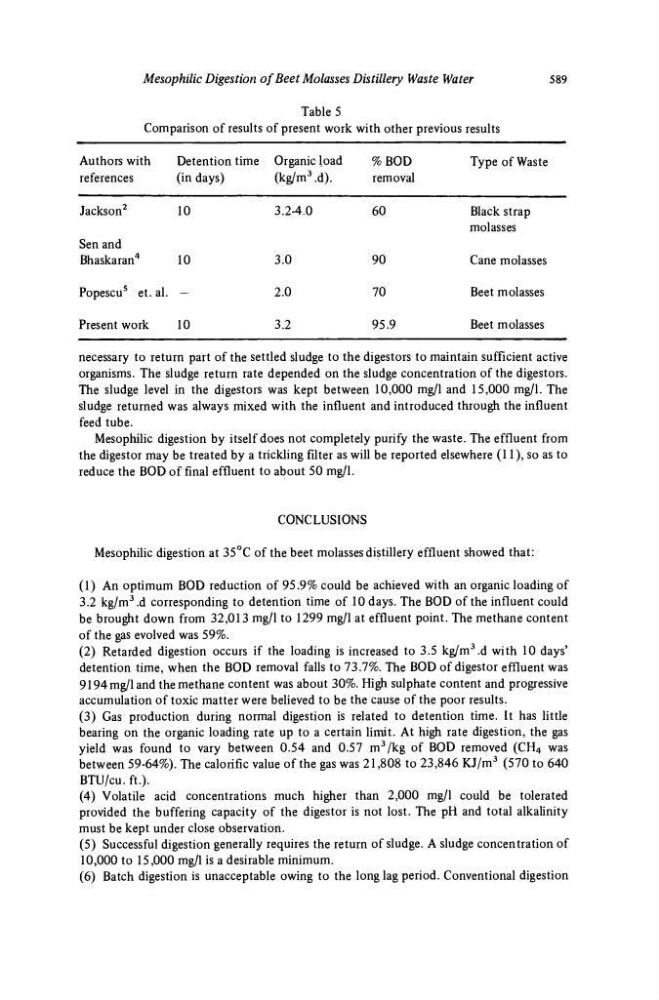
Table 5
Comparison of results of present work with other previous results
589
Authors with
references
Jackson
2
Sen and
Bhaskaran
4
Popescu
5 et. al.
Present work
Detention time
(in
10
10
-
10
days)
Organic
(kg/m
3 .
3.2-4.0
3.0
2.0
3.2
load
.d).
%BOD
removal
60
90
70
95.9
Type of Waste
Black strap
molasses
Cane molasses
Beet molasses
Beet molasses
necessary to return part of the settled sludge to the digestors to maintain sufficient active
organisms. The sludge return rate depended on the sludge concentration of the digestors.
The sludge level in the digestors was kept between 10,000 mg/1 and 15,000 mg/1. The
sludge returned was always mixed with the influent and introduced through the influent
feed tube.
Mesophilic digestion by itself does not completely purify the waste. The effluent from
the digestor may be treated by a trickling filter as will be reported elsewhere (11), so as to
reduce the BOD of final effluent to about 50 mg/1.
CONCLUSIONS
Mesophilic digestion at 35°C of the beet molasses distillery effluent showed that:
(1) An optimum BOD reduction of 95.9% could be achieved with an organic loading of
3.2 kg/m
3 .d corresponding to detention time of 10 days. The BOD of the influent could
be brought down from 32,013 mg/1 to 1299 mg/1 at effluent point. The methane content
of the gas evolved was 59%.
(2) Retarded digestion occurs if the loading is increased to 3.5 kg/m
3 .d with 10 days'
detention time, when the BOD removal falls to 73.7%. The BOD of digestor effluent was
9194 mg/1 and the methane content was about 30%. High sulphate content and progressive
accumulation of toxic matter were believed to be the cause of the poor results.
(3) Gas production during normal digestion is related to detention time. It has little
bearing on the organic loading rate up to a certain limit. At high rate digestion, the gas
yield was found to vary between 0.54 and 0.57 m
3 /kg of BOD removed (CH 4 was
between 59-64%). The calorific value of the gas was 21,808 to 23,846 KJ/m
3 (570 to 640
BTU/cu. ft.).
(4) Volatile acid concentrations much higher than 2,000 mg/1 could be tolerated
provided the buffering capacity of the digestor is not lost. The pH and total alkalinity
must be kept under close observation.
(5) Successful digestion generally requires the return of sludge. A sludge concentration of
10,000 to 15,000 mg/1 is a desirable minimum.
(6) Batch digestion is unacceptable owing to the long lag period. Conventional digestion
Table 5
Comparison of results of present work with other previous results
589
Authors with
references
Jackson
2
Sen and
Bhaskaran
4
Popescu
5 et. al.
Present work
Detention time
(in
10
10
-
10
days)
Organic
(kg/m
3 .
3.2-4.0
3.0
2.0
3.2
load
.d).
%BOD
removal
60
90
70
95.9
Type of Waste
Black strap
molasses
Cane molasses
Beet molasses
Beet molasses
necessary to return part of the settled sludge to the digestors to maintain sufficient active
organisms. The sludge return rate depended on the sludge concentration of the digestors.
The sludge level in the digestors was kept between 10,000 mg/1 and 15,000 mg/1. The
sludge returned was always mixed with the influent and introduced through the influent
feed tube.
Mesophilic digestion by itself does not completely purify the waste. The effluent from
the digestor may be treated by a trickling filter as will be reported elsewhere (11), so as to
reduce the BOD of final effluent to about 50 mg/1.
CONCLUSIONS
Mesophilic digestion at 35°C of the beet molasses distillery effluent showed that:
(1) An optimum BOD reduction of 95.9% could be achieved with an organic loading of
3.2 kg/m
3 .d corresponding to detention time of 10 days. The BOD of the influent could
be brought down from 32,013 mg/1 to 1299 mg/1 at effluent point. The methane content
of the gas evolved was 59%.
(2) Retarded digestion occurs if the loading is increased to 3.5 kg/m
3 .d with 10 days'
detention time, when the BOD removal falls to 73.7%. The BOD of digestor effluent was
9194 mg/1 and the methane content was about 30%. High sulphate content and progressive
accumulation of toxic matter were believed to be the cause of the poor results.
(3) Gas production during normal digestion is related to detention time. It has little
bearing on the organic loading rate up to a certain limit. At high rate digestion, the gas
yield was found to vary between 0.54 and 0.57 m
3 /kg of BOD removed (CH 4 was
between 59-64%). The calorific value of the gas was 21,808 to 23,846 KJ/m
3 (570 to 640
BTU/cu. ft.).
(4) Volatile acid concentrations much higher than 2,000 mg/1 could be tolerated
provided the buffering capacity of the digestor is not lost. The pH and total alkalinity
must be kept under close observation.
(5) Successful digestion generally requires the return of sludge. A sludge concentration of
10,000 to 15,000 mg/1 is a desirable minimum.
(6) Batch digestion is unacceptable owing to the long lag period. Conventional digestion