

588
A.K. Basu and Edmond Leclerc
35°C
Days
Fig. 8.
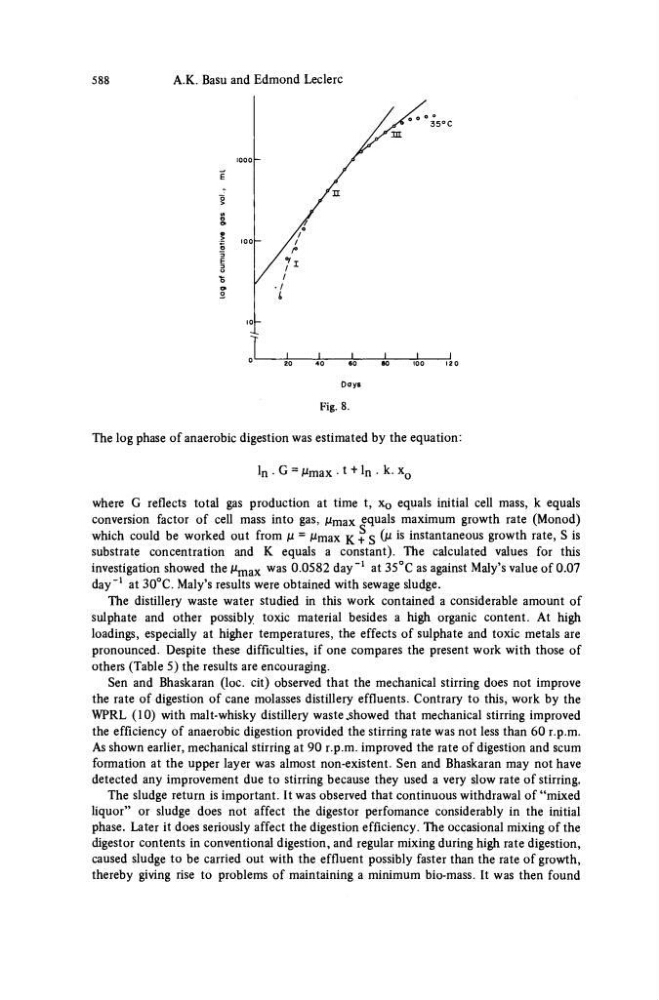
The log phase of anaerobic digestion was estimated by the equation:
In · G = Mmax . t + l n . k. x Q
where G reflects total gas production at time t, x 0 equals initial cell mass, k equals
conversion factor of cell mass into gas, Mmax equals maximum growth rate (Monod)
which could be worked out from μ = Mmax K + S ^
is i n s t a n t a n e o u s growth rate, S is
substrate concentration and K equals a constant). The calculated values for this
investigation showed the M max was 0.0582 day"
1 at 35°C as against Maly's value of 0.07
day"
1 at 30°C. Maly's results were obtained with sewage sludge.
The distillery waste water studied in this work contained a considerable amount of
sulphate and other possibly toxic material besides a high organic content. At high
loadings, especially at higher temperatures, the effects of sulphate and toxic metals are
pronounced. Despite these difficulties, if one compares the present work with those of
others (Table 5) the results are encouraging.
Sen and Bhaskaran (loc. cit) observed that the mechanical stirring does not improve
the rate of digestion of cane molasses distillery effluents. Contrary to this, work by the
WPRL (10) with malt-whisky distillery waste .showed that mechanical stirring improved
the efficiency of anaerobic digestion provided the stirring rate was not less than 60 r.p.m.
As shown earlier, mechanical stirring at 90 r.p.m. improved the rate of digestion and scum
formation at the upper layer was almost non-existent. Sen and Bhaskaran may not have
detected any improvement due to stirring because they used a very slow rate of stirring.
The sludge return is important. It was observed that continuous withdrawal of "mixed
liquor" or sludge does not affect the digestor perfomance considerably in the initial
phase. Later it does seriously affect the digestion efficiency. The occasional mixing of the
digestor contents in conventional digestion, and regular mixing during high rate digestion,
caused sludge to be carried out with the effluent possibly faster than the rate of growth,
thereby giving rise to problems of maintaining a minimum bio-mass. It was then found
A.K. Basu and Edmond Leclerc
35°C
Days
Fig. 8.
The log phase of anaerobic digestion was estimated by the equation:
In · G = Mmax . t + l n . k. x Q
where G reflects total gas production at time t, x 0 equals initial cell mass, k equals
conversion factor of cell mass into gas, Mmax equals maximum growth rate (Monod)
which could be worked out from μ = Mmax K + S ^
is i n s t a n t a n e o u s growth rate, S is
substrate concentration and K equals a constant). The calculated values for this
investigation showed the M max was 0.0582 day"
1 at 35°C as against Maly's value of 0.07
day"
1 at 30°C. Maly's results were obtained with sewage sludge.
The distillery waste water studied in this work contained a considerable amount of
sulphate and other possibly toxic material besides a high organic content. At high
loadings, especially at higher temperatures, the effects of sulphate and toxic metals are
pronounced. Despite these difficulties, if one compares the present work with those of
others (Table 5) the results are encouraging.
Sen and Bhaskaran (loc. cit) observed that the mechanical stirring does not improve
the rate of digestion of cane molasses distillery effluents. Contrary to this, work by the
WPRL (10) with malt-whisky distillery waste .showed that mechanical stirring improved
the efficiency of anaerobic digestion provided the stirring rate was not less than 60 r.p.m.
As shown earlier, mechanical stirring at 90 r.p.m. improved the rate of digestion and scum
formation at the upper layer was almost non-existent. Sen and Bhaskaran may not have
detected any improvement due to stirring because they used a very slow rate of stirring.
The sludge return is important. It was observed that continuous withdrawal of "mixed
liquor" or sludge does not affect the digestor perfomance considerably in the initial
phase. Later it does seriously affect the digestion efficiency. The occasional mixing of the
digestor contents in conventional digestion, and regular mixing during high rate digestion,
caused sludge to be carried out with the effluent possibly faster than the rate of growth,
thereby giving rise to problems of maintaining a minimum bio-mass. It was then found