

576
Membrane
Power
Labour
Materials
A. Golomb
D =
replacement
15 gal/day
$0.50
$0.10
Nil
$0.10
$0.70
D = 50 gal/day
$0.50
$0.10
$2.70
$0.10
$3.40
D = 500 gal/day
$0.50
$0.10
$1.35
$0.10
$2.05
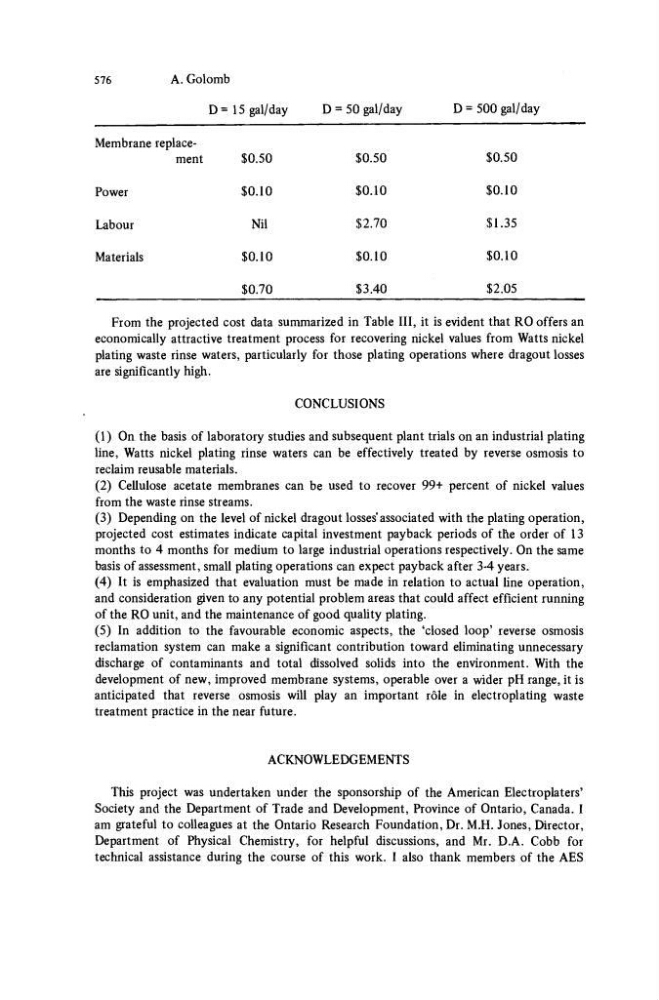
From the projected cost data summarized in Table III, it is evident that RO offers an
economically attractive treatment process for recovering nickel values from Watts nickel
plating waste rinse waters, particularly for those plating operations where dragout losses
are significantly high.
CONCLUSIONS
(1) On the basis of laboratory studies and subsequent plant trials on an industrial plating
line, Watts nickel plating rinse waters can be effectively treated by reverse osmosis to
reclaim reusable materials.
(2) Cellulose acetate membranes can be used to recover 99+ percent of nickel values
from the waste rinse streams.
(3) Depending on the level of nickel dragout losses'associated with the plating operation,
projected cost estimates indicate capital investment payback periods of the order of 13
months to 4 months for medium to large industrial operations respectively. On the same
basis of assessment, small plating operations can expect payback after 3-4 years.
(4) It is emphasized that evaluation must be made in relation to actual line operation,
and consideration given to any potential problem areas that could affect efficient running
of the RO unit, and the maintenance of good quality plating.
(5) In addition to the favourable economic aspects, the 'closed loop' reverse osmosis
reclamation system can make a significant contribution toward eliminating unnecessary
discharge of contaminants and total dissolved solids into the environment. With the
development of new, improved membrane systems, operable over a wider pH range, it is
anticipated that reverse osmosis will play an important role in electroplating waste
treatment practice in the near future.
ACKNOWLEDGEMENTS
This project was undertaken under the sponsorship of the American Electroplaters'
Society and the Department of Trade and Development, Province of Ontario, Canada. I
am grateful to colleagues at the Ontario Research Foundation, Dr. M.H. Jones, Director,
Department of Physical Chemistry, for helpful discussions, and Mr. D.A. Cobb for
technical assistance during the course of this work. I also thank members of the AES
Membrane
Power
Labour
Materials
A. Golomb
D =
replacement
15 gal/day
$0.50
$0.10
Nil
$0.10
$0.70
D = 50 gal/day
$0.50
$0.10
$2.70
$0.10
$3.40
D = 500 gal/day
$0.50
$0.10
$1.35
$0.10
$2.05
From the projected cost data summarized in Table III, it is evident that RO offers an
economically attractive treatment process for recovering nickel values from Watts nickel
plating waste rinse waters, particularly for those plating operations where dragout losses
are significantly high.
CONCLUSIONS
(1) On the basis of laboratory studies and subsequent plant trials on an industrial plating
line, Watts nickel plating rinse waters can be effectively treated by reverse osmosis to
reclaim reusable materials.
(2) Cellulose acetate membranes can be used to recover 99+ percent of nickel values
from the waste rinse streams.
(3) Depending on the level of nickel dragout losses'associated with the plating operation,
projected cost estimates indicate capital investment payback periods of the order of 13
months to 4 months for medium to large industrial operations respectively. On the same
basis of assessment, small plating operations can expect payback after 3-4 years.
(4) It is emphasized that evaluation must be made in relation to actual line operation,
and consideration given to any potential problem areas that could affect efficient running
of the RO unit, and the maintenance of good quality plating.
(5) In addition to the favourable economic aspects, the 'closed loop' reverse osmosis
reclamation system can make a significant contribution toward eliminating unnecessary
discharge of contaminants and total dissolved solids into the environment. With the
development of new, improved membrane systems, operable over a wider pH range, it is
anticipated that reverse osmosis will play an important role in electroplating waste
treatment practice in the near future.
ACKNOWLEDGEMENTS
This project was undertaken under the sponsorship of the American Electroplaters'
Society and the Department of Trade and Development, Province of Ontario, Canada. I
am grateful to colleagues at the Ontario Research Foundation, Dr. M.H. Jones, Director,
Department of Physical Chemistry, for helpful discussions, and Mr. D.A. Cobb for
technical assistance during the course of this work. I also thank members of the AES