

554
P. Farkas
Δ-^'^
1
(15)
After integrating with d Hi we obtain:
r H
r H
W h e r e
L·
_ ρ _ Ρ / τ τ Λ (
0
6 )
r H "
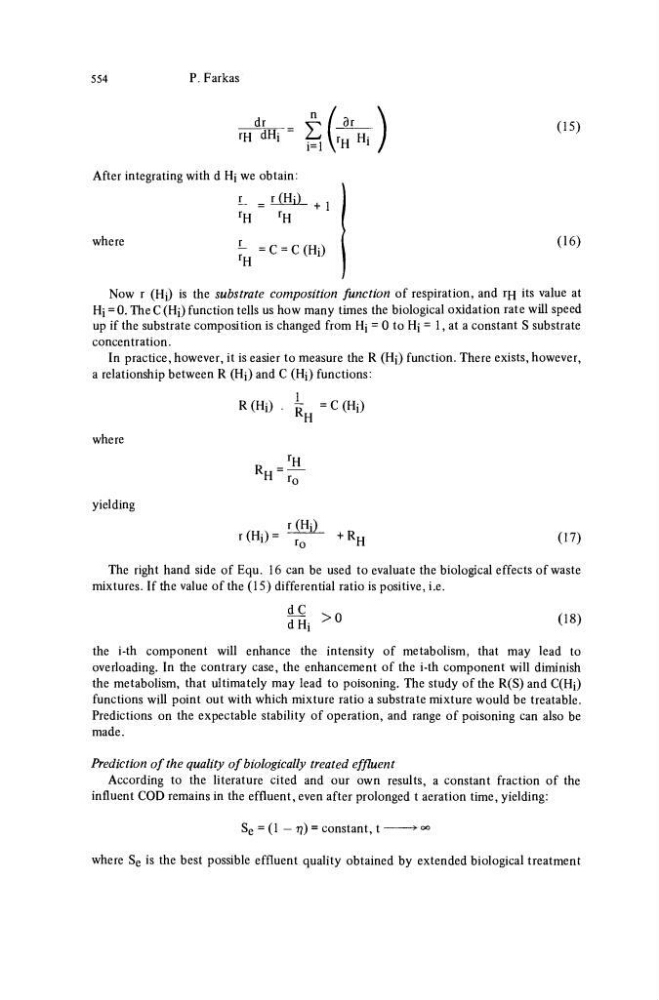
Now r (Hj) is the substrate composition function of respiration, and rn its value at
Hi = 0. The C (HO function tells us how many times the biological oxidation rate will speed
up if the substrate composition is changed from Hi = 0 to Hi = 1, at a constant S substrate
concentration.
In practice, however, it is easier to measure the R (Hi) function. There exists, however,
a relationship between R (Hj) and C (Hi) functions:
R(Hj) . £
=C(H0
K H
where
R u
r 0
yielding
r(Hj)
r(Hi)= —
+ R H
(17)
The right hand side of Equ. 16 can be used to evaluate the biological effects of waste
mixtures. If the value of the (15) differential ratio is positive, i.e.
dC
dHi >°
08)
the i-th component will enhance the intensity of metabolism, that may lead to
overloading. In the contrary case, the enhancement of the i-th component will diminish
the metabolism, that ultimately may lead to poisoning. The study of the R(S) and C(Hi)
functions will point out with which mixture ratio a substrate mixture would be treatable.
Predictions on the expectable stability of operation, and range of poisoning can also be
made.
Prediction of the quality of biologically treated effluent
According to the literature cited and our own results, a constant fraction of the
influent COD remains in the effluent, even after prolonged t aeration time, yielding:
S e = (1 — r?) = constant, t
°°
where S e is the best possible effluent quality obtained by extended biological treatment
P. Farkas
Δ-^'^
1
(15)
After integrating with d Hi we obtain:
r H
r H
W h e r e
L·
_ ρ _ Ρ / τ τ Λ (
0
6 )
r H "
Now r (Hj) is the substrate composition function of respiration, and rn its value at
Hi = 0. The C (HO function tells us how many times the biological oxidation rate will speed
up if the substrate composition is changed from Hi = 0 to Hi = 1, at a constant S substrate
concentration.
In practice, however, it is easier to measure the R (Hi) function. There exists, however,
a relationship between R (Hj) and C (Hi) functions:
R(Hj) . £
=C(H0
K H
where
R u
r 0
yielding
r(Hj)
r(Hi)= —
+ R H
(17)
The right hand side of Equ. 16 can be used to evaluate the biological effects of waste
mixtures. If the value of the (15) differential ratio is positive, i.e.
dC
dHi >°
08)
the i-th component will enhance the intensity of metabolism, that may lead to
overloading. In the contrary case, the enhancement of the i-th component will diminish
the metabolism, that ultimately may lead to poisoning. The study of the R(S) and C(Hi)
functions will point out with which mixture ratio a substrate mixture would be treatable.
Predictions on the expectable stability of operation, and range of poisoning can also be
made.
Prediction of the quality of biologically treated effluent
According to the literature cited and our own results, a constant fraction of the
influent COD remains in the effluent, even after prolonged t aeration time, yielding:
S e = (1 — r?) = constant, t
°°
where S e is the best possible effluent quality obtained by extended biological treatment