

The Operation of Plants Treating Mixed Industrial Wastes
553
S= ^
Si
(9)
i = l
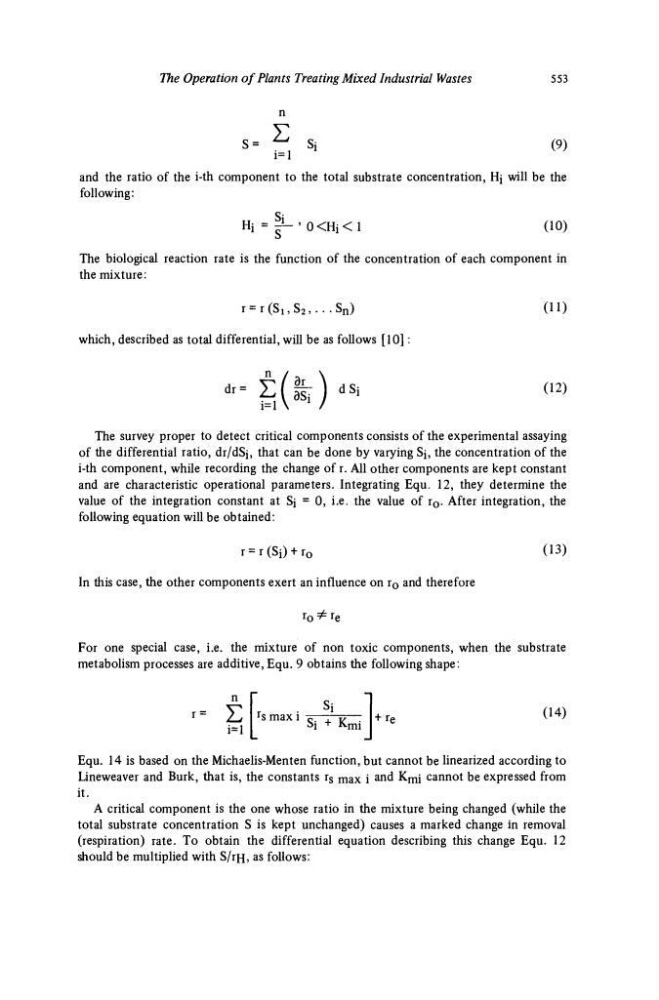
and the ratio of the i-th component to the total substrate concentration, Hj will be the
following:
Hi = | - ' 0
The biological reaction rate is the function of the concentration of each component in
the mixture:
r = r ( S 1 , S 2 , . . . S n )
(11)
which, described as total differential, will be as follows [10]:
sir M si
(i2)
*-£(*)
The survey proper to detect critical components consists of the experimental assaying
of the differential ratio, dr/dSi, that can be done by varying Si, the concentration of the
i-th component, while recording the change of r. All other components are kept constant
and are characteristic operational parameters. Integrating Equ. 12, they determine the
value of the integration constant at Si = 0, i.e. the value of r 0 . After integration, the
following equation will be obtained:
r = r(Si) + r 0
(13)
In this case, the other components exert an influence on r 0 and therefore
r 0 ^ r e
For one special case, i.e. the mixture of non toxic components, when the substrate
metabolism processes are additive, Equ. 9 obtains the following shape:
= Σ
i=l
•
S i
r s max l Sj + K : mi
+ r e
(14)
Equ. 14 is based on the Michaelis-Menten function, but cannot be linearized according to
Lineweaver and Burk, that is, the constants r s m a x i and K m i cannot be expressed from
it.
A critical component is the one whose ratio in the mixture being changed (while the
total substrate concentration S is kept unchanged) causes a marked change in removal
(respiration) rate. To obtain the differential equation describing this change Equ. 12
should be multiplied with S/rH, as follows:
553
S= ^
Si
(9)
i = l
and the ratio of the i-th component to the total substrate concentration, Hj will be the
following:
Hi = | - ' 0
(10)The biological reaction rate is the function of the concentration of each component in
the mixture:
r = r ( S 1 , S 2 , . . . S n )
(11)
which, described as total differential, will be as follows [10]:
sir M si
(i2)
*-£(*)
The survey proper to detect critical components consists of the experimental assaying
of the differential ratio, dr/dSi, that can be done by varying Si, the concentration of the
i-th component, while recording the change of r. All other components are kept constant
and are characteristic operational parameters. Integrating Equ. 12, they determine the
value of the integration constant at Si = 0, i.e. the value of r 0 . After integration, the
following equation will be obtained:
r = r(Si) + r 0
(13)
In this case, the other components exert an influence on r 0 and therefore
r 0 ^ r e
For one special case, i.e. the mixture of non toxic components, when the substrate
metabolism processes are additive, Equ. 9 obtains the following shape:
= Σ
i=l
•
S i
r s max l Sj + K : mi
+ r e
(14)
Equ. 14 is based on the Michaelis-Menten function, but cannot be linearized according to
Lineweaver and Burk, that is, the constants r s m a x i and K m i cannot be expressed from
it.
A critical component is the one whose ratio in the mixture being changed (while the
total substrate concentration S is kept unchanged) causes a marked change in removal
(respiration) rate. To obtain the differential equation describing this change Equ. 12
should be multiplied with S/rH, as follows: