

Trace Metals in Natural Waters
41
m
m
Me T = Me + Σ £Me m (OH) J + £
[M^L^J
1
1
0)
where all values of m, n and i have to be considered for the summation in (1).
Thus a small solubility product does not necessarily mean a small solubility; on the
contrary, if a compound has a very small solubility product, it must be expected that
molecular associates between the metal ion and the lattice ligand exist in true solution as
stable complexes. The true solubility under natural water conditions of the trace metals
Pb(II), Zn(II), Cu(II), Ni(II), Co(II), Hg(II), Ag(I), Fe(II), Fe(III), Mn(II), Al(III), is
typically not smaller than IGT
8 M. For example the solubility in natural water of such
"insoluble" substances like Ag 2 S (Kso = 1CT
50
), HgS (IGT
52 ), FeOOH (1CT
38
), CuO
(1CT
20
), Cu 2 (OH) 2 (C0 3 ) (1CT
60
) is determined by the presence of the following soluble
species: AgSH, Ag(SH) 2 - and Ag 2 S 3 H 2
2 -, Hg(SH) 2 , Fe(OH) 2
+ , CuC0 3 and Cu(C0 3 ) 2
2 -.
While information on the stability of hydroxo complexes has become available within
the past two decades, information on other inorganic complexes with ions of the
medium, HC0 3 ", C0 3
2 ", HS", S
2 " HP0 4
2 "etc. are scarce.Such complexes, however,often
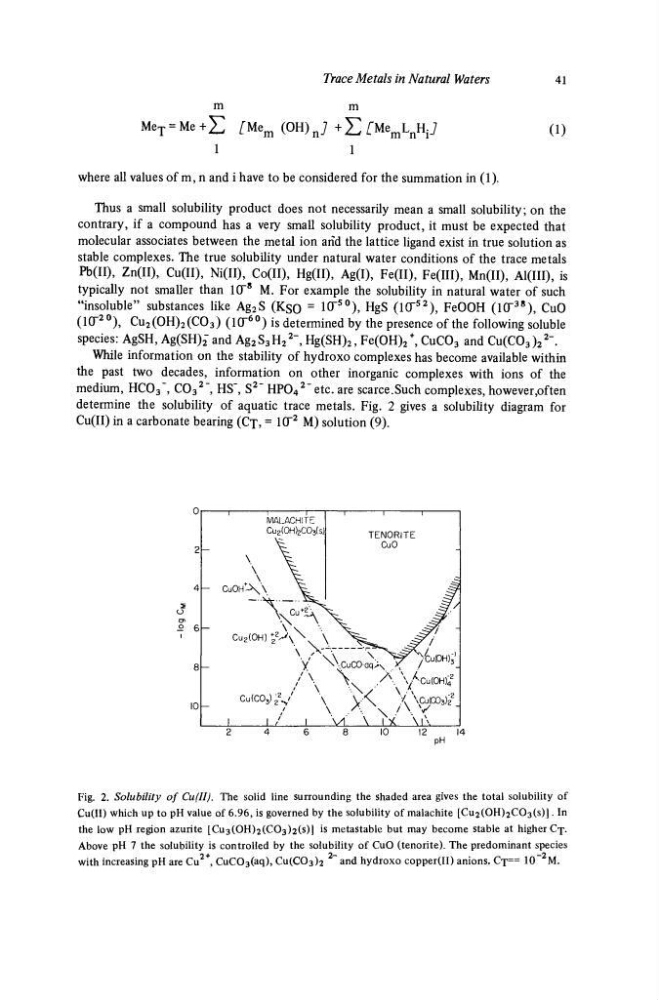
determine the solubility of aquatic trace metals. Fig. 2 gives a solubility diagram for
Cu(II) in a carbonate bearing (CT, = 1CT
2 M) solution (9).
.9 6
10
MALACHITE
Cu2(OH)2C03(s}|
Cu (COj)^/
\
\ \
X \Cu(C0 3 ) 2
\ A. \ Λ v
VI"
\
I JL \ l \
10
12
14
pH
Fig. 2. Solubility of Cu(II). The solid line surrounding the shaded area gives the total solubility of
Cu(II) which up to pH value of 6.96, is governed by the solubility of malachite [Cu 2 (OH) 2 C0 3 (s)]. In
the low pH region azurite [Cu 3 (OH) 2 (C03) 2 (s)] is metastable but may become stable at higher Cj.
Above pH 7 the solubility is controlled by the solubility of CuO (tenorite). The predominant species
with increasing pH are Cu
2+ , CuC0 3 (aq), Cu(C0 3 ) 2
2
~ and hydroxo copper(H) anions. Cx== 10~
2 M.
41
m
m
Me T = Me + Σ £Me m (OH) J + £
[M^L^J
1
1
0)
where all values of m, n and i have to be considered for the summation in (1).
Thus a small solubility product does not necessarily mean a small solubility; on the
contrary, if a compound has a very small solubility product, it must be expected that
molecular associates between the metal ion and the lattice ligand exist in true solution as
stable complexes. The true solubility under natural water conditions of the trace metals
Pb(II), Zn(II), Cu(II), Ni(II), Co(II), Hg(II), Ag(I), Fe(II), Fe(III), Mn(II), Al(III), is
typically not smaller than IGT
8 M. For example the solubility in natural water of such
"insoluble" substances like Ag 2 S (Kso = 1CT
50
), HgS (IGT
52 ), FeOOH (1CT
38
), CuO
(1CT
20
), Cu 2 (OH) 2 (C0 3 ) (1CT
60
) is determined by the presence of the following soluble
species: AgSH, Ag(SH) 2 - and Ag 2 S 3 H 2
2 -, Hg(SH) 2 , Fe(OH) 2
+ , CuC0 3 and Cu(C0 3 ) 2
2 -.
While information on the stability of hydroxo complexes has become available within
the past two decades, information on other inorganic complexes with ions of the
medium, HC0 3 ", C0 3
2 ", HS", S
2 " HP0 4
2 "etc. are scarce.Such complexes, however,often
determine the solubility of aquatic trace metals. Fig. 2 gives a solubility diagram for
Cu(II) in a carbonate bearing (CT, = 1CT
2 M) solution (9).
.9 6
10
MALACHITE
Cu2(OH)2C03(s}|
Cu (COj)^/
\
\ \
X \Cu(C0 3 ) 2
\ A. \ Λ v
VI"
\
I JL \ l \
10
12
14
pH
Fig. 2. Solubility of Cu(II). The solid line surrounding the shaded area gives the total solubility of
Cu(II) which up to pH value of 6.96, is governed by the solubility of malachite [Cu 2 (OH) 2 C0 3 (s)]. In
the low pH region azurite [Cu 3 (OH) 2 (C03) 2 (s)] is metastable but may become stable at higher Cj.
Above pH 7 the solubility is controlled by the solubility of CuO (tenorite). The predominant species
with increasing pH are Cu
2+ , CuC0 3 (aq), Cu(C0 3 ) 2
2
~ and hydroxo copper(H) anions. Cx== 10~
2 M.