

40
W. Stumm and H. Bilinski
THE APPARENT SUPERSATURATION
Free
metal
ions
Inorganic ion pairs;
inorganic complexes
Diameter range:
- · -
Examples:
Cu.aq
2+
Fe.aq
3+
Pb. aq
3+
Cu2(OH)f
+
Pb(C03)2~
CuC03
AgSH
CdCt
+
CoOH
+
Zn(OH)3
Ag2S3H|filtrable
Organic complexes,
chelates
10 A°
Me-SR
Me-OOCR
/ H 2 - C = 0
NH2
0
0 = C — C H 2
Metal species
complex bound
to high molecular
org. material
Metal species in
the form of highly
dispersed colloids
ΙΠΠ Δ°
Me—lipids
Me—humic—acid
polymers
"lakes"
"Gelbstoffe"
Me polysaccharides
FeOOH
Fe(OH)3
Mn( IV) oxides
Mn7Ol3 . 5H20
Na4Mn!^D27
Ag2s
Metal species
sorted on
colloids
Mex(OH)y,
MeC03, MeS
etc. on clays,
FeOOH or on
Mn(N) oxides
Precipitates
organic particles,
remains of
living organisms
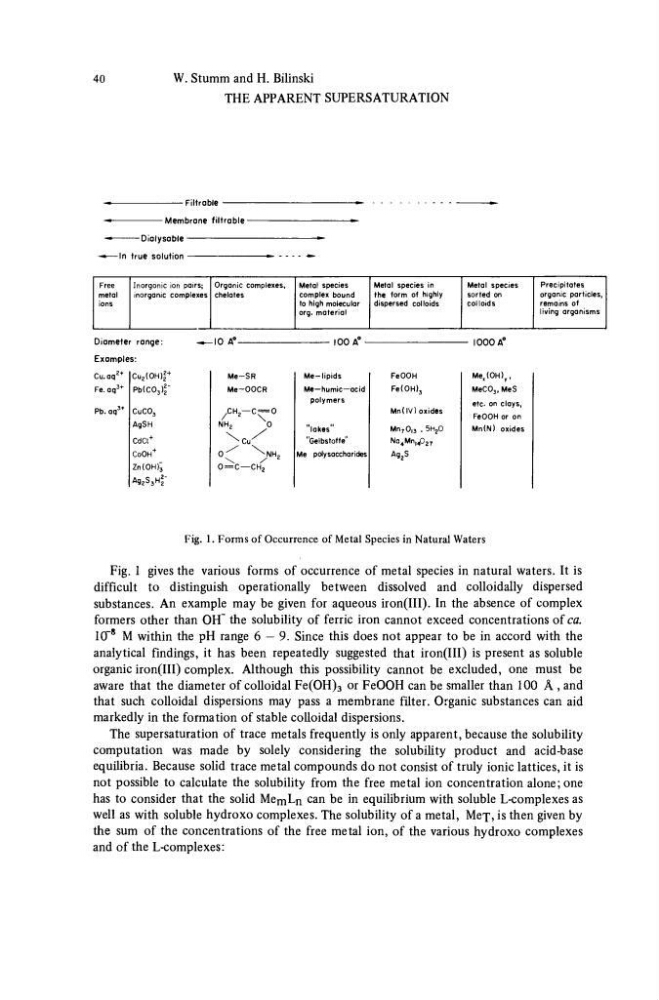
Fig. 1. Forms of Occurrence of Metal Species in Natural Waters
Fig. 1 gives the various forms of occurrence of metal species in natural waters. It is
difficult to distinguish operationally between dissolved and colloidally dispersed
substances. An example may be given for aqueous iron(III). In the absence of complex
formers other than OH" the solubility of ferric iron cannot exceed concentrations of ca.
1CT
8 M within the pH range 6 - 9 . Since this does not appear to be in accord with the
analytical findings, it has been repeatedly suggested that iron(III) is present as soluble
organic iron(III) complex. Although this possibility cannot be excluded, one must be
aware that the diameter of colloidal Fe(OH) 3 or FeOOH can be smaller than 100 Ä , and
that such colloidal dispersions may pass a membrane filter. Organic substances can aid
markedly in the formation of stable colloidal dispersions.
The supersaturation of trace metals frequently is only apparent, because the solubility
computation was made by solely considering the solubility product and acid-base
equilibria. Because solid trace metal compounds do not consist of truly ionic lattices, it is
not possible to calculate the solubility from the free metal ion concentration alone; one
has to consider that the solid Me m L n can be in equilibrium with soluble L-complexes as
well as with soluble hydroxo complexes. The solubility of a metal, Mej, is then given by
the sum of the concentrations of the free metal ion, of the various hydroxo complexes
and of the L-complexes:
W. Stumm and H. Bilinski
THE APPARENT SUPERSATURATION
Free
metal
ions
Inorganic ion pairs;
inorganic complexes
Diameter range:
- · -
Examples:
Cu.aq
2+
Fe.aq
3+
Pb. aq
3+
Cu2(OH)f
+
Pb(C03)2~
CuC03
AgSH
CdCt
+
CoOH
+
Zn(OH)3
Ag2S3H|filtrable
Organic complexes,
chelates
10 A°
Me-SR
Me-OOCR
/ H 2 - C = 0
NH2
0
0 = C — C H 2
Metal species
complex bound
to high molecular
org. material
Metal species in
the form of highly
dispersed colloids
ΙΠΠ Δ°
Me—lipids
Me—humic—acid
polymers
"lakes"
"Gelbstoffe"
Me polysaccharides
FeOOH
Fe(OH)3
Mn( IV) oxides
Mn7Ol3 . 5H20
Na4Mn!^D27
Ag2s
Metal species
sorted on
colloids
Mex(OH)y,
MeC03, MeS
etc. on clays,
FeOOH or on
Mn(N) oxides
Precipitates
organic particles,
remains of
living organisms
Fig. 1. Forms of Occurrence of Metal Species in Natural Waters
Fig. 1 gives the various forms of occurrence of metal species in natural waters. It is
difficult to distinguish operationally between dissolved and colloidally dispersed
substances. An example may be given for aqueous iron(III). In the absence of complex
formers other than OH" the solubility of ferric iron cannot exceed concentrations of ca.
1CT
8 M within the pH range 6 - 9 . Since this does not appear to be in accord with the
analytical findings, it has been repeatedly suggested that iron(III) is present as soluble
organic iron(III) complex. Although this possibility cannot be excluded, one must be
aware that the diameter of colloidal Fe(OH) 3 or FeOOH can be smaller than 100 Ä , and
that such colloidal dispersions may pass a membrane filter. Organic substances can aid
markedly in the formation of stable colloidal dispersions.
The supersaturation of trace metals frequently is only apparent, because the solubility
computation was made by solely considering the solubility product and acid-base
equilibria. Because solid trace metal compounds do not consist of truly ionic lattices, it is
not possible to calculate the solubility from the free metal ion concentration alone; one
has to consider that the solid Me m L n can be in equilibrium with soluble L-complexes as
well as with soluble hydroxo complexes. The solubility of a metal, Mej, is then given by
the sum of the concentrations of the free metal ion, of the various hydroxo complexes
and of the L-complexes: