

Photosynthetic Yields and Byproduct Recovery
5 25
BOD concentration would be expected. It was of interest to study the effects of such
variations on sewage treatment and algal production. A feeding apparatus was devised to
permit control of influent flow and BOD to four test ponds. The flow to three of the
ponds was varied between a minimum of 0.5 mean daily flow at 3 am to a maximum of
1.45 mean daily flow at noon. Influent BOD concentration reached a minimum value of
0.45 mean daily BOD at 5 am and peaked at 1.85 mean daily BOD at noon. Various
effluent removal regimes were also considered: pond A, removal during the night between
8 pm and 8 am; pond B, removal during the day between 8 am and 8 pm; and pond C,
continuous removal by overflow weir. These were compared to the fourth pond D under
constant influent flow and BOD and effluent removal by overflow weir (Lin, 1971).
Average daily loading, depth and detention period for all ponds were 224 kg/ha-d, 45 cm.
and 1.5 days respectively. The ponds were not mixed. Daily pond analyses were averaged
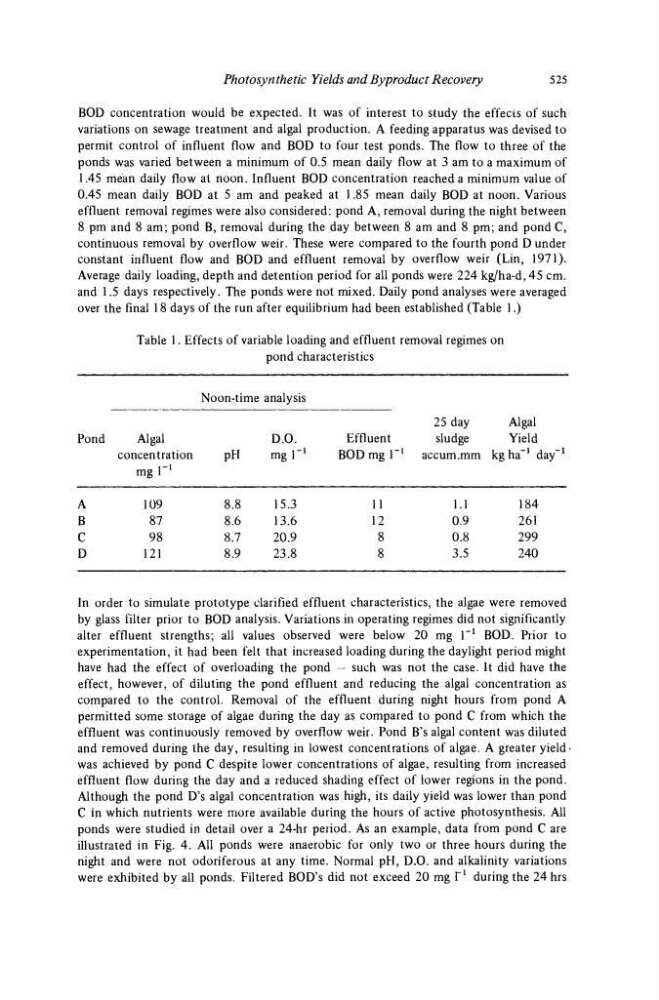
over the final 18 days of the run after equilibrium had been established (Table 1.)
Table 1. Effects of variable loading and effluent removal regimes on
pond characteristics
Pond
A
B
C
D
Algal
concentration
mg Γ
1
109
87
98
121
Noon-time
pH
8.8
8.6
8.7
8.9
analysis
D.O.
mg Γ
1
15.3
13.6
20.9
23.8
Effluent
BODmgF
1
11
12
8
8
25 day
sludge
accum.mm
1.1
0.9
0.8
3.5
Algal
Yield
kg ha"
1 day"
1
184
261
299
240
In order to simulate prototype clarified effluent characteristics, the algae were removed
by glass filter prior to BOD analysis. Variations in operating regimes did not significantly
alter effluent strengths; all values observed were below 20 mg Γ
1 BOD. Prior to
experimentation, it had been felt that increased loading during the daylight period might
have had the effect of overloading the pond - such was not the case. It did have the
effect, however, of diluting the pond effluent and reducing the algal concentration as
compared to the control. Removal of the effluent during night hours from pond A
permitted some storage of algae during the day as compared to pond C from which the
effluent was continuously removed by overflow weir. Pond B's algal content was diluted
and removed during the day, resulting in lowest concentrations of algae. A greater yieldwas achieved by pond C despite lower concentrations of algae, resulting from increased
effluent flow during the day and a reduced shading effect of lower regions in the pond.
Although the pond D's algal concentration was high, its daily yield was lower than pond
C in which nutrients were more available during the hours of active photosynthesis. All
ponds were studied in detail over a 24-hr period. As an example, data from pond C are
illustrated in Fig. 4. All ponds were anaerobic for only two or three hours during the
night and were not odoriferous at any time. Normal pH, D.O. and alkalinity variations
were exhibited by all ponds. Filtered BOD's did not exceed 20 mg Γ
1 during the 24hrs
5 25
BOD concentration would be expected. It was of interest to study the effects of such
variations on sewage treatment and algal production. A feeding apparatus was devised to
permit control of influent flow and BOD to four test ponds. The flow to three of the
ponds was varied between a minimum of 0.5 mean daily flow at 3 am to a maximum of
1.45 mean daily flow at noon. Influent BOD concentration reached a minimum value of
0.45 mean daily BOD at 5 am and peaked at 1.85 mean daily BOD at noon. Various
effluent removal regimes were also considered: pond A, removal during the night between
8 pm and 8 am; pond B, removal during the day between 8 am and 8 pm; and pond C,
continuous removal by overflow weir. These were compared to the fourth pond D under
constant influent flow and BOD and effluent removal by overflow weir (Lin, 1971).
Average daily loading, depth and detention period for all ponds were 224 kg/ha-d, 45 cm.
and 1.5 days respectively. The ponds were not mixed. Daily pond analyses were averaged
over the final 18 days of the run after equilibrium had been established (Table 1.)
Table 1. Effects of variable loading and effluent removal regimes on
pond characteristics
Pond
A
B
C
D
Algal
concentration
mg Γ
1
109
87
98
121
Noon-time
pH
8.8
8.6
8.7
8.9
analysis
D.O.
mg Γ
1
15.3
13.6
20.9
23.8
Effluent
BODmgF
1
11
12
8
8
25 day
sludge
accum.mm
1.1
0.9
0.8
3.5
Algal
Yield
kg ha"
1 day"
1
184
261
299
240
In order to simulate prototype clarified effluent characteristics, the algae were removed
by glass filter prior to BOD analysis. Variations in operating regimes did not significantly
alter effluent strengths; all values observed were below 20 mg Γ
1 BOD. Prior to
experimentation, it had been felt that increased loading during the daylight period might
have had the effect of overloading the pond - such was not the case. It did have the
effect, however, of diluting the pond effluent and reducing the algal concentration as
compared to the control. Removal of the effluent during night hours from pond A
permitted some storage of algae during the day as compared to pond C from which the
effluent was continuously removed by overflow weir. Pond B's algal content was diluted
and removed during the day, resulting in lowest concentrations of algae. A greater yieldwas achieved by pond C despite lower concentrations of algae, resulting from increased
effluent flow during the day and a reduced shading effect of lower regions in the pond.
Although the pond D's algal concentration was high, its daily yield was lower than pond
C in which nutrients were more available during the hours of active photosynthesis. All
ponds were studied in detail over a 24-hr period. As an example, data from pond C are
illustrated in Fig. 4. All ponds were anaerobic for only two or three hours during the
night and were not odoriferous at any time. Normal pH, D.O. and alkalinity variations
were exhibited by all ponds. Filtered BOD's did not exceed 20 mg Γ
1 during the 24hrs