

524
M.G. McGarry, CD. Lin and J.L. Merto
percentage of total incident radiation to reach each surface. The materials used were wire
screening, translucent plastic and white and black cloth. These permitted 83%, 58%, 43%
and 8% of total incident light to reach the pond water surfaces respectively. Spectral
distribution of light, which affects algal synthesis, was not constant over the light levels
studied. The shading technique did, however, reveal overall in vivo effects of light
limitation (Fig. 2). Light strongly influenced the process. Algal concentration increased in
a near linear fashion with radiation available. Associated increases in pH and dissolved
oxygen concentrations also illustrated the sunlight's overriding effects. Decreases in
incident light and algal concentration resulted in reduced pond water temperatures which
had a bearing on benthal accumulation. Aerobiosis within the pond tended to decrease
deposit thicknesses. Sludge taken from the bottom of the uncovered pond contained
3.5% solids and was light brown in colour.
Prediction of algal yield
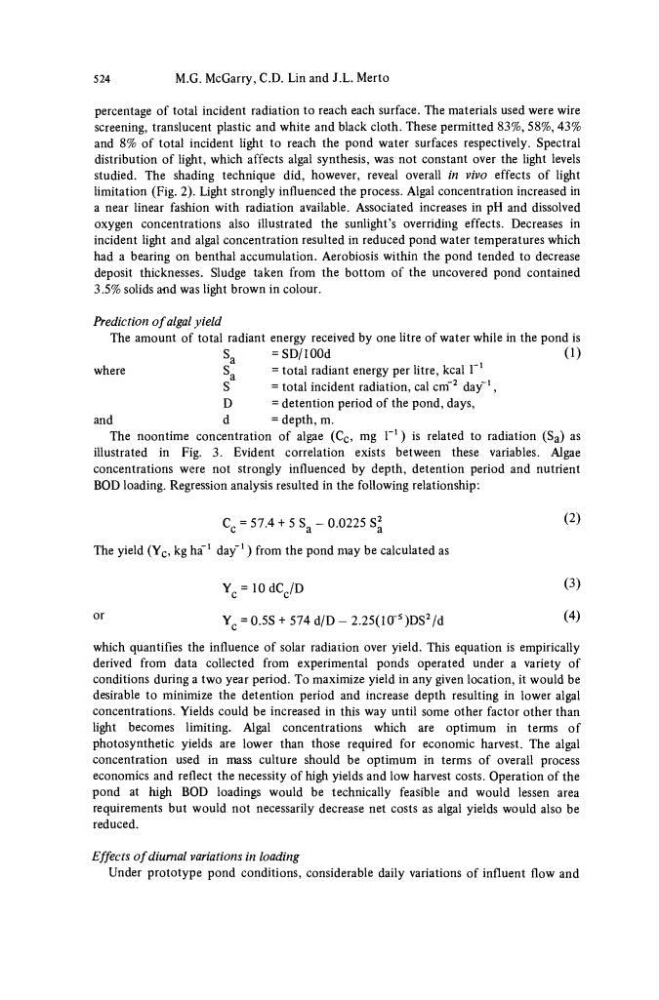
The amount of total radiant energy received by one litre of water while in the pond is
S,
=SD/100d
(1)
- 1
where
S
= total radiant energy per litre, kcal 1
S
= total incident radiation, cal cm"
2 day
-1 ,
D
= detention period of the pond, days,
and
d
= depth, m.
The noontime concentration of algae (C c , mg Γ
1 ) is related to radiation (S a ) as
illustrated in Fig. 3. Evident correlation exists between these variables. Algae
concentrations were not strongly influenced by depth, detention period and nutrient
BOD loading. Regression analysis resulted in the following relationship:
CL = 57.4 + 5 S, - 0.0225 S
2
(
2 )
L
d
a
The yield (Y c , kg ha"
1 day"
1 ) from the pond may be calculated as
Y c =10dC c /D
(
3
>
o r
Y c = 0.5S + 574 d/D - 2.25(1 F
5 )DS
2 /d
<
4
)
which quantifies the influence of solar radiation over yield. This equation is empirically
derived from data collected from experimental ponds operated under a variety of
conditions during a two year period. To maximize yield in any given location, it would be
desirable to minimize the detention period and increase depth resulting in lower algal
concentrations. Yields could be increased in this way until some other factor other than
light becomes limiting. Algal concentrations which are optimum in terms of
photosynthetic yields are lower than those required for economic harvest. The algal
concentration used in mass culture should be optimum in terms of overall process
economics and reflect the necessity of high yields and low harvest costs. Operation of the
pond at high BOD loadings would be technically feasible and would lessen area
requirements but would not necessarily decrease net costs as algal yields would also be
reduced.
Effects of diurnal variations in loading
Under prototype pond conditions, considerable daily variations of influent flow and
M.G. McGarry, CD. Lin and J.L. Merto
percentage of total incident radiation to reach each surface. The materials used were wire
screening, translucent plastic and white and black cloth. These permitted 83%, 58%, 43%
and 8% of total incident light to reach the pond water surfaces respectively. Spectral
distribution of light, which affects algal synthesis, was not constant over the light levels
studied. The shading technique did, however, reveal overall in vivo effects of light
limitation (Fig. 2). Light strongly influenced the process. Algal concentration increased in
a near linear fashion with radiation available. Associated increases in pH and dissolved
oxygen concentrations also illustrated the sunlight's overriding effects. Decreases in
incident light and algal concentration resulted in reduced pond water temperatures which
had a bearing on benthal accumulation. Aerobiosis within the pond tended to decrease
deposit thicknesses. Sludge taken from the bottom of the uncovered pond contained
3.5% solids and was light brown in colour.
Prediction of algal yield
The amount of total radiant energy received by one litre of water while in the pond is
S,
=SD/100d
(1)
- 1
where
S
= total radiant energy per litre, kcal 1
S
= total incident radiation, cal cm"
2 day
-1 ,
D
= detention period of the pond, days,
and
d
= depth, m.
The noontime concentration of algae (C c , mg Γ
1 ) is related to radiation (S a ) as
illustrated in Fig. 3. Evident correlation exists between these variables. Algae
concentrations were not strongly influenced by depth, detention period and nutrient
BOD loading. Regression analysis resulted in the following relationship:
CL = 57.4 + 5 S, - 0.0225 S
2
(
2 )
L
d
a
The yield (Y c , kg ha"
1 day"
1 ) from the pond may be calculated as
Y c =10dC c /D
(
3
>
o r
Y c = 0.5S + 574 d/D - 2.25(1 F
5 )DS
2 /d
<
4
)
which quantifies the influence of solar radiation over yield. This equation is empirically
derived from data collected from experimental ponds operated under a variety of
conditions during a two year period. To maximize yield in any given location, it would be
desirable to minimize the detention period and increase depth resulting in lower algal
concentrations. Yields could be increased in this way until some other factor other than
light becomes limiting. Algal concentrations which are optimum in terms of
photosynthetic yields are lower than those required for economic harvest. The algal
concentration used in mass culture should be optimum in terms of overall process
economics and reflect the necessity of high yields and low harvest costs. Operation of the
pond at high BOD loadings would be technically feasible and would lessen area
requirements but would not necessarily decrease net costs as algal yields would also be
reduced.
Effects of diurnal variations in loading
Under prototype pond conditions, considerable daily variations of influent flow and