

Nitrogen Removal through Ammonia Release from Holding Ponds
513
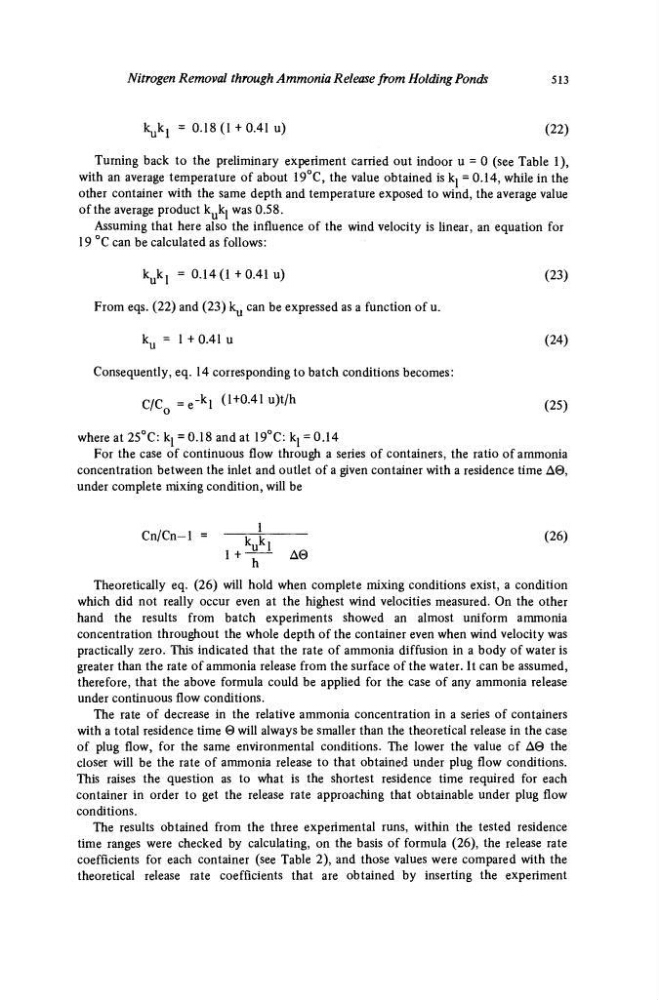
k u k 1 = 0.18(1 + 0.41 u)
(22)
Turning back to the preliminary experiment carried out indoor u = 0 (see Table 1),
with an average temperature of about 19°C, the value obtained is ki = 0.14, while in the
other container with the same depth and temperature exposed to wind, the average value
of the average product k kj was 0.58.
Assuming that here also the influence of the wind velocity is linear, an equation for
19 °C can be calculated as follows:
k u kj = 0.14(1+0.41 u)
(23)
From eqs. (22) and (23) k u can be expressed as a function of u.
k u = 1 + 0.41 u
(24)
Consequently, eq. 14 corresponding to batch conditions becomes:
C / C 0 = e "
k l (1+0.41 u)t/h
( 2 5 )
where at 25°C: k, = 0.18 and at 19°C: k, = 0.14
For the case of continuous flow through a series of containers, the ratio of ammonia
concentration between the inlet and outlet of a given container with a residence time ΔΘ,
under complete mixing condition, will be
Cn/Cn-1 =
τΛ
(26)
u 1
1 + - Ϊ Γ
1
ΔΘ
h
Theoretically eq. (26) will hold when complete mixing conditions exist, a condition
which did not really occur even at the highest wind velocities measured. On the other
hand the results from batch experiments showed an almost uniform ammonia
concentration throughout the whole depth of the container even when wind velocity was
practically zero. This indicated that the rate of ammonia diffusion in a body of water is
greater than the rate of ammonia release from the surface of the water. It can be assumed,
therefore, that the above formula could be applied for the case of any ammonia release
under continuous flow conditions.
The rate of decrease in the relative ammonia concentration in a series of containers
with a total residence time Θ will always be smaller than the theoretical release in the case
of plug flow, for the same environmental conditions. The lower the value of ΔΘ the
closer will be the rate of ammonia release to that obtained under plug flow conditions.
This raises the question as to what is the shortest residence time required for each
container in order to get the release rate approaching that obtainable under plug flow
conditions.
The results obtained from the three experimental runs, within the tested residence
time ranges were checked by calculating, on the basis of formula (26), the release rate
coefficients for each container (see Table 2), and those values were compared with the
theoretical release rate coefficients that are obtained by inserting the experiment
513
k u k 1 = 0.18(1 + 0.41 u)
(22)
Turning back to the preliminary experiment carried out indoor u = 0 (see Table 1),
with an average temperature of about 19°C, the value obtained is ki = 0.14, while in the
other container with the same depth and temperature exposed to wind, the average value
of the average product k kj was 0.58.
Assuming that here also the influence of the wind velocity is linear, an equation for
19 °C can be calculated as follows:
k u kj = 0.14(1+0.41 u)
(23)
From eqs. (22) and (23) k u can be expressed as a function of u.
k u = 1 + 0.41 u
(24)
Consequently, eq. 14 corresponding to batch conditions becomes:
C / C 0 = e "
k l (1+0.41 u)t/h
( 2 5 )
where at 25°C: k, = 0.18 and at 19°C: k, = 0.14
For the case of continuous flow through a series of containers, the ratio of ammonia
concentration between the inlet and outlet of a given container with a residence time ΔΘ,
under complete mixing condition, will be
Cn/Cn-1 =
τΛ
(26)
u 1
1 + - Ϊ Γ
1
ΔΘ
h
Theoretically eq. (26) will hold when complete mixing conditions exist, a condition
which did not really occur even at the highest wind velocities measured. On the other
hand the results from batch experiments showed an almost uniform ammonia
concentration throughout the whole depth of the container even when wind velocity was
practically zero. This indicated that the rate of ammonia diffusion in a body of water is
greater than the rate of ammonia release from the surface of the water. It can be assumed,
therefore, that the above formula could be applied for the case of any ammonia release
under continuous flow conditions.
The rate of decrease in the relative ammonia concentration in a series of containers
with a total residence time Θ will always be smaller than the theoretical release in the case
of plug flow, for the same environmental conditions. The lower the value of ΔΘ the
closer will be the rate of ammonia release to that obtained under plug flow conditions.
This raises the question as to what is the shortest residence time required for each
container in order to get the release rate approaching that obtainable under plug flow
conditions.
The results obtained from the three experimental runs, within the tested residence
time ranges were checked by calculating, on the basis of formula (26), the release rate
coefficients for each container (see Table 2), and those values were compared with the
theoretical release rate coefficients that are obtained by inserting the experiment