

36
P.A. KRENKEL and V. NOVOTNY
This computation applies if deoxygenation is negligible as was the case in the conditions described in
the authors' paper. In this equation,
K = reaction rate coefficient X = distance U = velocity of flow D = (C s - C) = oxygen deficit
For a completely mixed tank, the deficit ratio would be:
D (in tank) =
1
D (influent)
1 + Kt
where t = the detention time in the tank
The special case of weir aeration was described by Southgate (1961) and Gameson (1957) as follows:
D (under) = _ 1
D (above)
1 + aH
where: a' = a constant depending on the characteristics of the weir and the water quality H = height of
the weir
A similar equation can be applied to oxygen supplementation by power station turbines.
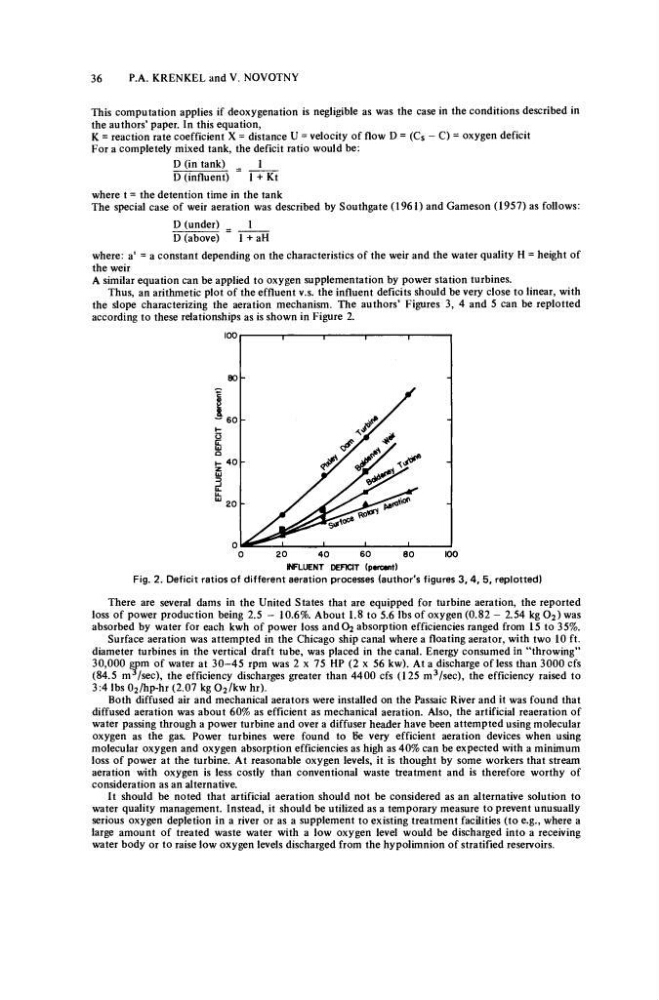
Thus, an arithmetic plot of the effluent v.s. the influent deficits should be very close to linear, with
the slope characterizing the aeration mechanism. The authors' Figures 3, 4 and 5 can be replotted
according to these relationships as is shown in Figure 2.
0
2 0
4 0
6 0
8 0
100
INFLUENT DEFICIT (percent)
Fig. 2. Deficit ratios of different aeration processes (author's figures 3, 4, 5, replotted)
There are several dams in the United States that are equipped for turbine aeration, the reported
loss of power production being 2.5 - 10.6%. About 1.8 to 5.6 lbs of oxygen (0.82 - 2.54 kg O2) was
absorbed by water for each kwh of power loss andOj absorption efficiencies ranged from 15 to 35%.
Surface aeration was attempted in the Chicago ship canal where a floating aerator, with two 10 ft.
diameter turbines in the vertical draft tube, was placed in the canal. Energy consumed in "throwing"
30,000 gpm of water at 30-45 rpm was 2 x 75 HP (2 x 56 kw). At a discharge of less than 3000 cfs
(84.5 m
3 /sec), the efficiency discharges greater than 4400 cfs (125 m
3 /sec), the efficiency raised to
3:4 lbs 0 2 /hp-hr (2.07 kg 0 2 /kw hr).
Both diffused air and mechanical aerators were installed on the Passaic River and it was found that
diffused aeration was about 60% as efficient as mechanical aeration. Also, the artificial reaeration of
water passing through a power turbine and over a diffuser header have been attempted using molecular
oxygen as the gas. Power turbines were found to V3e very efficient aeration devices when using
molecular oxygen and oxygen absorption efficiencies as high as 40% can be expected with a minimum
loss of power at the turbine. At reasonable oxygen levels, it is thought by some workers that stream
aeration with oxygen is less costly than conventional waste treatment and is therefore worthy of
consideration as an alternative.
It should be noted that artificial aeration should not be considered as an alternative solution to
water quality management. Instead, it should be utilized as a temporary measure to prevent unusually
serious oxygen depletion in a river or as a supplement to existing treatment facilities (to e.g., where a
large amount of treated waste water with a low oxygen level would be discharged into a receiving
water body or to raise low oxygen levels discharged from the hypolimnion of stratified reservoirs.
P.A. KRENKEL and V. NOVOTNY
This computation applies if deoxygenation is negligible as was the case in the conditions described in
the authors' paper. In this equation,
K = reaction rate coefficient X = distance U = velocity of flow D = (C s - C) = oxygen deficit
For a completely mixed tank, the deficit ratio would be:
D (in tank) =
1
D (influent)
1 + Kt
where t = the detention time in the tank
The special case of weir aeration was described by Southgate (1961) and Gameson (1957) as follows:
D (under) = _ 1
D (above)
1 + aH
where: a' = a constant depending on the characteristics of the weir and the water quality H = height of
the weir
A similar equation can be applied to oxygen supplementation by power station turbines.
Thus, an arithmetic plot of the effluent v.s. the influent deficits should be very close to linear, with
the slope characterizing the aeration mechanism. The authors' Figures 3, 4 and 5 can be replotted
according to these relationships as is shown in Figure 2.
0
2 0
4 0
6 0
8 0
100
INFLUENT DEFICIT (percent)
Fig. 2. Deficit ratios of different aeration processes (author's figures 3, 4, 5, replotted)
There are several dams in the United States that are equipped for turbine aeration, the reported
loss of power production being 2.5 - 10.6%. About 1.8 to 5.6 lbs of oxygen (0.82 - 2.54 kg O2) was
absorbed by water for each kwh of power loss andOj absorption efficiencies ranged from 15 to 35%.
Surface aeration was attempted in the Chicago ship canal where a floating aerator, with two 10 ft.
diameter turbines in the vertical draft tube, was placed in the canal. Energy consumed in "throwing"
30,000 gpm of water at 30-45 rpm was 2 x 75 HP (2 x 56 kw). At a discharge of less than 3000 cfs
(84.5 m
3 /sec), the efficiency discharges greater than 4400 cfs (125 m
3 /sec), the efficiency raised to
3:4 lbs 0 2 /hp-hr (2.07 kg 0 2 /kw hr).
Both diffused air and mechanical aerators were installed on the Passaic River and it was found that
diffused aeration was about 60% as efficient as mechanical aeration. Also, the artificial reaeration of
water passing through a power turbine and over a diffuser header have been attempted using molecular
oxygen as the gas. Power turbines were found to V3e very efficient aeration devices when using
molecular oxygen and oxygen absorption efficiencies as high as 40% can be expected with a minimum
loss of power at the turbine. At reasonable oxygen levels, it is thought by some workers that stream
aeration with oxygen is less costly than conventional waste treatment and is therefore worthy of
consideration as an alternative.
It should be noted that artificial aeration should not be considered as an alternative solution to
water quality management. Instead, it should be utilized as a temporary measure to prevent unusually
serious oxygen depletion in a river or as a supplement to existing treatment facilities (to e.g., where a
large amount of treated waste water with a low oxygen level would be discharged into a receiving
water body or to raise low oxygen levels discharged from the hypolimnion of stratified reservoirs.