

Discussion by Peter A. Krenkel* and Vladimir Novotnyf
Basically, two mechanisms for the replenishment of the oxygen supply in a water environment can
be differentiated. One by diffusion of oxygen from air bubbles introduced into the water by air
diffusers and/or from the water surface, and the other mechanism being a dispersion of air saturated
particles in the water by mechanical action. Natural reaeration in rivers, diffused aeration and surface
aeration can be considered as being in the first group, while the second group may include turbine
aeration and weir aeration. It can be assumed that the diffusion processes are temperature dependent
while the effect of temperature on turbulent dispersion is minimal.
A general description of the relationships describing the first aeration category may be written as:
R = A x (C s - C) x 0
T -
2 0 where R = oxygen supply rate
A = aeration coefficient depending on the aeration mechanism and the turbulence level, C s = saturation
value of oxygen at a given temperature, C = actual concentration of oxygen in the water, Θ =
temperature coefficient, T = temperature of the water in °C.
A general mathematical formula describing the second category is:
R = A (C s - C)
where the nomenclature is as previously noted.
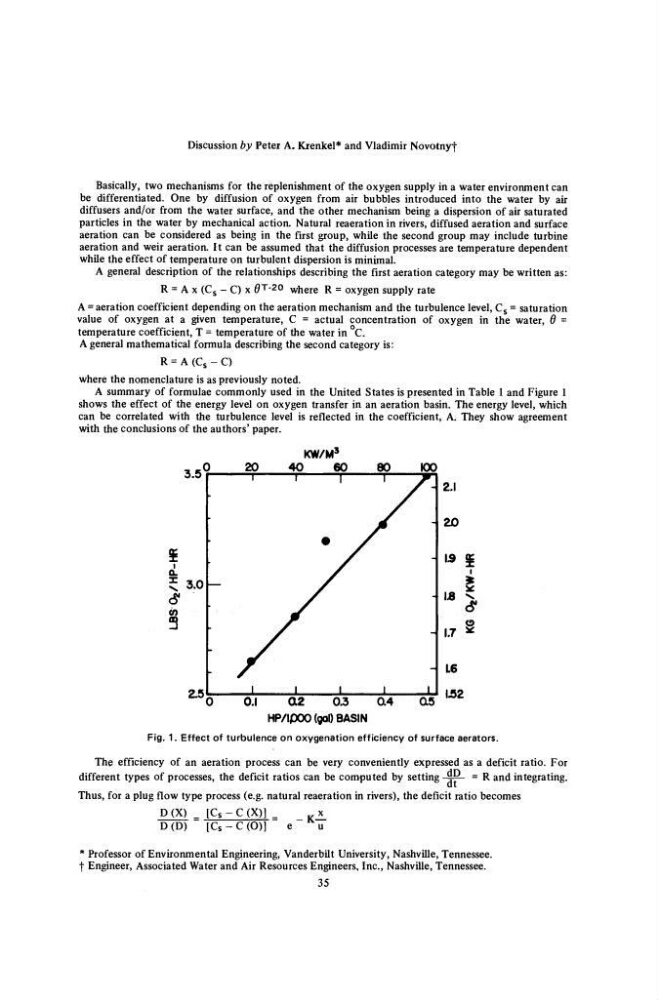
A summary of formulae commonly used in the United States is presented in Table 1 and Figure 1
shows the effect of the energy level on oxygen transfer in an aeration basin. The energy level, which
can be correlated with the turbulence level is reflected in the coefficient, A. They show agreement
with the conclusions of the authors' paper.
KW/M
3
, . 0
20
40
60
80
KX)
2.1
20
IS jg
4
(9
1.7 *
L6
— 0
0.1
(X2
0.3
0.4
0L5
HP/IPOO (gal) BASIN
Fig. 1. Effect of turbulence on oxygenation efficiency of surface aerators.
The efficiency of an aeration process can be very conveniently expressed as a deficit ratio. For
different types of processes, the deficit ratios can be computed by setting - ^ - = R and integrating.
Thus, for a plug flow type process (e.g. natural reaeration in rivers), the deficit ratio becomes
D (X) _ [C s - C (X)1 _
x_
D(D)
[ C s - C ( O ) ]
e
u
* Professor of Environmental Engineering, Vanderbilt University, Nashville, Tennessee.
f Engineer, Associated Water and Air Resources Engineers, Inc., Nashville, Tennessee.
35
Basically, two mechanisms for the replenishment of the oxygen supply in a water environment can
be differentiated. One by diffusion of oxygen from air bubbles introduced into the water by air
diffusers and/or from the water surface, and the other mechanism being a dispersion of air saturated
particles in the water by mechanical action. Natural reaeration in rivers, diffused aeration and surface
aeration can be considered as being in the first group, while the second group may include turbine
aeration and weir aeration. It can be assumed that the diffusion processes are temperature dependent
while the effect of temperature on turbulent dispersion is minimal.
A general description of the relationships describing the first aeration category may be written as:
R = A x (C s - C) x 0
T -
2 0 where R = oxygen supply rate
A = aeration coefficient depending on the aeration mechanism and the turbulence level, C s = saturation
value of oxygen at a given temperature, C = actual concentration of oxygen in the water, Θ =
temperature coefficient, T = temperature of the water in °C.
A general mathematical formula describing the second category is:
R = A (C s - C)
where the nomenclature is as previously noted.
A summary of formulae commonly used in the United States is presented in Table 1 and Figure 1
shows the effect of the energy level on oxygen transfer in an aeration basin. The energy level, which
can be correlated with the turbulence level is reflected in the coefficient, A. They show agreement
with the conclusions of the authors' paper.
KW/M
3
, . 0
20
40
60
80
KX)
2.1
20
IS jg
4
(9
1.7 *
L6
— 0
0.1
(X2
0.3
0.4
0L5
HP/IPOO (gal) BASIN
Fig. 1. Effect of turbulence on oxygenation efficiency of surface aerators.
The efficiency of an aeration process can be very conveniently expressed as a deficit ratio. For
different types of processes, the deficit ratios can be computed by setting - ^ - = R and integrating.
Thus, for a plug flow type process (e.g. natural reaeration in rivers), the deficit ratio becomes
D (X) _ [C s - C (X)1 _
x_
D(D)
[ C s - C ( O ) ]
e
u
* Professor of Environmental Engineering, Vanderbilt University, Nashville, Tennessee.
f Engineer, Associated Water and Air Resources Engineers, Inc., Nashville, Tennessee.
35