

482
O.D. Brocket! and P. Welsby
POND TOP LIQUOR SHOWING OXIDATION POND INSTABILITY
(6)t
o-±E
'[ 1 I Γ
+Tfi rrl-1—i^l
Î! i ±Ί-1
M i l l
1
444=H
-t:fctj4
I ' l l
~ ~ tj
1 |
1 1 j-j
44¹
( 7 ) —
-
^J
2
_
-
4
6
8
-
10 HOUR 14 16
~4__1A .
16 20
::.\z
22
1 _:
4
6
8
10 HOURS 14 16 18 2 0 22
-J
.
4 i
! V s. "ü
_:
L
-
24
24
"i
>
4
' * " ~i
8
Ί l"
10 HOURS 14
1
|
1
4 -
T: TH
J_L_
-b*
^~
4^
Γ Α>ήοΰ* r
1
4
16
■^
18
-h-Kd
1 6
â"
20
20
22
22
24
24
2
4
6
8
10 HOURS 14 16 18 2 0
22 24
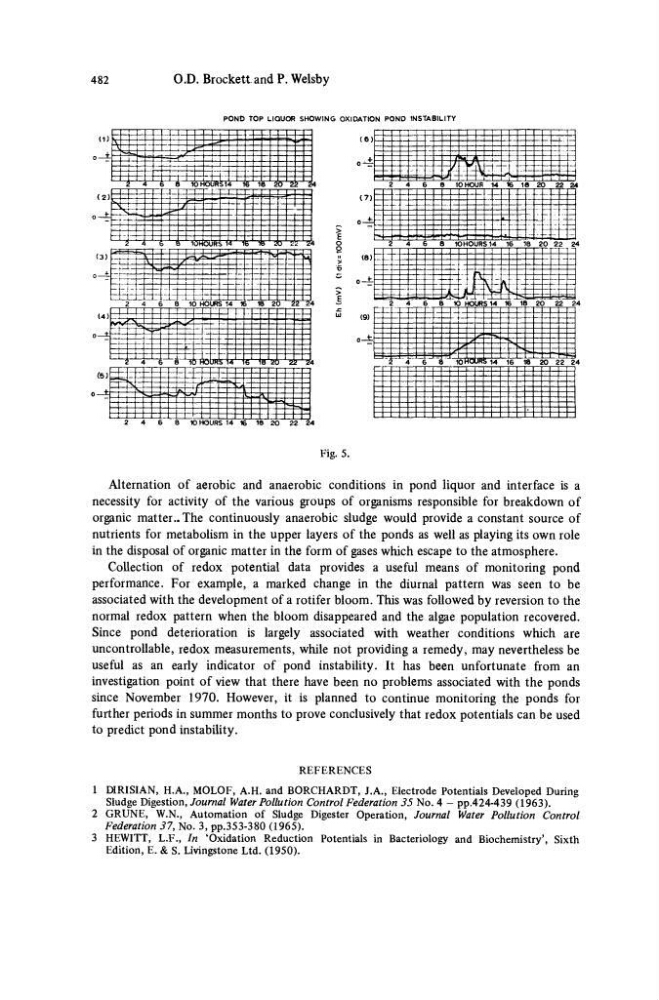
Fig. 5.
Alternation of aerobic and anaerobic conditions in pond liquor and interface is a
necessity for activity of the various groups of organisms responsible for breakdown of
organic matter.. The continuously anaerobic sludge would provide a constant source of
nutrients for metabolism in the upper layers of the ponds as well as playing its own role
in the disposal of organic matter in the form of gases which escape to the atmosphere.
Collection of redox potential data provides a useful means of monitoring pond
performance. For example, a marked change in the diurnal pattern was seen to be
associated with the development of a rotifer bloom. This was followed by reversion to the
normal redox pattern when the bloom disappeared and the algae population recovered.
Since pond deterioration is largely associated with weather conditions which are
uncontrollable, redox measurements, while not providing a remedy, may nevertheless be
useful as an early indicator of pond instability. It has been unfortunate from an
investigation point of view that there have been no problems associated with the ponds
since November 1970. However, it is planned to continue monitoring the ponds for
further periods in summer months to prove conclusively that redox potentials can be used
to predict pond instability.
REFERENCES
DIRISIAN, H.A., MOLOF, A.H. and BORCHARDT, J.A., Electrode Potentials Developed During
Sludge Digestion, Journal Water Pollution Control Federation 35 No. 4 - pp.424-439 (1963).
GRάNE, W.N., Automation of Sludge Digester Operation, Journal Water Pollution Control
Federation 37, No. 3, pp.353-380 (1965).
HEWITT, L.F., In Oxidation Reduction Potentials in Bacteriology and Biochemistry', Sixth
Edition, E. & S. Livingstone Ltd. (1950).
O.D. Brocket! and P. Welsby
POND TOP LIQUOR SHOWING OXIDATION POND INSTABILITY
(6)t
o-±E
'[ 1 I Γ
+Tfi rrl-1—i^l
Î! i ±Ί-1
M i l l
1
444=H
-t:fctj4
I ' l l
~ ~ tj
1 |
1 1 j-j
44¹
( 7 ) —
-
^J
2
_
-
4
6
8
-
10 HOUR 14 16
~4__1A .
16 20
::.\z
22
1 _:
4
6
8
10 HOURS 14 16 18 2 0 22
-J
.
4 i
! V s. "ü
_:
L
-
24
24
"i
>
4
' * " ~i
8
Ί l"
10 HOURS 14
1
|
1
4 -
T: TH
J_L_
-b*
^~
4^
Γ Α>ήοΰ* r
1
4
16
■^
18
-h-Kd
1 6
â"
20
20
22
22
24
24
2
4
6
8
10 HOURS 14 16 18 2 0
22 24
Fig. 5.
Alternation of aerobic and anaerobic conditions in pond liquor and interface is a
necessity for activity of the various groups of organisms responsible for breakdown of
organic matter.. The continuously anaerobic sludge would provide a constant source of
nutrients for metabolism in the upper layers of the ponds as well as playing its own role
in the disposal of organic matter in the form of gases which escape to the atmosphere.
Collection of redox potential data provides a useful means of monitoring pond
performance. For example, a marked change in the diurnal pattern was seen to be
associated with the development of a rotifer bloom. This was followed by reversion to the
normal redox pattern when the bloom disappeared and the algae population recovered.
Since pond deterioration is largely associated with weather conditions which are
uncontrollable, redox measurements, while not providing a remedy, may nevertheless be
useful as an early indicator of pond instability. It has been unfortunate from an
investigation point of view that there have been no problems associated with the ponds
since November 1970. However, it is planned to continue monitoring the ponds for
further periods in summer months to prove conclusively that redox potentials can be used
to predict pond instability.
REFERENCES
DIRISIAN, H.A., MOLOF, A.H. and BORCHARDT, J.A., Electrode Potentials Developed During
Sludge Digestion, Journal Water Pollution Control Federation 35 No. 4 - pp.424-439 (1963).
GRάNE, W.N., Automation of Sludge Digester Operation, Journal Water Pollution Control
Federation 37, No. 3, pp.353-380 (1965).
HEWITT, L.F., In Oxidation Reduction Potentials in Bacteriology and Biochemistry', Sixth
Edition, E. & S. Livingstone Ltd. (1950).