

A Simulation Model of the Gravity Separation of Concentrated Solids
461
the test).
The settling test is normally conducted by placing a well mixed sample of a suspension
in a tall cylinder and allowing it to settle while the height of the liquid solids interface is
recorded at various time intervals so that a curve of height versus time may be plotted.
The dry weight concentration of the initial suspended solids, the bound water content
and specific gravity of the dry solids are also determined.
The idealized settling test begins with a cylinder of uniformly concentrated suspended
solids which are consolidating due to the difference in weight between the solids and the
suspending liquid. To study this process, the sludge will be examined as a mass composed
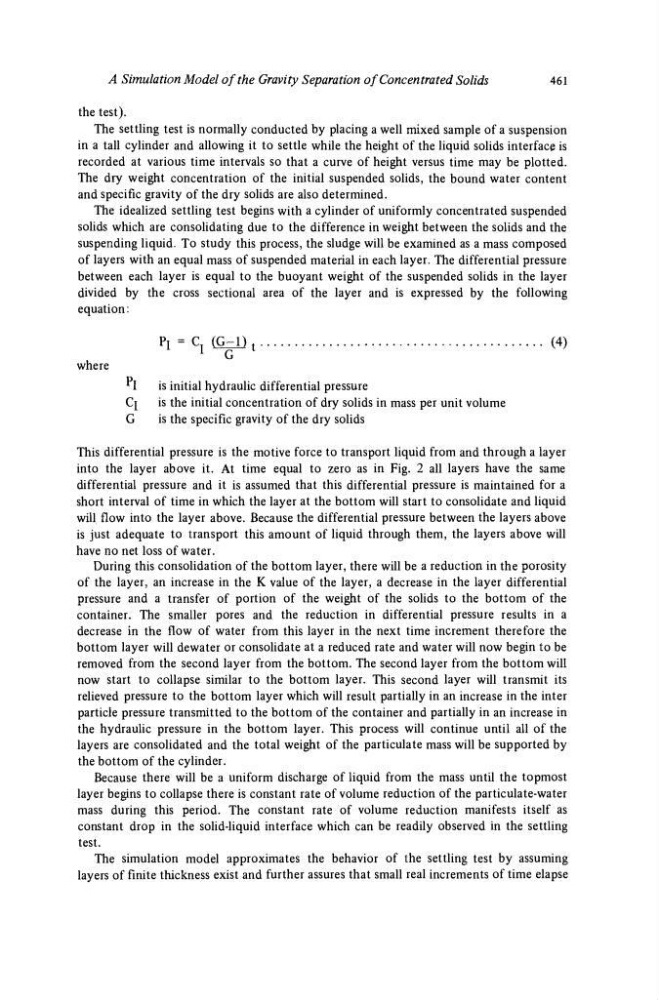
of layers with an equal mass of suspended material in each layer. The differential pressure
between each layer is equal to the buoyant weight of the suspended solids in the layer
divided by the cross sectional area of the layer and is expressed by the following
equation:
Pi = C (GzdJ t
(4)
1
G
where
M
is initial hydraulic differential pressure
Cj is the initial concentration of dry solids in mass per unit volume
G
is the specific gravity of the dry solids
This differential pressure is the motive force to transport liquid from and through a layer
into the layer above it. At time equal to zero as in Fig. 2 all layers have the same
differential pressure and it is assumed that this differential pressure is maintained for a
short interval of time in which the layer at the bottom will start to consolidate and liquid
will flow into the layer above. Because the differential pressure between the layers above
is just adequate to transport this amount of liquid through them, the layers above will
have no net loss of water.
During this consolidation of the bottom layer, there will be a reduction in the porosity
of the layer, an increase in the K value of the layer, a decrease in the layer differential
pressure and a transfer of portion of the weight of the solids to the bottom of the
container. The smaller pores and the reduction in differential pressure results in a
decrease in the flow of water from this layer in the next time increment therefore the
bottom layer will dewater or consolidate at a reduced rate and water will now begin to be
removed from the second layer from the bottom. The second layer from the bottom will
now start to collapse similar to the bottom layer. This second layer will transmit its
relieved pressure to the bottom layer which will result partially in an increase in the inter
particle pressure transmitted to the bottom of the container and partially in an increase in
the hydraulic pressure in the bottom layer. This process will continue until all of the
layers are consolidated and the total weight of the particulate mass will be supported by
the bottom of the cylinder.
Because there will be a uniform discharge of liquid from the mass until the topmost
layer begins to collapse there is constant rate of volume reduction of the particulate-water
mass during this period. The constant rate of volume reduction manifests itself as
constant drop in the solid-liquid interface which can be readily observed in the settling
test.
The simulation model approximates the behavior of the settling test by assuming
layers of finite thickness exist and further assures that small real increments of time elapse
461
the test).
The settling test is normally conducted by placing a well mixed sample of a suspension
in a tall cylinder and allowing it to settle while the height of the liquid solids interface is
recorded at various time intervals so that a curve of height versus time may be plotted.
The dry weight concentration of the initial suspended solids, the bound water content
and specific gravity of the dry solids are also determined.
The idealized settling test begins with a cylinder of uniformly concentrated suspended
solids which are consolidating due to the difference in weight between the solids and the
suspending liquid. To study this process, the sludge will be examined as a mass composed
of layers with an equal mass of suspended material in each layer. The differential pressure
between each layer is equal to the buoyant weight of the suspended solids in the layer
divided by the cross sectional area of the layer and is expressed by the following
equation:
Pi = C (GzdJ t
(4)
1
G
where
M
is initial hydraulic differential pressure
Cj is the initial concentration of dry solids in mass per unit volume
G
is the specific gravity of the dry solids
This differential pressure is the motive force to transport liquid from and through a layer
into the layer above it. At time equal to zero as in Fig. 2 all layers have the same
differential pressure and it is assumed that this differential pressure is maintained for a
short interval of time in which the layer at the bottom will start to consolidate and liquid
will flow into the layer above. Because the differential pressure between the layers above
is just adequate to transport this amount of liquid through them, the layers above will
have no net loss of water.
During this consolidation of the bottom layer, there will be a reduction in the porosity
of the layer, an increase in the K value of the layer, a decrease in the layer differential
pressure and a transfer of portion of the weight of the solids to the bottom of the
container. The smaller pores and the reduction in differential pressure results in a
decrease in the flow of water from this layer in the next time increment therefore the
bottom layer will dewater or consolidate at a reduced rate and water will now begin to be
removed from the second layer from the bottom. The second layer from the bottom will
now start to collapse similar to the bottom layer. This second layer will transmit its
relieved pressure to the bottom layer which will result partially in an increase in the inter
particle pressure transmitted to the bottom of the container and partially in an increase in
the hydraulic pressure in the bottom layer. This process will continue until all of the
layers are consolidated and the total weight of the particulate mass will be supported by
the bottom of the cylinder.
Because there will be a uniform discharge of liquid from the mass until the topmost
layer begins to collapse there is constant rate of volume reduction of the particulate-water
mass during this period. The constant rate of volume reduction manifests itself as
constant drop in the solid-liquid interface which can be readily observed in the settling
test.
The simulation model approximates the behavior of the settling test by assuming
layers of finite thickness exist and further assures that small real increments of time elapse