

A Simulation Model of the Gravity Separation of Concentrated Solids
459
and equation (1) becomes:
h = Kv Ü=Q?
1
f 3
(3)
The value of K can be determined by direct measurement of the concentration of dry
solids, the specific gravity of the dry solids, the bound water content and the velocity of
settling.
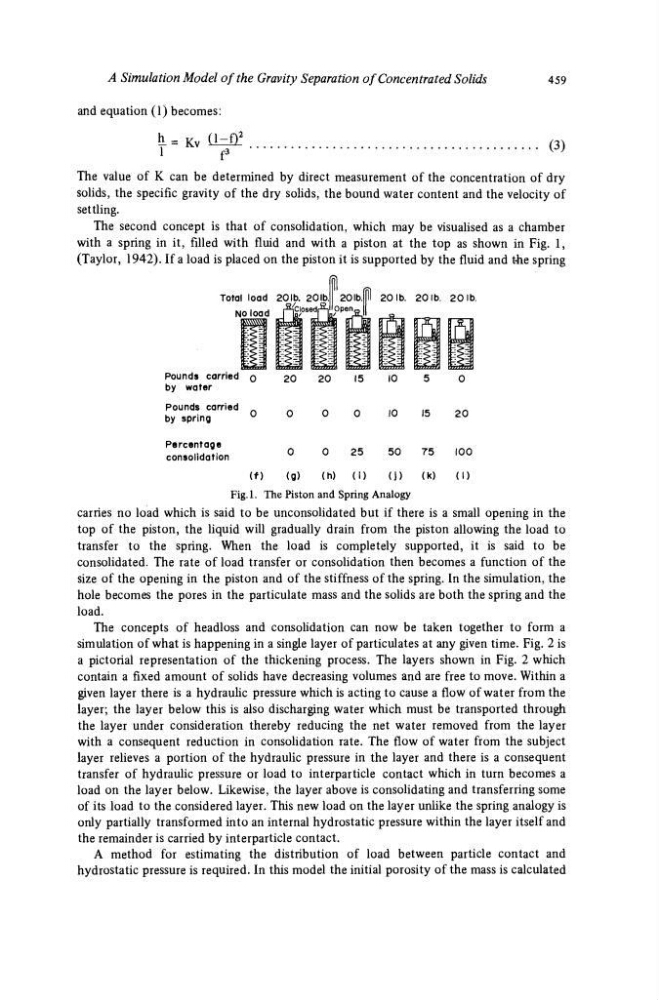
The second concept is that of consolidation, which may be visualised as a chamber
with a spring in it, filled with fluid and with a piston at the top as shown in Fig. 1,
(Taylor, 1942). If a load is placed on the piston it is supported by the fluid and the spring
I
Total load 201b. 201b.
/ —
Closed,
Pounds carried
by water
Pounds carried
by spring
Percentage
consolidation
20lb.|
Open
f
20 lb. 20 lb. 2 0 lb.
2 0
15
25
10
10
5 0
15
2 0
75
100
(f)
(g)
(h)
( i )
( i )
(k)
(I)
Fig.l. The Piston and Spring Analogy
carries no load which is said to be unconsolidated but if there is a small opening in the
top of the piston, the liquid will gradually drain from the piston allowing the load to
transfer to the spring. When the load is completely supported, it is said to be
consolidated. The rate of load transfer or consolidation then becomes a function of the
size of the opening in the piston and of the stiffness of the spring. In the simulation, the
hole becomes the pores in the particulate mass and the solids are both the spring and the
load.
The concepts of headloss and consolidation can now be taken together to form a
simulation of what is happening in a single layer of particulates at any given time. Fig. 2 is
a pictorial representation of the thickening process. The layers shown in Fig. 2 which
contain a fixed amount of solids have decreasing volumes and are free to move. Within a
given layer there is a hydraulic pressure which is acting to cause a flow of water from the
layer; the layer below this is also discharging water which must be transported through
the layer under consideration thereby reducing the net water removed from the layer
with a consequent reduction in consolidation rate. The flow of water from the subject
layer relieves a portion of the hydraulic pressure in the layer and there is a consequent
transfer of hydraulic pressure or load to interparticle contact which in turn becomes a
load on the layer below. Likewise, the layer above is consolidating and transferring some
of its load to the considered layer. This new load on the layer unlike the spring analogy is
only partially transformed into an internal hydrostatic pressure within the layer itself and
the remainder is carried by interparticle contact.
A method for estimating the distribution of load between particle contact and
hydrostatic pressure is required. In this model the initial porosity of the mass is calculated
459
and equation (1) becomes:
h = Kv Ü=Q?
1
f 3
(3)
The value of K can be determined by direct measurement of the concentration of dry
solids, the specific gravity of the dry solids, the bound water content and the velocity of
settling.
The second concept is that of consolidation, which may be visualised as a chamber
with a spring in it, filled with fluid and with a piston at the top as shown in Fig. 1,
(Taylor, 1942). If a load is placed on the piston it is supported by the fluid and the spring
I
Total load 201b. 201b.
/ —
Closed,
Pounds carried
by water
Pounds carried
by spring
Percentage
consolidation
20lb.|
Open
f
20 lb. 20 lb. 2 0 lb.
2 0
15
25
10
10
5 0
15
2 0
75
100
(f)
(g)
(h)
( i )
( i )
(k)
(I)
Fig.l. The Piston and Spring Analogy
carries no load which is said to be unconsolidated but if there is a small opening in the
top of the piston, the liquid will gradually drain from the piston allowing the load to
transfer to the spring. When the load is completely supported, it is said to be
consolidated. The rate of load transfer or consolidation then becomes a function of the
size of the opening in the piston and of the stiffness of the spring. In the simulation, the
hole becomes the pores in the particulate mass and the solids are both the spring and the
load.
The concepts of headloss and consolidation can now be taken together to form a
simulation of what is happening in a single layer of particulates at any given time. Fig. 2 is
a pictorial representation of the thickening process. The layers shown in Fig. 2 which
contain a fixed amount of solids have decreasing volumes and are free to move. Within a
given layer there is a hydraulic pressure which is acting to cause a flow of water from the
layer; the layer below this is also discharging water which must be transported through
the layer under consideration thereby reducing the net water removed from the layer
with a consequent reduction in consolidation rate. The flow of water from the subject
layer relieves a portion of the hydraulic pressure in the layer and there is a consequent
transfer of hydraulic pressure or load to interparticle contact which in turn becomes a
load on the layer below. Likewise, the layer above is consolidating and transferring some
of its load to the considered layer. This new load on the layer unlike the spring analogy is
only partially transformed into an internal hydrostatic pressure within the layer itself and
the remainder is carried by interparticle contact.
A method for estimating the distribution of load between particle contact and
hydrostatic pressure is required. In this model the initial porosity of the mass is calculated