

458
A.S. Anderson and R.C. Hanson
particulate matter develops immediately in the settling test.
In the activated sludge process, the suspension entering the clarifier is usually
sufficient to promote complete hindered settling. As the concentrations usually reported,
in terms of dry solids, content are of the order of 0.2%, it would seem that free settling
occurs. These studies indicate that the dry solids are only a fraction of the total solids,
the remainder being the bound water which is a definite part of the in-situ sludge. This
water cannot be measured directly but can be indirectly measured by determining the
free water content of a sludge sample by the method of Heukelekian and Weisberg
(1956). In this test the free water is determined by freezing a sludge sample of known
volume and measuring the expansion due to freezing, which permits determination of free
water content. The bound water can be estimated by subtracting the free water from the
sample volume and the calculated volume of the dry solids determined with an assumed
or measured specific gravity of the dry solids. The bound water content of sludge is
variable and values as low as 90 percent by weight of the dry solids and as high as 3000
percent by weight for an industrial waste activated sludge have been reported.
BASIC CONCEPTS
To better understand what occurs in the thickening process, one may visualize a long
settling column with a barrier placed near the top to create a chamber where a uniform
suspension of known concentration can be placed. If the barrier is suddenly removed and
wall effects are neglected, the suspension will begin to settle and will stabilize at a
constant velocity without increasing its concentration. For this to occur there must be a
flow of water through the particulate mass with a consequent headloss which is therefore
equal to the buoyant weight of the particulates. This condition is analogous to the flow
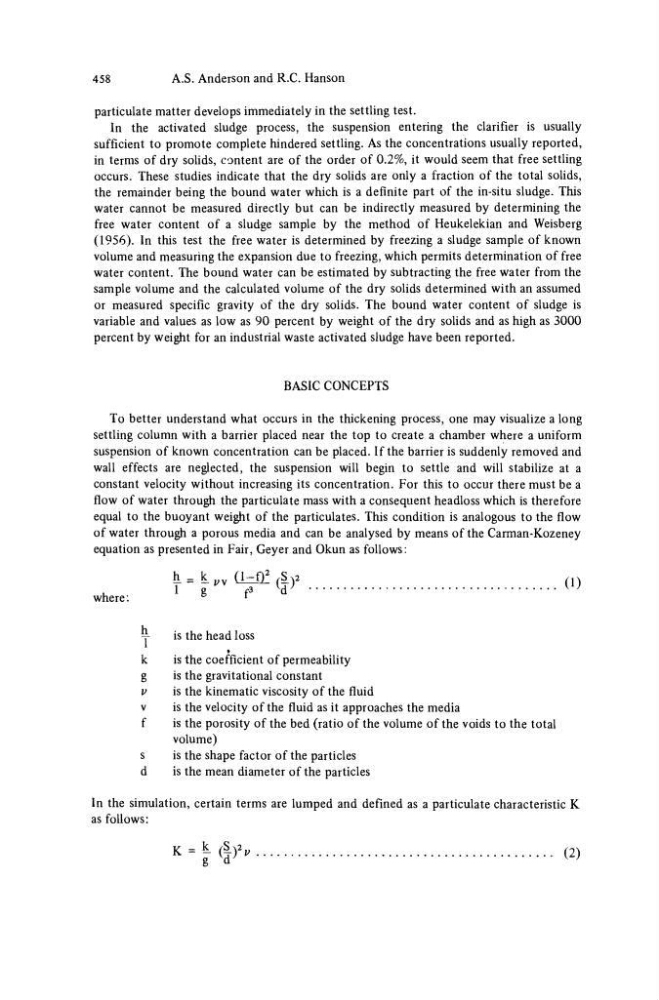
of water through a porous media and can be analysed by means of the Carman-Kozeney
equation as presented in Fair, Geyer and Okun as follows:
t - k v v (!=£(£)»
(1)
1
g
f3
v
d
v
is the head loss
is the coefficient of permeability
is the gravitational constant
is the kinematic viscosity of the fluid
is the velocity of the fluid as it approaches the media
is the porosity of the bed (ratio of the volume of the voids to the total
volume)
is the shape factor of the particles
is the mean diameter of the particles
In the simulation, certain terms are lumped and defined as a particulate characteristic K
as follows:
K = | ( | )
2 ^
(2)
where:
h
1
k
g
v
v
f
s
d
A.S. Anderson and R.C. Hanson
particulate matter develops immediately in the settling test.
In the activated sludge process, the suspension entering the clarifier is usually
sufficient to promote complete hindered settling. As the concentrations usually reported,
in terms of dry solids, content are of the order of 0.2%, it would seem that free settling
occurs. These studies indicate that the dry solids are only a fraction of the total solids,
the remainder being the bound water which is a definite part of the in-situ sludge. This
water cannot be measured directly but can be indirectly measured by determining the
free water content of a sludge sample by the method of Heukelekian and Weisberg
(1956). In this test the free water is determined by freezing a sludge sample of known
volume and measuring the expansion due to freezing, which permits determination of free
water content. The bound water can be estimated by subtracting the free water from the
sample volume and the calculated volume of the dry solids determined with an assumed
or measured specific gravity of the dry solids. The bound water content of sludge is
variable and values as low as 90 percent by weight of the dry solids and as high as 3000
percent by weight for an industrial waste activated sludge have been reported.
BASIC CONCEPTS
To better understand what occurs in the thickening process, one may visualize a long
settling column with a barrier placed near the top to create a chamber where a uniform
suspension of known concentration can be placed. If the barrier is suddenly removed and
wall effects are neglected, the suspension will begin to settle and will stabilize at a
constant velocity without increasing its concentration. For this to occur there must be a
flow of water through the particulate mass with a consequent headloss which is therefore
equal to the buoyant weight of the particulates. This condition is analogous to the flow
of water through a porous media and can be analysed by means of the Carman-Kozeney
equation as presented in Fair, Geyer and Okun as follows:
t - k v v (!=£(£)»
(1)
1
g
f3
v
d
v
is the head loss
is the coefficient of permeability
is the gravitational constant
is the kinematic viscosity of the fluid
is the velocity of the fluid as it approaches the media
is the porosity of the bed (ratio of the volume of the voids to the total
volume)
is the shape factor of the particles
is the mean diameter of the particles
In the simulation, certain terms are lumped and defined as a particulate characteristic K
as follows:
K = | ( | )
2 ^
(2)
where:
h
1
k
g
v
v
f
s
d