

450
T. Matsuo
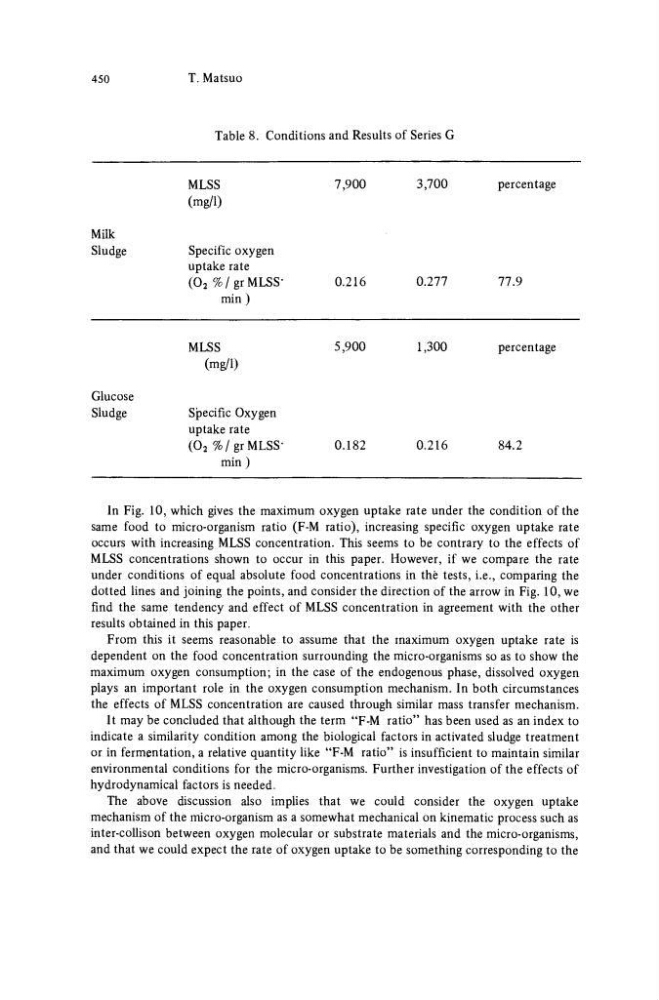
Table 8. Conditions and Results of Series G
MLSS
7,900
3,700
percentage
(mg/1)
Milk
Sludge
Specific oxygen
uptake rate
(0 2 %/grMLSS·
0.216
0.277
77.9
min )
MLSS
5,900
1,300
percentage
(mg/1)
Glucose
Sludge
Specific Oxygen
uptake rate
(0 2 %/grMLSS'
0.182
0.216
84.2
min)
In Fig. 10, which gives the maximum oxygen uptake rate under the condition of the
same food to micro-organism ratio (F-M ratio), increasing specific oxygen uptake rate
occurs with increasing MLSS concentration. This seems to be contrary to the effects of
MLSS concentrations shown to occur in this paper. However, if we compare the rate
under conditions of equal absolute food concentrations in the tests, i.e., comparing the
dotted lines and joining the points, and consider the direction of the arrow in Fig. 10, we
find the same tendency and effect of MLSS concentration in agreement with the other
results obtained in this paper.
From this it seems reasonable to assume that the maximum oxygen uptake rate is
dependent on the food concentration surrounding the micro-organisms so as to show the
maximum oxygen consumption; in the case of the endogenous phase, dissolved oxygen
plays an important role in the oxygen consumption mechanism. In both circumstances
the effects of MLSS concentration are caused through similar mass transfer mechanism.
It may be concluded that although the term "F-M ratio" has been used as an index to
indicate a similarity condition among the biological factors in activated sludge treatment
or in fermentation, a relative quantity like "F-M ratio" is insufficient to maintain similar
environmental conditions for the micro-organisms. Further investigation of the effects of
hydro dynamical factors is needed.
The above discussion also implies that we could consider the oxygen uptake
mechanism of the micro-organism as a somewhat mechanical on kinematic process such as
inter-collison between oxygen molecular or substrate materials and the micro-organisms,
and that we could expect the rate of oxygen uptake to be something corresponding to the
T. Matsuo
Table 8. Conditions and Results of Series G
MLSS
7,900
3,700
percentage
(mg/1)
Milk
Sludge
Specific oxygen
uptake rate
(0 2 %/grMLSS·
0.216
0.277
77.9
min )
MLSS
5,900
1,300
percentage
(mg/1)
Glucose
Sludge
Specific Oxygen
uptake rate
(0 2 %/grMLSS'
0.182
0.216
84.2
min)
In Fig. 10, which gives the maximum oxygen uptake rate under the condition of the
same food to micro-organism ratio (F-M ratio), increasing specific oxygen uptake rate
occurs with increasing MLSS concentration. This seems to be contrary to the effects of
MLSS concentrations shown to occur in this paper. However, if we compare the rate
under conditions of equal absolute food concentrations in the tests, i.e., comparing the
dotted lines and joining the points, and consider the direction of the arrow in Fig. 10, we
find the same tendency and effect of MLSS concentration in agreement with the other
results obtained in this paper.
From this it seems reasonable to assume that the maximum oxygen uptake rate is
dependent on the food concentration surrounding the micro-organisms so as to show the
maximum oxygen consumption; in the case of the endogenous phase, dissolved oxygen
plays an important role in the oxygen consumption mechanism. In both circumstances
the effects of MLSS concentration are caused through similar mass transfer mechanism.
It may be concluded that although the term "F-M ratio" has been used as an index to
indicate a similarity condition among the biological factors in activated sludge treatment
or in fermentation, a relative quantity like "F-M ratio" is insufficient to maintain similar
environmental conditions for the micro-organisms. Further investigation of the effects of
hydro dynamical factors is needed.
The above discussion also implies that we could consider the oxygen uptake
mechanism of the micro-organism as a somewhat mechanical on kinematic process such as
inter-collison between oxygen molecular or substrate materials and the micro-organisms,
and that we could expect the rate of oxygen uptake to be something corresponding to the