

Structure of Turbulence and Oxygen Transfer Mechanism
441
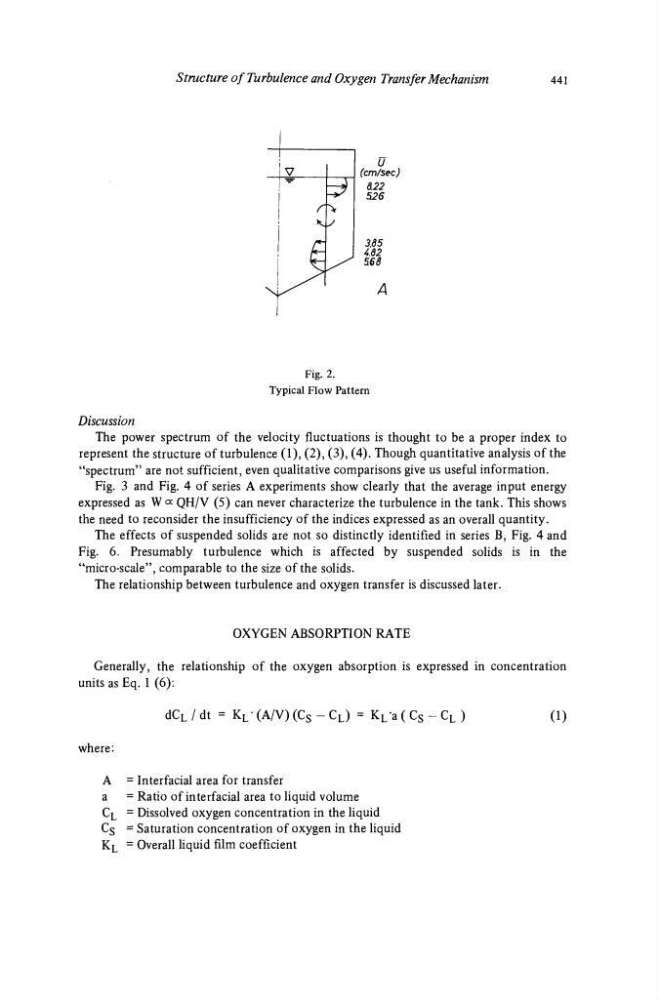
Fig. 2.
Typical Flow Pattern
Discussion
The power spectrum of the velocity fluctuations is thought to be a proper index to
represent the structure of turbulence (1), (2), (3), (4). Though quantitative analysis of the
"spectrum" are not sufficient, even qualitative comparisons give us useful information.
Fig. 3 and Fig. 4 of series A experiments show clearly that the average input energy
expressed a s W « QH/V (5) can never characterize the turbulence in the tank. This shows
the need to reconsider the insufficiency of the indices expressed as an overall quantity.
The effects of suspended solids are not so distinctly identified in series B, Fig. 4 and
Fig. 6. Presumably turbulence which is affected by suspended solids is in the
"micro-scale", comparable to the size of the solids.
The relationship between turbulence and oxygen transfer is discussed later.
OXYGEN ABSORPTION RATE
Generally, the relationship of the oxygen absorption is expressed in concentration
units as Eq. 1 (6):
dC L / dt = K L ' (A/V) (C S - C L ) = K L 'a ( C s - C L )
0)
where:
A = Interfacial area for transfer
a = Ratio of interfacial area to liquid volume
CL
= Dissolved oxygen concentration in the liquid
Cs = Saturation concentration of oxygen in the liquid
KL
= Overall liquid film coefficient
441
Fig. 2.
Typical Flow Pattern
Discussion
The power spectrum of the velocity fluctuations is thought to be a proper index to
represent the structure of turbulence (1), (2), (3), (4). Though quantitative analysis of the
"spectrum" are not sufficient, even qualitative comparisons give us useful information.
Fig. 3 and Fig. 4 of series A experiments show clearly that the average input energy
expressed a s W « QH/V (5) can never characterize the turbulence in the tank. This shows
the need to reconsider the insufficiency of the indices expressed as an overall quantity.
The effects of suspended solids are not so distinctly identified in series B, Fig. 4 and
Fig. 6. Presumably turbulence which is affected by suspended solids is in the
"micro-scale", comparable to the size of the solids.
The relationship between turbulence and oxygen transfer is discussed later.
OXYGEN ABSORPTION RATE
Generally, the relationship of the oxygen absorption is expressed in concentration
units as Eq. 1 (6):
dC L / dt = K L ' (A/V) (C S - C L ) = K L 'a ( C s - C L )
0)
where:
A = Interfacial area for transfer
a = Ratio of interfacial area to liquid volume
CL
= Dissolved oxygen concentration in the liquid
Cs = Saturation concentration of oxygen in the liquid
KL
= Overall liquid film coefficient