

28
K.R. Imhoff and D. Albrecht
in an oxygenation efficiency of 1.41 kg 0 2 /kwh. At the Pixley Dam two turbines aerated
a total river water quantity of 11.5m
3 /s. In this case an oxygen transfer of 61 kg 0 2 /h
and an efficiency of 0.45 kg 0 2 /kwh was achieved at 20°C and 50% average deficit [23].
3.2 Weir aeration
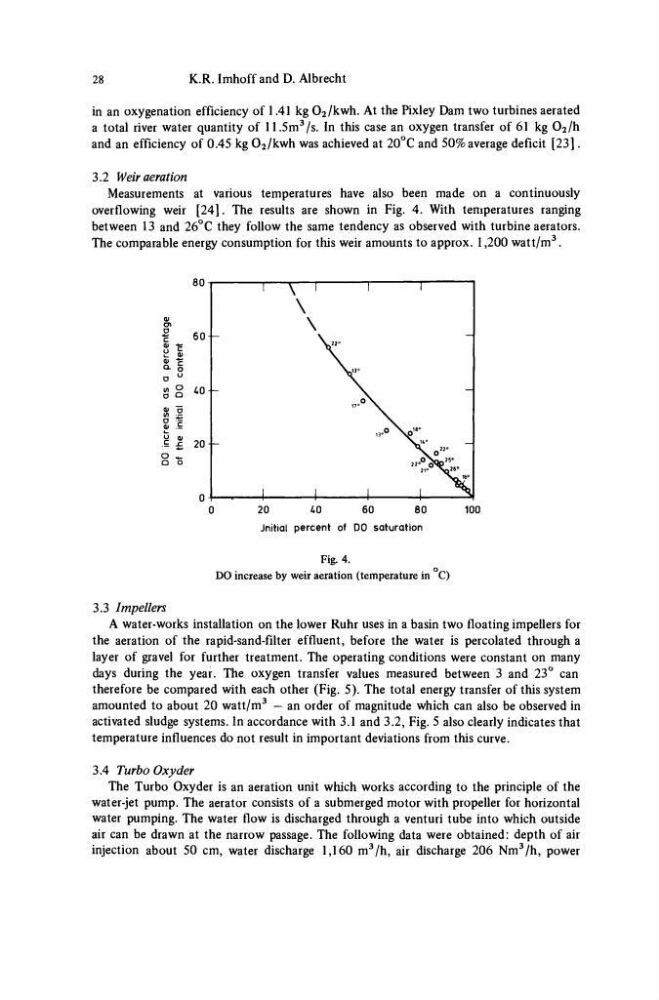
Measurements at various temperatures have also been made on a continuously
overflowing weir [24]. The results are shown in Fig. 4. With temperatures ranging
between 13 and 26°C they follow the same tendency as observed with turbine aerators.
The comparable energy consumption for this weir amounts to approx. 1,200 watt/m
3 .
80
0)
|
60
- 1
Φ "C
Q- o
o °
8 § *°
S 1
S 1
υ
at
,
c £ 20 fo -_
Q
O
o-l
20
40
60
80
Jnitial percent of DO saturation
Fig. 4.
o
DO increase by weir aeration (temperature in C)
3.3 Impellers
A water-works installation on the lower Ruhr uses in a basin two floating impellers for
the aeration of the rapid-sand-filter effluent, before the water is percolated through a
layer of gravel for further treatment. The operating conditions were constant on many
days during the year. The oxygen transfer values measured between 3 and 23° can
therefore be compared with each other (Fig. 5). The total energy transfer of this system
amounted to about 20 watt/m
3 — an order of magnitude which can also be observed in
activated sludge systems. In accordance with 3.1 and 3.2, Fig. 5 also clearly indicates that
temperature influences do not result in important deviations from this curve.
3.4 Turbo Oxyder
The Turbo Oxyder is an aeration unit which works according to the principle of the
water-jet pump. The aerator consists of a submerged motor with propeller for horizontal
water pumping. The water flow is discharged through a venturi tube into which outside
air can be drawn at the narrow passage. The following data were obtained: depth of air
injection about 50 cm, water discharge 1,160 m
3 /h, air discharge 206 Nm
3 /h, power
K.R. Imhoff and D. Albrecht
in an oxygenation efficiency of 1.41 kg 0 2 /kwh. At the Pixley Dam two turbines aerated
a total river water quantity of 11.5m
3 /s. In this case an oxygen transfer of 61 kg 0 2 /h
and an efficiency of 0.45 kg 0 2 /kwh was achieved at 20°C and 50% average deficit [23].
3.2 Weir aeration
Measurements at various temperatures have also been made on a continuously
overflowing weir [24]. The results are shown in Fig. 4. With temperatures ranging
between 13 and 26°C they follow the same tendency as observed with turbine aerators.
The comparable energy consumption for this weir amounts to approx. 1,200 watt/m
3 .
80
0)
|
60
- 1
Φ "C
Q- o
o °
8 § *°
S 1
S 1
υ
at
,
c £ 20 fo -_
Q
O
o-l
20
40
60
80
Jnitial percent of DO saturation
Fig. 4.
o
DO increase by weir aeration (temperature in C)
3.3 Impellers
A water-works installation on the lower Ruhr uses in a basin two floating impellers for
the aeration of the rapid-sand-filter effluent, before the water is percolated through a
layer of gravel for further treatment. The operating conditions were constant on many
days during the year. The oxygen transfer values measured between 3 and 23° can
therefore be compared with each other (Fig. 5). The total energy transfer of this system
amounted to about 20 watt/m
3 — an order of magnitude which can also be observed in
activated sludge systems. In accordance with 3.1 and 3.2, Fig. 5 also clearly indicates that
temperature influences do not result in important deviations from this curve.
3.4 Turbo Oxyder
The Turbo Oxyder is an aeration unit which works according to the principle of the
water-jet pump. The aerator consists of a submerged motor with propeller for horizontal
water pumping. The water flow is discharged through a venturi tube into which outside
air can be drawn at the narrow passage. The following data were obtained: depth of air
injection about 50 cm, water discharge 1,160 m
3 /h, air discharge 206 Nm
3 /h, power