

26
K.R. Imhoff and D. Albrecht
3.1 Turbine aeration
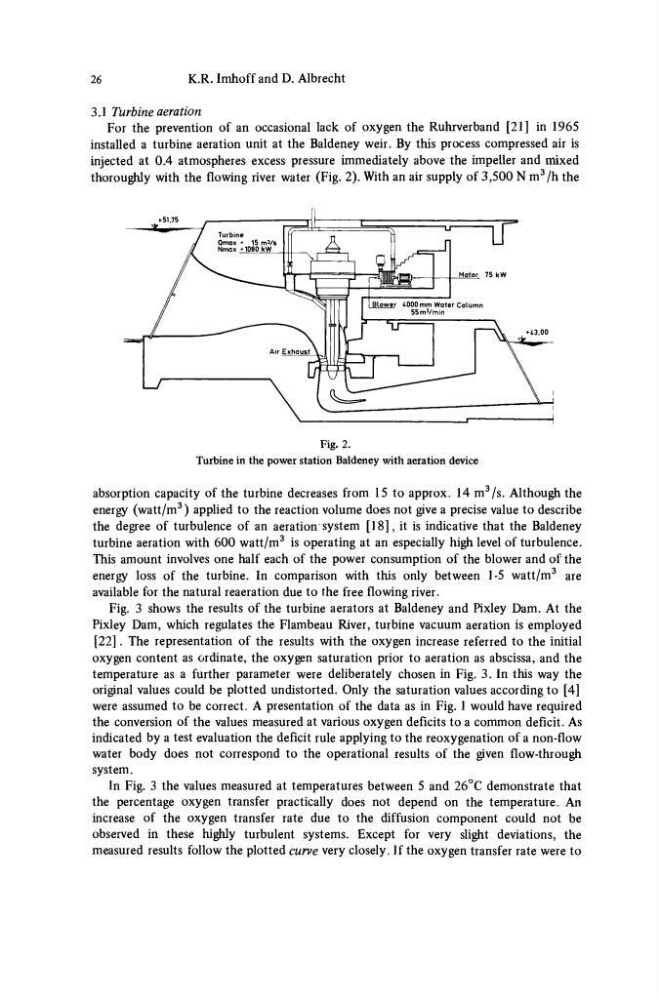
For the prevention of an occasional lack of oxygen the Ruhrverband [21] in 1965
installed a turbine aeration unit at the Baldeney weir. By this process compressed air is
injected at 0.4 atmospheres excess pressure immediately above the impeller and mixed
thoroughly with the flowing river water (Fig. 2). With an air supply of 3,500 N m
3 /h the
Fig. 2.
Turbine in the power station Baldeney with aeration device
absorption capacity of the turbine decreases from 15 to approx. 14 m
3 /s. Although the
energy (watt/m
3 ) applied to the reaction volume does not give a precise value to describe
the degree of turbulence of an aeration system [18], it is indicative that the Baldeney
turbine aeration with 600 watt/m
3 is operating at an especially high level of turbulence.
This amount involves one half each of the power consumption of the blower and of the
energy loss of the turbine. In comparison with this only between 1-5 watt/m
3 are
available for the natural reaeration due to the free flowing river.
Fig. 3 shows the results of the turbine aerators at Baldeney and Pixley Dam. At the
Pixley Dam, which regulates the Flambeau River, turbine vacuum aeration is employed
[22]. The representation of the results with the oxygen increase referred to the initial
oxygen content as ordinate, the oxygen saturation prior to aeration as abscissa, and the
temperature as a further parameter were deliberately chosen in Fig. 3. In this way the
original values could be plotted undistorted. Only the saturation values according to [4]
were assumed to be correct. A presentation of the data as in Fig. 1 would have required
the conversion of the values measured at various oxygen deficits to a common deficit. As
indicated by a test evaluation the deficit rule applying to the reoxygenation of a non-flow
water body does not correspond to the operational results of the given flow-through
system.
In Fig. 3 the values measured at temperatures between 5 and 26°C demonstrate that
the percentage oxygen transfer practically does not depend on the temperature. An
increase of the oxygen transfer rate due to the diffusion component could not be
observed in these highly turbulent systems. Except for very slight deviations, the
measured results follow the plotted curve very closely. If the oxygen transfer rate were to
K.R. Imhoff and D. Albrecht
3.1 Turbine aeration
For the prevention of an occasional lack of oxygen the Ruhrverband [21] in 1965
installed a turbine aeration unit at the Baldeney weir. By this process compressed air is
injected at 0.4 atmospheres excess pressure immediately above the impeller and mixed
thoroughly with the flowing river water (Fig. 2). With an air supply of 3,500 N m
3 /h the
Fig. 2.
Turbine in the power station Baldeney with aeration device
absorption capacity of the turbine decreases from 15 to approx. 14 m
3 /s. Although the
energy (watt/m
3 ) applied to the reaction volume does not give a precise value to describe
the degree of turbulence of an aeration system [18], it is indicative that the Baldeney
turbine aeration with 600 watt/m
3 is operating at an especially high level of turbulence.
This amount involves one half each of the power consumption of the blower and of the
energy loss of the turbine. In comparison with this only between 1-5 watt/m
3 are
available for the natural reaeration due to the free flowing river.
Fig. 3 shows the results of the turbine aerators at Baldeney and Pixley Dam. At the
Pixley Dam, which regulates the Flambeau River, turbine vacuum aeration is employed
[22]. The representation of the results with the oxygen increase referred to the initial
oxygen content as ordinate, the oxygen saturation prior to aeration as abscissa, and the
temperature as a further parameter were deliberately chosen in Fig. 3. In this way the
original values could be plotted undistorted. Only the saturation values according to [4]
were assumed to be correct. A presentation of the data as in Fig. 1 would have required
the conversion of the values measured at various oxygen deficits to a common deficit. As
indicated by a test evaluation the deficit rule applying to the reoxygenation of a non-flow
water body does not correspond to the operational results of the given flow-through
system.
In Fig. 3 the values measured at temperatures between 5 and 26°C demonstrate that
the percentage oxygen transfer practically does not depend on the temperature. An
increase of the oxygen transfer rate due to the diffusion component could not be
observed in these highly turbulent systems. Except for very slight deviations, the
measured results follow the plotted curve very closely. If the oxygen transfer rate were to