

Design Optimization for Activated Sludge and Extended A eration Plants
379
aS r + kbXy - V ( a S r + k b X v )
2 - (4kbX v O.77aS r )
x "
2kbX v
( 7 )
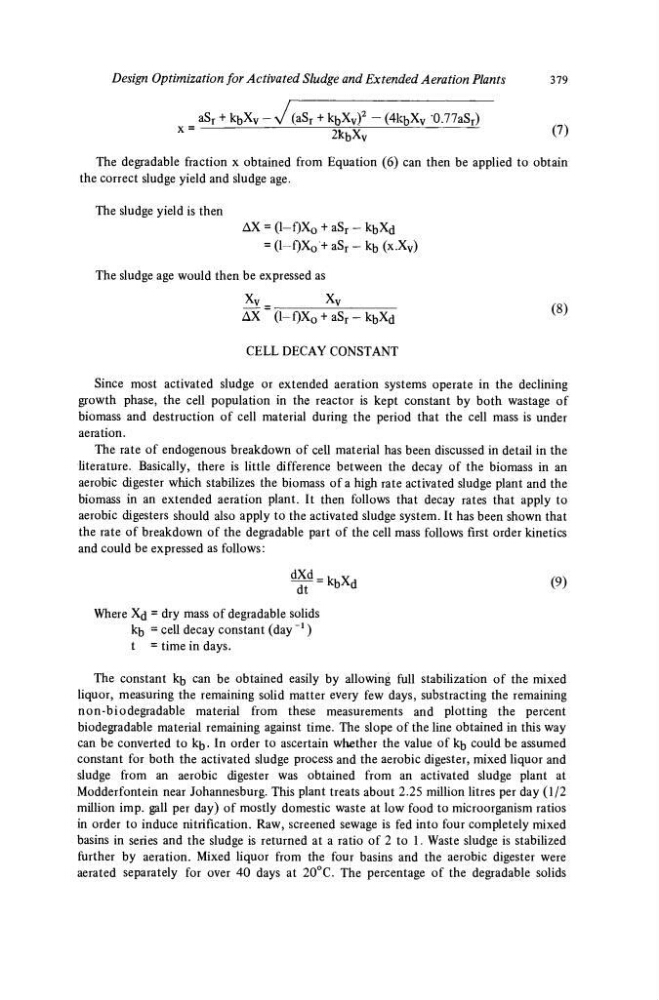
The degradable fraction x obtained from Equation (6) can then be applied to obtain
the correct sludge yield and sludge age.
The sludge yield is then
ΔΧ = (1-OXo + aS r - kbXd
= (l-f)X 0 + a S r - k b ( x . X v )
The sludge age would then be expressed as
Ay
Xy
ΔΧ (l-f)Xo + aS r - ^ X d
CELL DECAY CONSTANT
(8)
Since most activated sludge or extended aeration systems operate in the declining
growth phase, the cell population in the reactor is kept constant by both wastage of
biomass and destruction of cell material during the period that the cell mass is under
aeration.
The rate of endogenous breakdown of cell material has been discussed in detail in the
literature. Basically, there is little difference between the decay of the biomass in an
aerobic digester which stabilizes the biomass of a high rate activated sludge plant and the
biomass in an extended aeration plant. It then follows that decay rates that apply to
aerobic digesters should also apply to the activated sludge system. It has been shown that
the rate of breakdown of the degradable part of the cell mass follows first order kinetics
and could be expressed as follows:
< £ - * *
(9)
Where Xd = dry mass of degradable solids
kb = cell decay constant (day
-1 )
t = time in days.
The constant kb can be obtained easily by allowing full stabilization of the mixed
liquor, measuring the remaining solid matter every few days, substracting the remaining
non-biodegradable material from these measurements and plotting the percent
biodegradable material remaining against time. The slope of the line obtained in this way
can be converted to kb- In order to ascertain whether the value of kb could be assumed
constant for both the activated sludge process and the aerobic digester, mixed liquor and
sludge from an aerobic digester was obtained from an activated sludge plant at
Modderfontein near Johannesburg. This plant treats about 2.25 million litres per day (1/2
million imp. gall per day) of mostly domestic waste at low food to microorganism ratios
in order to induce nitrification. Raw, screened sewage is fed into four completely mixed
basins in series and the sludge is returned at a ratio of 2 to 1. Waste sludge is stabilized
further by aeration. Mixed liquor from the four basins and the aerobic digester were
aerated separately for over 40 days at 20°C. The percentage of the degradable solids
379
aS r + kbXy - V ( a S r + k b X v )
2 - (4kbX v O.77aS r )
x "
2kbX v
( 7 )
The degradable fraction x obtained from Equation (6) can then be applied to obtain
the correct sludge yield and sludge age.
The sludge yield is then
ΔΧ = (1-OXo + aS r - kbXd
= (l-f)X 0 + a S r - k b ( x . X v )
The sludge age would then be expressed as
Ay
Xy
ΔΧ (l-f)Xo + aS r - ^ X d
CELL DECAY CONSTANT
(8)
Since most activated sludge or extended aeration systems operate in the declining
growth phase, the cell population in the reactor is kept constant by both wastage of
biomass and destruction of cell material during the period that the cell mass is under
aeration.
The rate of endogenous breakdown of cell material has been discussed in detail in the
literature. Basically, there is little difference between the decay of the biomass in an
aerobic digester which stabilizes the biomass of a high rate activated sludge plant and the
biomass in an extended aeration plant. It then follows that decay rates that apply to
aerobic digesters should also apply to the activated sludge system. It has been shown that
the rate of breakdown of the degradable part of the cell mass follows first order kinetics
and could be expressed as follows:
< £ - * *
(9)
Where Xd = dry mass of degradable solids
kb = cell decay constant (day
-1 )
t = time in days.
The constant kb can be obtained easily by allowing full stabilization of the mixed
liquor, measuring the remaining solid matter every few days, substracting the remaining
non-biodegradable material from these measurements and plotting the percent
biodegradable material remaining against time. The slope of the line obtained in this way
can be converted to kb- In order to ascertain whether the value of kb could be assumed
constant for both the activated sludge process and the aerobic digester, mixed liquor and
sludge from an aerobic digester was obtained from an activated sludge plant at
Modderfontein near Johannesburg. This plant treats about 2.25 million litres per day (1/2
million imp. gall per day) of mostly domestic waste at low food to microorganism ratios
in order to induce nitrification. Raw, screened sewage is fed into four completely mixed
basins in series and the sludge is returned at a ratio of 2 to 1. Waste sludge is stabilized
further by aeration. Mixed liquor from the four basins and the aerobic digester were
aerated separately for over 40 days at 20°C. The percentage of the degradable solids