

378
J.L. Barnard, W.W. Eckenfelder, Jr., A.K. Upadhyaya and A.J. Englande
final clarifier will be mainly aerobically digested primary sludge plus a lesser fraction of
digested secondary sludge i.e., sludge formed in the aerator when substrate is converted to
cell material. Some primary solids will also be converted to cell material while some of
the cell material will be degraded by endogenous respiration.
In Equation (1) the sludge decay rate is taken as being dependent on the total volatile
solids of the mixed liquor rather than on the degradable solids only. This is an
approximation that is valid for high rate activated sludge systems treating soluble
wastewaters since the first section of the first-order cell breakdown curve can be
approximated by a straight line. Thus when low solids retention time or sludge ages are
involved the approximation will be valid. However, many industrial wastes such as
petrochemical wastes have low BOD removal rates which necessitate longer retention
times. Also, the need for nitrification of domestic wastes and the use of extended
aeration systems result in considerable error in using the above approximation. In the
latter process the degradable fraction of the mixed liquor is smaller and the rate of
breakdown of cell material is consequently smaller.
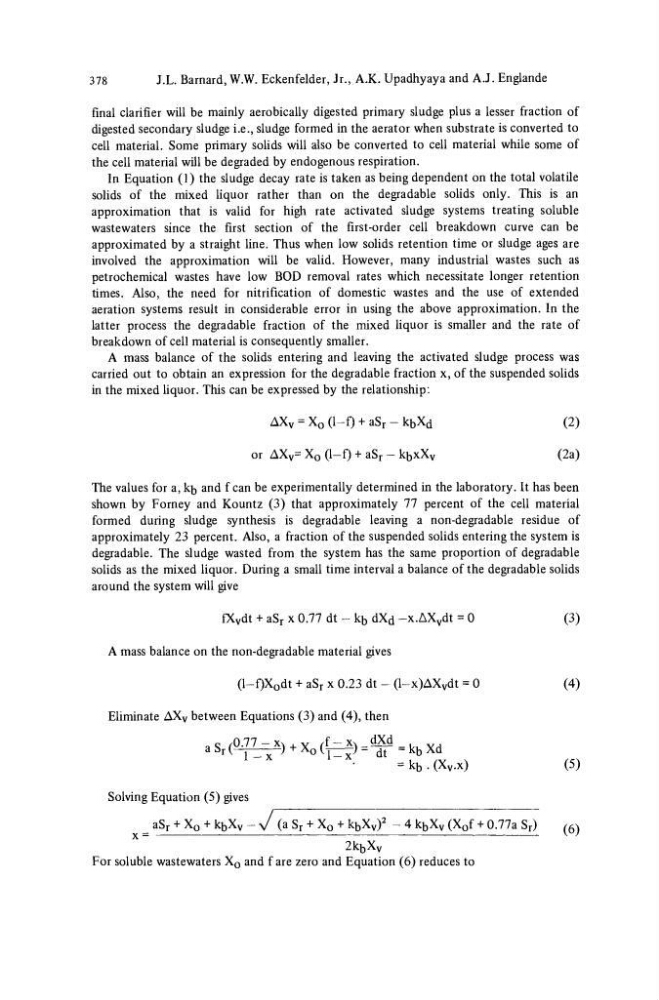
A mass balance of the solids entering and leaving the activated sludge process was
carried out to obtain an expression for the degradable fraction x, of the suspended solids
in the mixed liquor. This can be expressed by the relationship:
AX v = X o ( l - 0
+ a S r - k b X d
(2)
or ΔΧ ν = X 0 (1-0 + aS r - kbxX v
(2a)
The values for a, kb and f can be experimentally determined in the laboratory. It has been
shown by Forney and Kountz (3) that approximately 77 percent of the cell material
formed during sludge synthesis is degradable leaving a non-degradable residue of
approximately 23 percent. Also, a fraction of the suspended solids entering the system is
degradable. The sludge wasted from the system has the same proportion of degradable
solids as the mixed liquor. During a small time interval a balance of the degradable solids
around the system will give
fX v dt + aS r x 0.77 dt - kb dXd -x.AX v dt = 0
(3)
A mass balance on the non-degradable material gives
(l-f)X 0 dt + aS r x 0.23 dt - (l-x)AX v dt = 0
(4)
Eliminate ΔΧ ν between Equations (3) and (4), then
ί,ς /Q-77 - x u v r f-x>>_dXd
= k b .(X v .x)
(5)
Solving Equation (5) gives
- 7
_ aS r + X 0 + kbX v - V (a S r + X 0 + kbX v )
2 - 4 kbX v (X 0 f + 0.77a S r )
2kbX v
For soluble wastewaters X 0 and f are zero and Equation (6) reduces to
(6)
J.L. Barnard, W.W. Eckenfelder, Jr., A.K. Upadhyaya and A.J. Englande
final clarifier will be mainly aerobically digested primary sludge plus a lesser fraction of
digested secondary sludge i.e., sludge formed in the aerator when substrate is converted to
cell material. Some primary solids will also be converted to cell material while some of
the cell material will be degraded by endogenous respiration.
In Equation (1) the sludge decay rate is taken as being dependent on the total volatile
solids of the mixed liquor rather than on the degradable solids only. This is an
approximation that is valid for high rate activated sludge systems treating soluble
wastewaters since the first section of the first-order cell breakdown curve can be
approximated by a straight line. Thus when low solids retention time or sludge ages are
involved the approximation will be valid. However, many industrial wastes such as
petrochemical wastes have low BOD removal rates which necessitate longer retention
times. Also, the need for nitrification of domestic wastes and the use of extended
aeration systems result in considerable error in using the above approximation. In the
latter process the degradable fraction of the mixed liquor is smaller and the rate of
breakdown of cell material is consequently smaller.
A mass balance of the solids entering and leaving the activated sludge process was
carried out to obtain an expression for the degradable fraction x, of the suspended solids
in the mixed liquor. This can be expressed by the relationship:
AX v = X o ( l - 0
+ a S r - k b X d
(2)
or ΔΧ ν = X 0 (1-0 + aS r - kbxX v
(2a)
The values for a, kb and f can be experimentally determined in the laboratory. It has been
shown by Forney and Kountz (3) that approximately 77 percent of the cell material
formed during sludge synthesis is degradable leaving a non-degradable residue of
approximately 23 percent. Also, a fraction of the suspended solids entering the system is
degradable. The sludge wasted from the system has the same proportion of degradable
solids as the mixed liquor. During a small time interval a balance of the degradable solids
around the system will give
fX v dt + aS r x 0.77 dt - kb dXd -x.AX v dt = 0
(3)
A mass balance on the non-degradable material gives
(l-f)X 0 dt + aS r x 0.23 dt - (l-x)AX v dt = 0
(4)
Eliminate ΔΧ ν between Equations (3) and (4), then
ί,ς /Q-77 - x u v r f-x>>_dXd
= k b .(X v .x)
(5)
Solving Equation (5) gives
- 7
_ aS r + X 0 + kbX v - V (a S r + X 0 + kbX v )
2 - 4 kbX v (X 0 f + 0.77a S r )
2kbX v
For soluble wastewaters X 0 and f are zero and Equation (6) reduces to
(6)