

Contact Stabilization Activated Sludge Process
357
20
5 ιβ
X ί
8 * 12
Is
1 ε β
ϋ £
o Lab units
- · Pilot plant
_
ß^o
' • |
1
1
>/o
°S\
^ i Y - 0 . 7 4
1
1
0
4
8
12
16
20
24
Contact removal rate, qCf day"
1
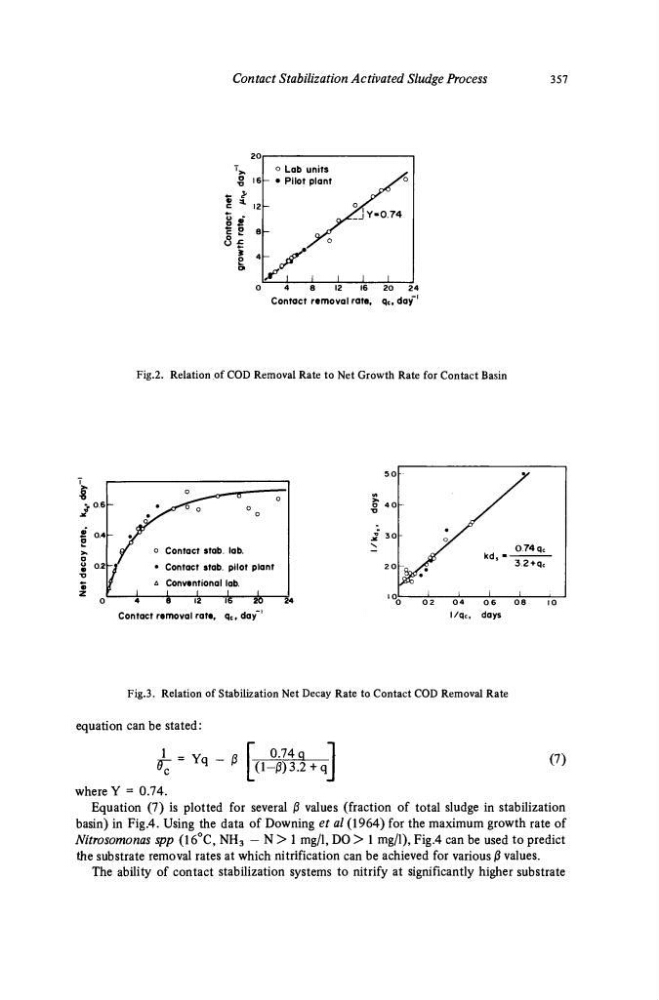
Fig.2. Relation of COD Removal Rate to Net Growth Rate for Contact Basin
2 0 2 h
o Contact stab. lab.
• Contact stab, pilot plant
Δ Conventional lab.
J
I
L
0
4 Θ
\2
16
20
Contact removal rate, qc, day"
1
24
"
""
-„
L
• y
of
t
3 2 + q c
i
i
i
0
0 2
0 4
0 6
0 8
10
l/qc, days
Fig.3. Relation of Stabilization Net Decay Rate to Contact COD Removal Rate
equation can be stated:
_ β Γ 0.74 q
1
P
[(1-03.2+ qj
(7)
where Y = 0.74.
Equation (7) is plotted for several ß values (fraction of total sludge in stabilization
basin) in Fig.4. Using the data of Downing et al (1964) for the maximum growth rate of
Nitrosomonas spp (16°C, NH 3 — N > 1 mg/1, DO > 1 mg/1), Fig.4 can be used to predict
the substrate removal rates at which nitrification can be achieved for various ß values.
The ability of contact stabilization systems to nitrify at significantly higher substrate
357
20
5 ιβ
X ί
8 * 12
Is
1 ε β
ϋ £
o Lab units
- · Pilot plant
_
ß^o
' • |
1
1
>/o
°S\
^ i Y - 0 . 7 4
1
1
0
4
8
12
16
20
24
Contact removal rate, qCf day"
1
Fig.2. Relation of COD Removal Rate to Net Growth Rate for Contact Basin
2 0 2 h
o Contact stab. lab.
• Contact stab, pilot plant
Δ Conventional lab.
J
I
L
0
4 Θ
\2
16
20
Contact removal rate, qc, day"
1
24
"
""
-„
L
• y
of
t
3 2 + q c
i
i
i
0
0 2
0 4
0 6
0 8
10
l/qc, days
Fig.3. Relation of Stabilization Net Decay Rate to Contact COD Removal Rate
equation can be stated:
_ β Γ 0.74 q
1
P
[(1-03.2+ qj
(7)
where Y = 0.74.
Equation (7) is plotted for several ß values (fraction of total sludge in stabilization
basin) in Fig.4. Using the data of Downing et al (1964) for the maximum growth rate of
Nitrosomonas spp (16°C, NH 3 — N > 1 mg/1, DO > 1 mg/1), Fig.4 can be used to predict
the substrate removal rates at which nitrification can be achieved for various ß values.
The ability of contact stabilization systems to nitrify at significantly higher substrate