

Uncertainty in Interpreting Biological Growth Rates
347
0·35ι
'» 0 30h
,0-25
0 20
5 0
1°
or
o
ΪΓ 0
o
15
10
05
CURVE
0
•
Δ
O
DOMAIN OF RAW DATA
MODELS (t) hrs
0 to 1.0
0 to 1.25
0 to 1. 5
0 to 1.75
4 0
80
120
SOLUBLE ORGANIC CARBON
160
(Cc>
200
mg./l.
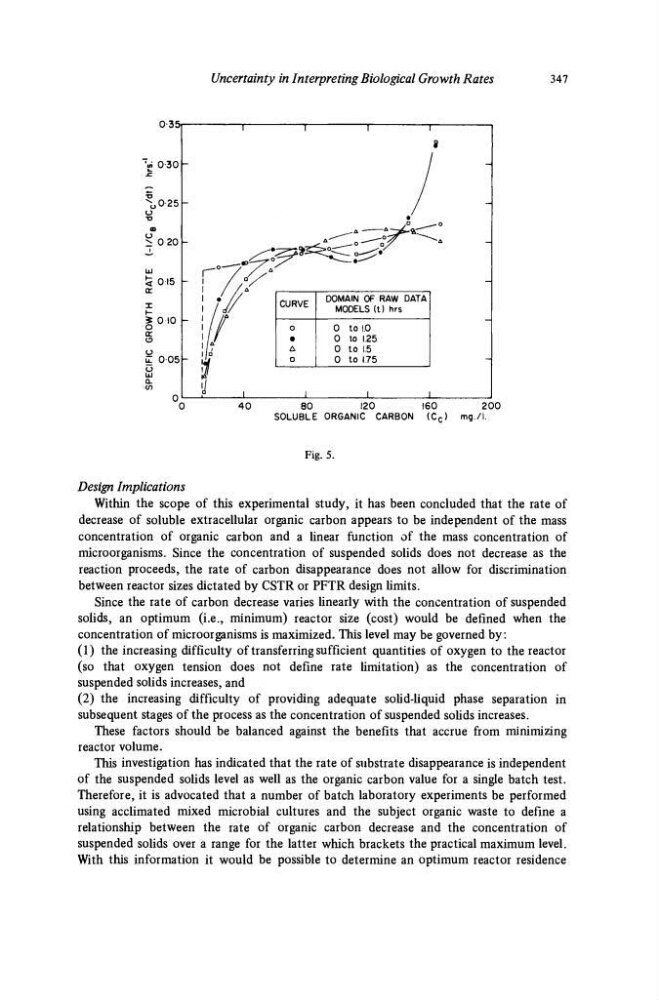
Fig. 5.
Design Implications
Within the scope of this experimental study, it has been concluded that the rate of
decrease of soluble extracellular organic carbon appears to be independent of the mass
concentration of organic carbon and a linear function of the mass concentration of
microorganisms. Since the concentration of suspended solids does not decrease as the
reaction proceeds, the rate of carbon disappearance does not allow for discrimination
between reactor sizes dictated by CSTR or PFTR design limits.
Since the rate of carbon decrease varies linearly with the concentration of suspended
solids, an optimum (i.e., minimum) reactor size (cost) would be defined when the
concentration of microorganisms is maximized. This level may be governed by:
(1) the increasing difficulty of transferring sufficient quantities of oxygen to the reactor
(so that oxygen tension does not define rate limitation) as the concentration of
suspended solids increases, and
(2) the increasing difficulty of providing adequate solid-liquid phase separation in
subsequent stages of the process as the concentration of suspended solids increases.
These factors should be balanced against the benefits that accrue from minimizing
reactor volume.
This investigation has indicated that the rate of substrate disappearance is independent
of the suspended solids level as well as the organic carbon value for a single batch test.
Therefore, it is advocated that a number of batch laboratory experiments be performed
using acclimated mixed microbial cultures and the subject organic waste to define a
relationship between the rate of organic carbon decrease and the concentration of
suspended solids over a range for the latter which brackets the practical maximum level.
With this information it would be possible to determine an optimum reactor residence
347
0·35ι
'» 0 30h
,0-25
0 20
5 0
1°
or
o
ΪΓ 0
o
15
10
05
CURVE
0
•
Δ
O
DOMAIN OF RAW DATA
MODELS (t) hrs
0 to 1.0
0 to 1.25
0 to 1. 5
0 to 1.75
4 0
80
120
SOLUBLE ORGANIC CARBON
160
(Cc>
200
mg./l.
Fig. 5.
Design Implications
Within the scope of this experimental study, it has been concluded that the rate of
decrease of soluble extracellular organic carbon appears to be independent of the mass
concentration of organic carbon and a linear function of the mass concentration of
microorganisms. Since the concentration of suspended solids does not decrease as the
reaction proceeds, the rate of carbon disappearance does not allow for discrimination
between reactor sizes dictated by CSTR or PFTR design limits.
Since the rate of carbon decrease varies linearly with the concentration of suspended
solids, an optimum (i.e., minimum) reactor size (cost) would be defined when the
concentration of microorganisms is maximized. This level may be governed by:
(1) the increasing difficulty of transferring sufficient quantities of oxygen to the reactor
(so that oxygen tension does not define rate limitation) as the concentration of
suspended solids increases, and
(2) the increasing difficulty of providing adequate solid-liquid phase separation in
subsequent stages of the process as the concentration of suspended solids increases.
These factors should be balanced against the benefits that accrue from minimizing
reactor volume.
This investigation has indicated that the rate of substrate disappearance is independent
of the suspended solids level as well as the organic carbon value for a single batch test.
Therefore, it is advocated that a number of batch laboratory experiments be performed
using acclimated mixed microbial cultures and the subject organic waste to define a
relationship between the rate of organic carbon decrease and the concentration of
suspended solids over a range for the latter which brackets the practical maximum level.
With this information it would be possible to determine an optimum reactor residence