

342
T.E. Pollock and J.D. Norman
reaction sense or a biological sense. The "biochemical kinetic" models, describing mixed
cultures, represent curve fitting techniques from which information about the
mechanisms of substrate utilization cannot generally be inferred. For process design and
operation, one is not interested in the mechanisms of removal per se but in defining the
degree of belief warranted by a mathematical description of the reactor dynamics. To this
end a series of experiments was performed and statistical models were built to describe
the raw data for each run.
EXPERIMENTAL
The reactor used in this investigation was a 3.5 litre completely mixed vessel equipped
with a fine bubble diffuser. Sufficient filtered air was supplied to maintain a minimum
dissolved oxygen concentration of 5 mg/1. Acclimated mixed cultures of microorganisms
were contacted with the nutrient solution (defined in Appendix I) for which dextrose was
the growth limiting constituent. During the course of an experimental run, the mass
concentrations of soluble organic carbon and microorganisms were monitored as a
function of time.
The carbon concentration was determined from five replicate measurements using a
Beckman Model IR 315 infrared carbonaceous analyzer. The suspended solids
concentration was determined from three replicate measurements using the membrane
filter gravimetric technique.
Samples were collected every 0.25 hours until the organic carbon concentration
reached steady-state.
RESULTS AND INTERPRETATION
Data Treatment
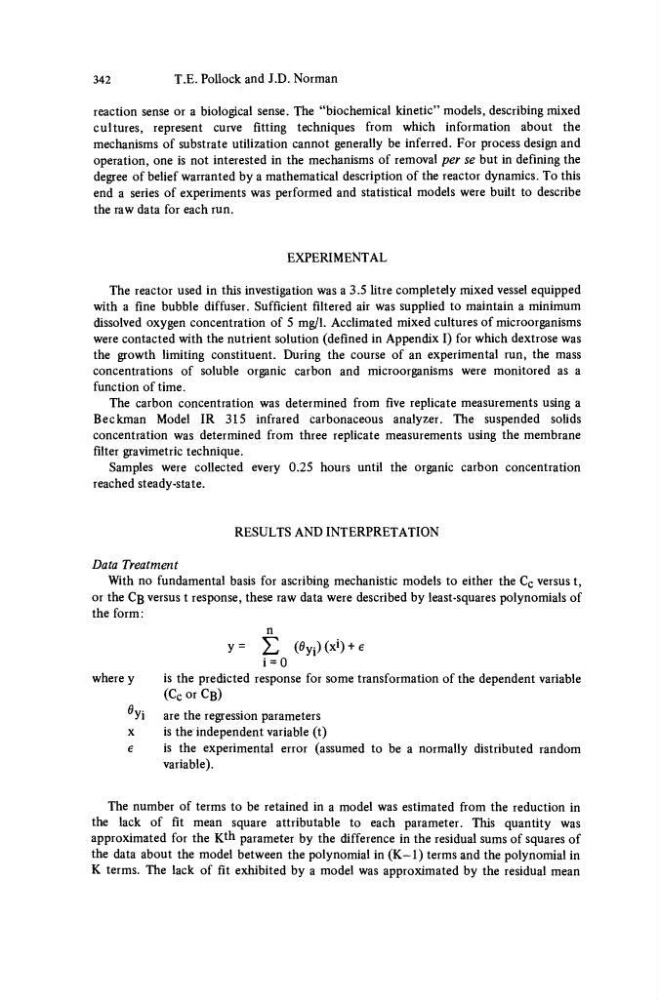
With no fundamental basis for ascribing mechanistic models to either the C c versus t,
or the Cß versus t response, these raw data were described by least-squares polynomials of
the form:
n
Υ= Σ
(ÖyiMxO + e
i = 0
where y
is the predicted response for some transformation of the dependent variable
(C c or C B )
Yi are the regression parameters
x
is the independent variable (t)
e
is the experimental error (assumed to be a normally distributed random
variable).
The number of terms to be retained in a model was estimated from the reduction in
the lack of fit mean square attributable to each parameter. This quantity was
approximated for the K
tn parameter by the difference in the residual sums of squares of
the data about the model between the polynomial in (K-1) terms and the polynomial in
K terms. The lack of fit exhibited by a model was approximated by the residual mean
T.E. Pollock and J.D. Norman
reaction sense or a biological sense. The "biochemical kinetic" models, describing mixed
cultures, represent curve fitting techniques from which information about the
mechanisms of substrate utilization cannot generally be inferred. For process design and
operation, one is not interested in the mechanisms of removal per se but in defining the
degree of belief warranted by a mathematical description of the reactor dynamics. To this
end a series of experiments was performed and statistical models were built to describe
the raw data for each run.
EXPERIMENTAL
The reactor used in this investigation was a 3.5 litre completely mixed vessel equipped
with a fine bubble diffuser. Sufficient filtered air was supplied to maintain a minimum
dissolved oxygen concentration of 5 mg/1. Acclimated mixed cultures of microorganisms
were contacted with the nutrient solution (defined in Appendix I) for which dextrose was
the growth limiting constituent. During the course of an experimental run, the mass
concentrations of soluble organic carbon and microorganisms were monitored as a
function of time.
The carbon concentration was determined from five replicate measurements using a
Beckman Model IR 315 infrared carbonaceous analyzer. The suspended solids
concentration was determined from three replicate measurements using the membrane
filter gravimetric technique.
Samples were collected every 0.25 hours until the organic carbon concentration
reached steady-state.
RESULTS AND INTERPRETATION
Data Treatment
With no fundamental basis for ascribing mechanistic models to either the C c versus t,
or the Cß versus t response, these raw data were described by least-squares polynomials of
the form:
n
Υ= Σ
(ÖyiMxO + e
i = 0
where y
is the predicted response for some transformation of the dependent variable
(C c or C B )
Yi are the regression parameters
x
is the independent variable (t)
e
is the experimental error (assumed to be a normally distributed random
variable).
The number of terms to be retained in a model was estimated from the reduction in
the lack of fit mean square attributable to each parameter. This quantity was
approximated for the K
tn parameter by the difference in the residual sums of squares of
the data about the model between the polynomial in (K-1) terms and the polynomial in
K terms. The lack of fit exhibited by a model was approximated by the residual mean