

18
F. Berger and W. Schmitz
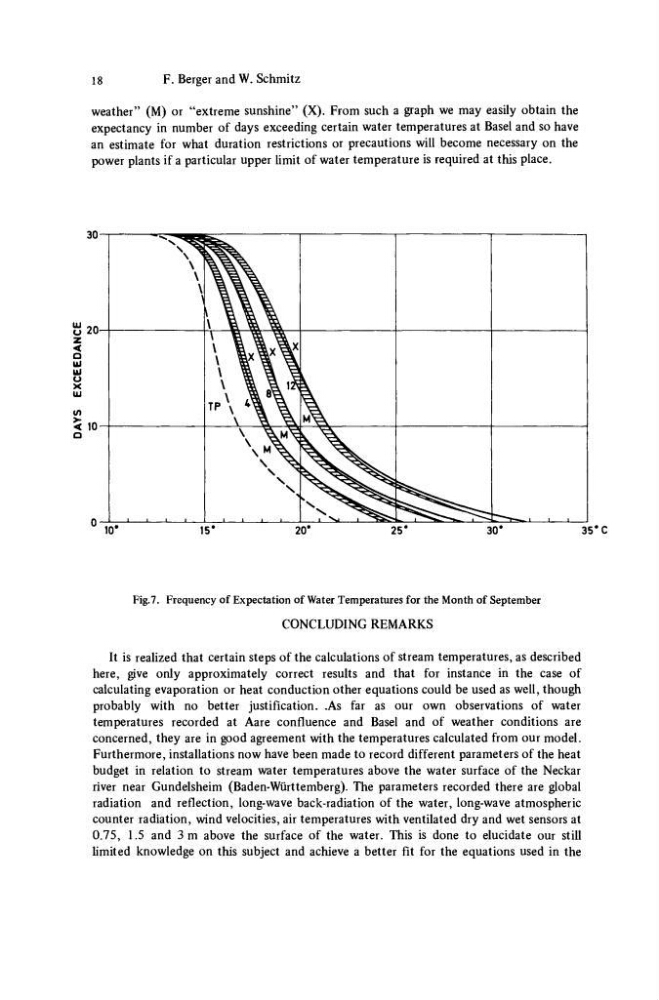
weather" (M) or "extreme sunshine" (X). From such a graph we may easily obtain the
expectancy in number of days exceeding certain water temperatures at Basel and so have
an estimate for what duration restrictions or precautions will become necessary on the
power plants if a particular upper limit of water temperature is required at this place.
30
20
<
Q
UJ
UJ
O
X
O
\ \ \
\
■
I
I
I
β V^ V l
I B m m
\ ^ m m
\
1 . 1
i
1™. .
^ V ^ L
w r^ShteT*>fc. i
Γ*"Τ-··^ι
i_
i
10*
15·
20*
25
#
30*
35* C
Fig.7. Frequency of Expectation of Water Temperatures for the Month of September
CONCLUDING REMARKS
It is realized that certain steps of the calculations of stream temperatures, as described
here, give only approximately correct results and that for instance in the case of
calculating evaporation or heat conduction other equations could be used as well, though
probably with no better justification. .As far as our own observations of water
temperatures recorded at Aare confluence and Basel and of weather conditions are
concerned, they are in good agreement with the temperatures calculated from our model.
Furthermore, installations now have been made to record different parameters of the heat
budget in relation to stream water temperatures above the water surface of the Neckar
river near Gundelsheim (Baden-Württemberg). The parameters recorded there are global
radiation and reflection, long-wave back-radiation of the water, long-wave atmospheric
counter radiation, wind velocities, air temperatures with ventilated dry and wet sensors at
0.75, 1.5 and 3 m above the surface of the water. This is done to elucidate our still
limited knowledge on this subject and achieve a better fit for the equations used in the
F. Berger and W. Schmitz
weather" (M) or "extreme sunshine" (X). From such a graph we may easily obtain the
expectancy in number of days exceeding certain water temperatures at Basel and so have
an estimate for what duration restrictions or precautions will become necessary on the
power plants if a particular upper limit of water temperature is required at this place.
30
20
<
Q
UJ
UJ
O
X
O
\ \ \
\
■
I
I
I
β V^ V l
I B m m
\ ^ m m
\
1 . 1
i
1™. .
^ V ^ L
w r^ShteT*>fc. i
Γ*"Τ-··^ι
i_
i
10*
15·
20*
25
#
30*
35* C
Fig.7. Frequency of Expectation of Water Temperatures for the Month of September
CONCLUDING REMARKS
It is realized that certain steps of the calculations of stream temperatures, as described
here, give only approximately correct results and that for instance in the case of
calculating evaporation or heat conduction other equations could be used as well, though
probably with no better justification. .As far as our own observations of water
temperatures recorded at Aare confluence and Basel and of weather conditions are
concerned, they are in good agreement with the temperatures calculated from our model.
Furthermore, installations now have been made to record different parameters of the heat
budget in relation to stream water temperatures above the water surface of the Neckar
river near Gundelsheim (Baden-Württemberg). The parameters recorded there are global
radiation and reflection, long-wave back-radiation of the water, long-wave atmospheric
counter radiation, wind velocities, air temperatures with ventilated dry and wet sensors at
0.75, 1.5 and 3 m above the surface of the water. This is done to elucidate our still
limited knowledge on this subject and achieve a better fit for the equations used in the