

286
D.K.B. Thistlethwayte and E.E. Goleb
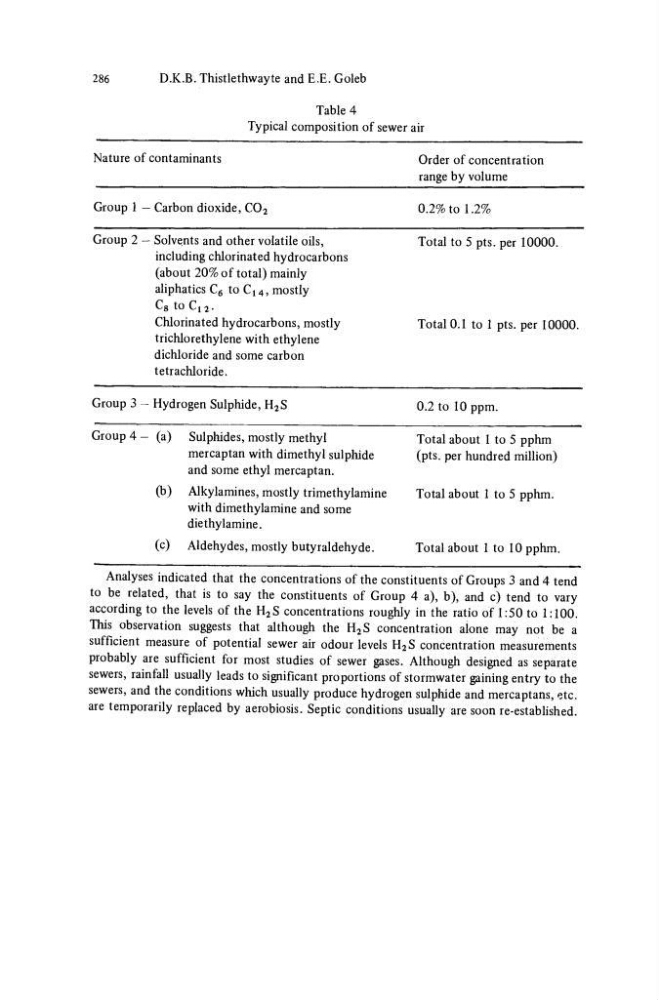
Table 4
Typical composition of sewer air
Nature of contaminants
Order of concentration
range by volume
Group 1 - Carbon dioxide, C0 2
0.2% to 1.2%
Group 2 - Solvents and other volatile oils,
including chlorinated hydrocarbons
(about 20% of total) mainly
aliphatics C 6 to C x 4 , mostly
C 8 to C 1 2 .
Chlorinated hydrocarbons, mostly
trichlorethylene with ethylene
dichloride and some carbon
tetrachloride.
Group 3 - Hydrogen Sulphide, H 2 S
Total to 5 pts. per 10000.
Total 0.1 to 1 pts. per 10000.
0.2 to 10 ppm.
Group 4 - (a) Sulphides, mostly methyl
mercaptan with dimethyl sulphide
and some ethyl mercaptan.
(b) Alkylamines, mostly trimethylamine
with dimethylamine and some
diethylamine.
(c) Aldehydes, mostly butyraldehyde.
Total about 1 to 5 pphm
(pts. per hundred million)
Total about 1 to 5 pphm.
Total about 1 to 10 pphm.
Analyses indicated that the concentrations of the constituents of Groups 3 and 4 tend
to be related, that is to say the constituents of Group 4 a), b), and c) tend to vary
according to the levels of the H 2 S concentrations roughly in the ratio of 1:50 to 1:100.
This observation suggests that although the H 2 S concentration alone may not be a
sufficient measure of potential sewer air odour levels H 2 S concentration measurements
probably are sufficient for most studies of sewer gases. Although designed as separate
sewers, rainfall usually leads to significant proportions of stormwater gaining entry to the
sewers, and the conditions which usually produce hydrogen sulphide and mercaptans, etc.
are temporarily replaced by aerobiosis. Septic conditions usually are soon re-established.
D.K.B. Thistlethwayte and E.E. Goleb
Table 4
Typical composition of sewer air
Nature of contaminants
Order of concentration
range by volume
Group 1 - Carbon dioxide, C0 2
0.2% to 1.2%
Group 2 - Solvents and other volatile oils,
including chlorinated hydrocarbons
(about 20% of total) mainly
aliphatics C 6 to C x 4 , mostly
C 8 to C 1 2 .
Chlorinated hydrocarbons, mostly
trichlorethylene with ethylene
dichloride and some carbon
tetrachloride.
Group 3 - Hydrogen Sulphide, H 2 S
Total to 5 pts. per 10000.
Total 0.1 to 1 pts. per 10000.
0.2 to 10 ppm.
Group 4 - (a) Sulphides, mostly methyl
mercaptan with dimethyl sulphide
and some ethyl mercaptan.
(b) Alkylamines, mostly trimethylamine
with dimethylamine and some
diethylamine.
(c) Aldehydes, mostly butyraldehyde.
Total about 1 to 5 pphm
(pts. per hundred million)
Total about 1 to 5 pphm.
Total about 1 to 10 pphm.
Analyses indicated that the concentrations of the constituents of Groups 3 and 4 tend
to be related, that is to say the constituents of Group 4 a), b), and c) tend to vary
according to the levels of the H 2 S concentrations roughly in the ratio of 1:50 to 1:100.
This observation suggests that although the H 2 S concentration alone may not be a
sufficient measure of potential sewer air odour levels H 2 S concentration measurements
probably are sufficient for most studies of sewer gases. Although designed as separate
sewers, rainfall usually leads to significant proportions of stormwater gaining entry to the
sewers, and the conditions which usually produce hydrogen sulphide and mercaptans, etc.
are temporarily replaced by aerobiosis. Septic conditions usually are soon re-established.